
Visual summary
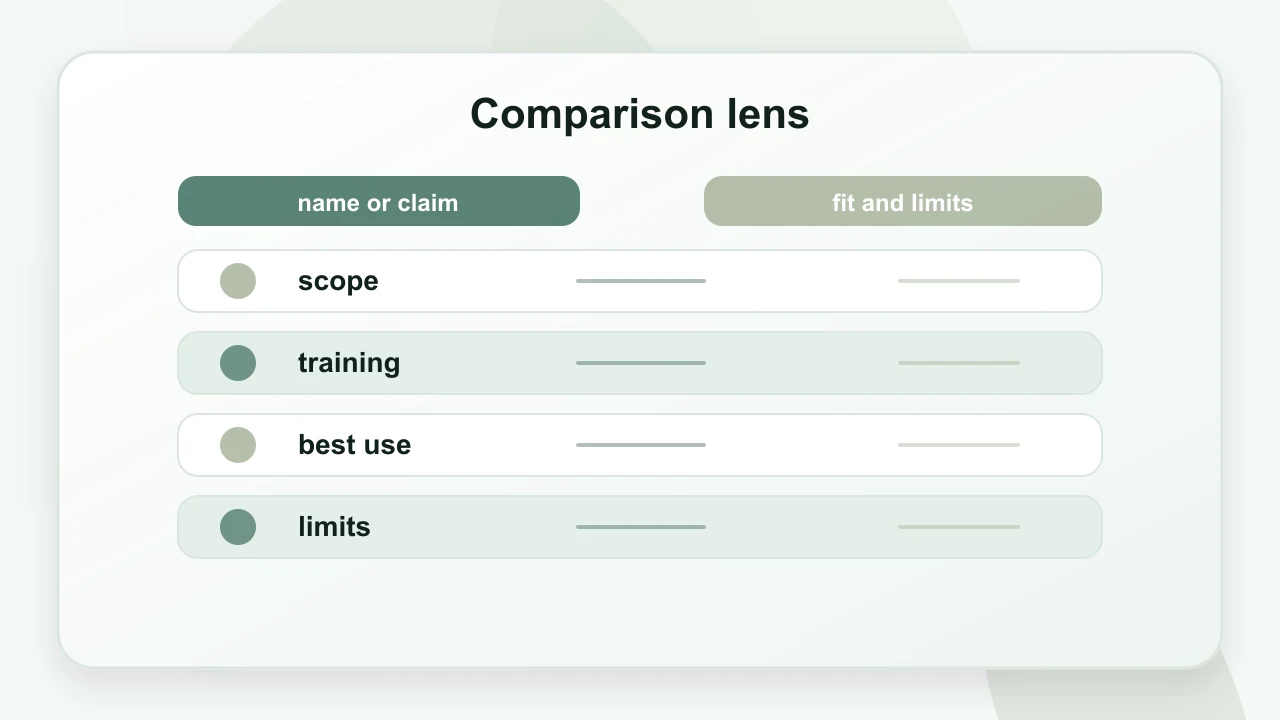
The infographic summarizes the article as scope, training, best use, limits. It is a reading aid only and does not add new claims beyond the article.
Misinformation about mental health includes claims that are false, misleading, oversimplified, unsupported, or presented without essential context. It may concern symptoms, diagnoses, causes, medication, therapy, trauma, neuroscience, supplements, relationships, or self-help.
Misleading information often looks credible. It may use scientific language, professional credentials, personal stories, before-and-after testimonials, or one real study while omitting limitations. The safest response is not to trust or reject a claim based on tone. Define the claim precisely, examine the source, and compare it with independent evidence.
Common forms of mental-health misinformation
Examples include claims that:
- one supplement cures depression;
- every difficult relationship involves narcissism;
- one childhood event explains every adult problem;
- a short quiz can diagnose a disorder;
- psychiatric medication is always harmful;
- medication solves every problem;
- breathing or meditation permanently resets the nervous system;
- trauma is stored in one body part and released by one technique;
- worsening symptoms always prove healing.
Why misinformation spreads
Broad symptom lists feel personal
Vague symptoms such as fatigue, distraction, worry, or procrastination fit many people and many conditions.
Emotional stories are memorable
A real personal experience does not prove that the same treatment works generally.
Algorithms reward certainty
Simple, emotional, identity-based content is easier to share than nuanced evidence.
Scientific language creates authority
Terms such as dopamine, cortisol, attachment, trauma, inflammation, and dysregulation can be used inaccurately.
Commercial incentives matter
A dramatic problem may be followed by a course, supplement, test, retreat, or coaching package.
What responsible mental-health information looks like
Credible information usually:
- names the exact claim;
- distinguishes association from causation;
- explains uncertainty;
- identifies risks and limitations;
- cites relevant evidence;
- avoids diagnosis from limited information;
- distinguishes education from treatment;
- recommends professional care when appropriate;
- discloses financial interests.
A seven-step evidence check
1. Define the claim
“May support relaxation” is different from “treats panic disorder.”
2. Identify the evidence type
Is it a testimonial, theory, animal study, small trial, systematic review, or clinical guideline?
3. Check the source
Prefer transparent government health agencies, professional organizations, peer-reviewed research, and qualified specialists.
4. Look for replication
One study rarely settles a mental-health question.
5. Review limitations
Who was studied? How large was the sample? How long did follow-up last?
6. Check risk information
Credible health information describes adverse effects and who may not benefit.
7. Notice what is being sold
A conflict of interest does not automatically invalidate a claim, but it should be visible.
Social-media red flags
Be cautious with phrases such as:
- “signs you secretly have”;
- “doctors do not want you to know”;
- “works for everyone”;
- “clinically proven” without a source;
- “natural means safe”;
- “detox your trauma”;
- “permanently rewire your brain”;
- “stop your medication”;
- “one hidden cause explains everything.”
Credentials are useful but not sufficient
A licensed clinician may still exaggerate evidence or speak outside their specialty.
Check:
- exact license;
- active status;
- relevant specialty;
- source quality;
- conflicts of interest;
- whether professional consensus is represented accurately.
Misinformation versus disagreement
Not every disagreement is misinformation. Responsible experts may disagree because:
- evidence is incomplete;
- benefits and risks are weighted differently;
- populations differ;
- treatment preferences matter;
- new evidence changes conclusions.
Honest uncertainty is a sign of credibility, not weakness.
How to respond safely
- Do not share a claim before verifying it.
- Ask for the original source.
- Compare several independent authorities.
- Discuss treatment changes with a qualified clinician.
- Report fraudulent or dangerous claims.
- Avoid publicly diagnosing other people.
- Correct calmly and specifically.
When misinformation becomes dangerous
It is especially harmful when it:
- delays emergency care;
- encourages abrupt medication withdrawal;
- discourages treatment for psychosis, mania, severe depression, or addiction;
- promotes unsafe fasting, breathwork, or supplement use;
- tells people to remain in abusive relationships;
- causes medical symptoms to be ignored.
Practical takeaway
Before accepting mental-health information:
- State the claim exactly.
- Identify the evidence.
- Check the source.
- Review limitations and risks.
- compare independent authorities.
- notice financial incentives.
- do not change treatment based on social-media content alone.
See Differences Between Conventional And Alternative Medicine, Difference Between Holistic And Conventional Medicine, and Complementary Therapy vs. Alternative Therapy.
Sources
- National Institutes of Health — health-information and evidence resources
- NCCIH — Know the Science
- Federal Trade Commission — Health Products and Services
- National Institute of Mental Health — Mental Health Information