

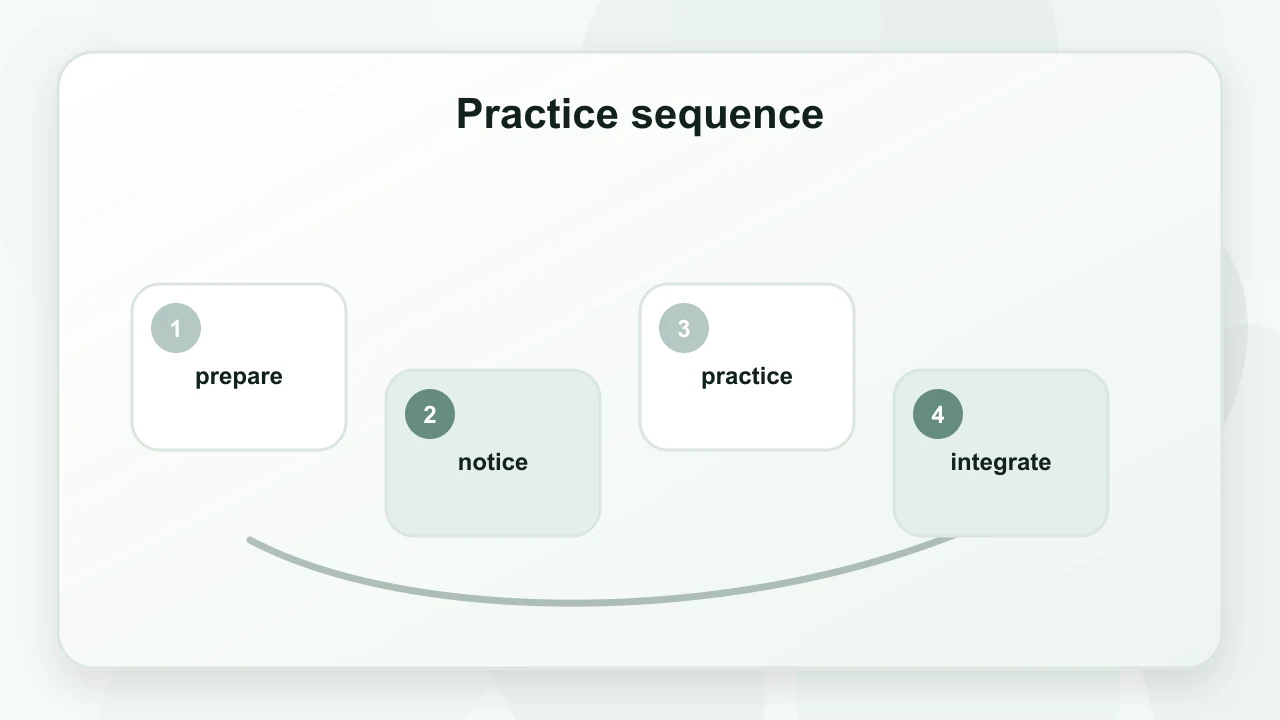
Visual summary
The infographic summarizes the article as prepare, notice, practice, integrate. It is a reading aid only and does not add new claims beyond the article.
Progressive muscle relaxation for sleep is a bedtime technique in which you gently tense and release muscle groups in sequence. The practice may help reduce physical tension and create a predictable transition from daytime activity to rest.
It is not a guaranteed cure for insomnia. Current evidence suggests progressive muscle relaxation may improve sleep quality for some people, but multicomponent cognitive behavioral therapy for insomnia remains the strongest recommended behavioral treatment for chronic insomnia.
How progressive muscle relaxation supports sleep
PMR may help by:
- increasing awareness of tension;
- reducing unnecessary muscular effort;
- shifting attention away from planning or rumination;
- creating a consistent wind-down cue;
- supporting a slower transition into rest.
The goal is not to force sleep. It is to reduce effort and create conditions that may make sleep easier.
A bedtime PMR sequence
Use mild tension for three to five seconds, then release for 10–15 seconds.
1. Hands and forearms
Make a gentle fist. Release completely.
2. Upper arms
Bend the elbows slightly and tense the arms. Release.
3. Face and jaw
Raise the eyebrows or tighten the jaw very gently. Soften the forehead, eyes, tongue, and jaw.
4. Shoulders
Lift the shoulders slightly toward the ears. Let them drop.
5. Abdomen
Tighten the abdominal muscles mildly while breathing normally. Release.
6. Thighs
Press the thighs together gently or tighten them. Release.
7. Lower legs and feet
Point or flex the feet only if comfortable. Release before cramping begins.
8. Whole-body pause
Notice the difference between effort and release. Return to ordinary breathing.
Guided progressive muscle relaxation for sleep
A guided recording can help when remembering the sequence feels effortful. Choose audio that:
- uses gentle rather than forceful instructions;
- allows you to skip muscle groups;
- avoids long breath holds;
- does not promise guaranteed deep sleep;
- ends quietly rather than with abrupt sound;
- comes from a transparent, qualified source.
Set a timer so audio does not continue all night.
Progressive muscle relaxation audio for sleep
Audio quality matters less than pacing and safety. Useful recordings generally include:
- a slow introduction;
- enough time to release each area;
- reminders not to strain;
- quiet background sound or no music;
- an option to remain awake;
- no pressure to “surrender” or achieve a special state.
Avoid recordings that include unsupported trauma-release or nervous-system-reset claims.
Muscle relaxation for sleep without tensing
Some people should not contract muscles because of pain, injury, surgery, cramping, or medical conditions. A release-only version may involve:
- notice the muscle group;
- imagine it becoming heavier or softer;
- adjust posture;
- move to the next area.
This may be less intense and still useful as a bedtime ritual.
When PMR can backfire
Progressive muscle relaxation may increase discomfort when:
- the person tenses too hard;
- body focus increases panic;
- trauma symptoms are activated;
- pain is present;
- the practice becomes a performance test;
- the person repeats it compulsively to force sleep.
Stop, open the eyes, orient to the room, or use external grounding instead.
PMR versus CBT-I
PMR is one relaxation technique. CBT-I is a structured treatment for chronic insomnia that may include:
- sleep scheduling;
- stimulus control;
- cognitive work;
- behavioral changes;
- relaxation methods;
- relapse planning.
PMR may support sleep, but it should not be presented as equivalent to a full CBT-I program.
Healthy sleep context
PMR works best as one part of a broader routine:
- keep a consistent wake time;
- reduce bright light late at night;
- move caffeine earlier;
- avoid using alcohol as a sleep aid;
- keep the room quiet, dark, and comfortable;
- seek assessment for snoring, gasping, restless legs, or severe daytime sleepiness.
Who should modify the practice?
Ask a clinician before using muscle-tensing exercises when you have:
- recent surgery;
- significant injury;
- severe pain;
- neurological or muscular conditions;
- cardiovascular concerns related to straining;
- pregnancy-related restrictions.
When professional help is needed
Seek evaluation when sleep problems persist, significantly impair daytime functioning, or occur with possible sleep apnea, severe depression, trauma symptoms, mania, psychosis, or suicidal thoughts.
In the United States, call or text 988 for crisis support.
Practical takeaway
Use progressive muscle relaxation for sleep gently:
- Create a quiet bedtime setting.
- Use mild tension.
- Release for longer than you tense.
- Breathe normally.
- Skip painful areas.
- Stop if anxiety increases.
- Seek CBT-I or medical assessment for persistent insomnia.
See Progressive Relaxation for Sleep, Grounded Exercise, and Lifestyle Changes for Anxiety.
Sources
- NCCIH — Relaxation Techniques: What You Need to Know
- NCCIH — Sleep Disorders and Complementary Health Approaches
- PubMed — 2026 systematic review and meta-analysis of progressive muscle relaxation and sleep quality