

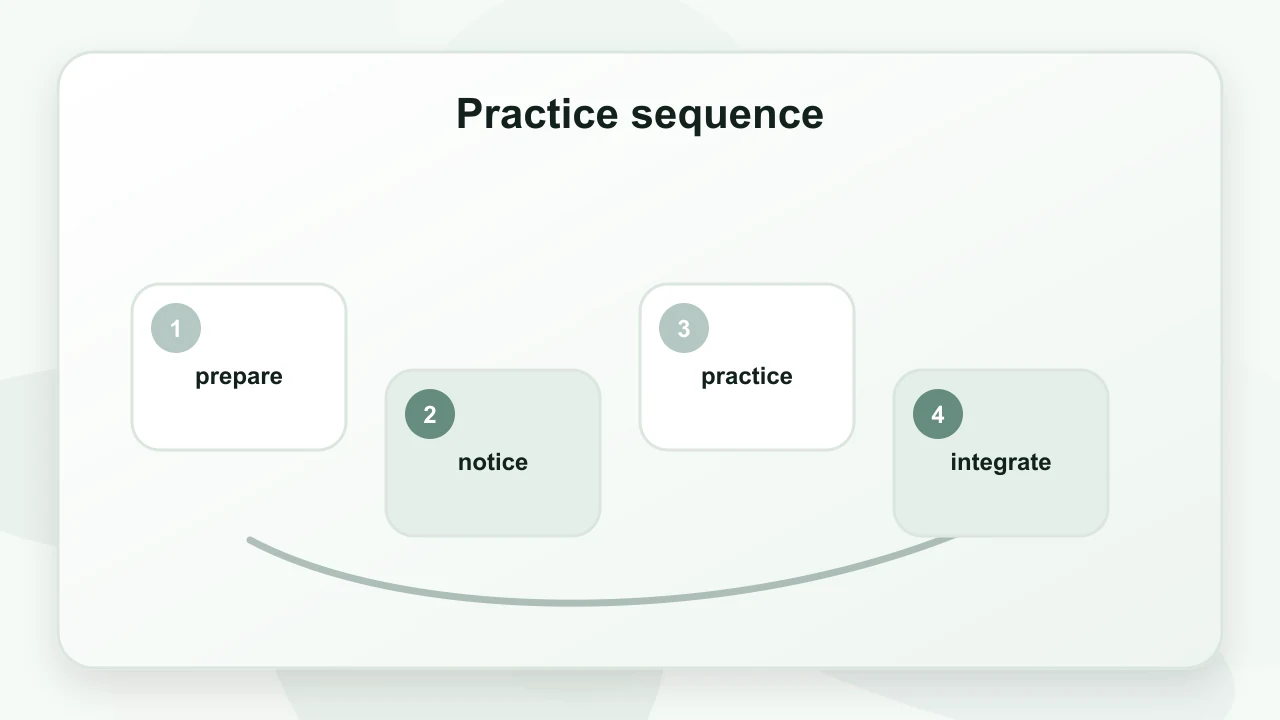
Visual summary
The infographic summarizes the article as prepare, notice, practice, integrate. It is a reading aid only and does not add new claims beyond the article.
Progressive relaxation for sleep is a structured wind-down practice that moves gradually through the body or through several relaxation steps. It may include muscle tension and release, comfortable breathing, guided imagery, body awareness, or a recorded sleep meditation.
The term is broader than progressive muscle relaxation. Some routines use active muscle contractions; others simply notice and soften tension. The goal is to reduce physical and mental effort before bed—not to force sleep.
What progressive relaxation includes
A progressive relaxation routine may move through:
- orientation to the room;
- posture and physical support;
- breathing;
- muscle groups;
- imagery or attention;
- reorientation or transition into sleep.
The sequence is predictable and can be shortened.
Progressive relaxation versus progressive muscle relaxation
Progressive muscle relaxation specifically involves tensing and releasing muscle groups.
Progressive relaxation may include PMR but can also use:
- release-only muscle awareness;
- breathing;
- guided imagery;
- meditation;
- self-hypnosis;
- grounding;
- a body scan.
This broader intent distinguishes this page from the dedicated Progressive Muscle Relaxation for Sleep guide.
A simple progressive relaxation sequence for sleep
Step 1: Orient
Notice that you are in bed or another safe resting place. Identify one sound and one point of physical support.
Step 2: Reduce unnecessary effort
Let the jaw soften. Lower the shoulders. Unclench the hands.
Step 3: Use comfortable breathing
Breathe naturally. Allow the exhale to become slightly slower only if comfortable.
Step 4: Move through the body
Notice:
- face;
- shoulders;
- arms;
- chest and abdomen;
- hips;
- legs;
- feet.
At each area, gently release tension. Tensing is optional.
Step 5: Choose one neutral focus
Use a quiet sound, a simple image, or the feeling of support beneath the body.
Step 6: Stop trying
End the exercise. Do not keep checking whether it “worked.”
Progressive relaxation for better sleep
The technique may support better sleep by creating consistency and reducing arousal. It is most useful when paired with healthy sleep conditions:
- a stable wake time;
- morning daylight;
- reduced caffeine late in the day;
- less bright light before bed;
- a cool, quiet, dark room;
- assessment of snoring, breathing pauses, pain, or restless legs.
Relaxation cannot correct every cause of poor sleep.
Muscle relaxation sleep meditation
A muscle relaxation sleep meditation combines body awareness with guided attention. It may use phrases such as:
“Notice the shoulders. Allow them to soften.”
This differs from active PMR because the person may not tense first.
A meditation should not demand complete relaxation or promise unconsciousness.
Deep sleep muscle relaxation
The phrase “deep sleep muscle relaxation” is often used in audio titles, but a recording cannot guarantee deep sleep or control sleep stages.
A more accurate promise is that the practice may help reduce tension and support a bedtime routine.
Sleep hypnosis muscle relaxation
Sleep-hypnosis recordings may combine suggestion, imagery, and relaxation. Evidence for hypnosis varies by condition, and recordings differ widely in quality.
Avoid material that:
- guarantees treatment;
- encourages unsafe memory work;
- uses manipulative language;
- discourages medical care;
- claims permanent subconscious reprogramming.
Guided sleep meditation muscle relaxation
A guided practice may be useful when the voice is calm, the instructions are optional, and the session allows modifications.
Choose recordings with:
- a clear length;
- no sudden volume changes;
- noncoercive language;
- safe physical instructions;
- no forced breath-holding;
- no cure claims.
When progressive relaxation may not help
It may be a poor fit when:
- body attention triggers panic or dissociation;
- the person has significant pain;
- the routine becomes compulsive;
- frustration about not sleeping increases;
- an untreated sleep disorder is present;
- the recording creates dependency or pressure.
Use external grounding, a quiet activity outside bed, or professional guidance when needed.
Progressive relaxation and chronic insomnia
For chronic insomnia, relaxation alone is usually not the strongest intervention. Multicomponent cognitive behavioral therapy for insomnia has stronger guideline support and addresses behaviors and beliefs that maintain insomnia.
Relaxation can be one component of that broader treatment.
When to seek medical or clinical help
Seek assessment when sleep difficulty:
- lasts for weeks;
- causes major daytime impairment;
- includes snoring, gasping, or breathing pauses;
- occurs with severe depression;
- occurs with very little need for sleep and unusual energy;
- involves trauma-related nightmares;
- leads to unsafe driving or work performance.
Seek urgent help for suicidal intent, psychosis, mania, or immediate danger.
Practical takeaway
Use progressive relaxation for sleep as a flexible sequence:
- Orient.
- Soften posture.
- Breathe comfortably.
- Release muscles gradually.
- Use one neutral focus.
- Stop trying to force sleep.
- Seek structured treatment when insomnia persists.
See Progressive Muscle Relaxation for Sleep, Grounded Exercise, and Lifestyle Changes for Anxiety.
Sources
- NCCIH — Sleep Disorders and Complementary Health Approaches
- NCCIH — Relaxation Techniques: What You Need to Know
- NCCIH — Mind and Body Practices for Sleep Disorders
- PubMed — 2026 PMR sleep-quality systematic review