

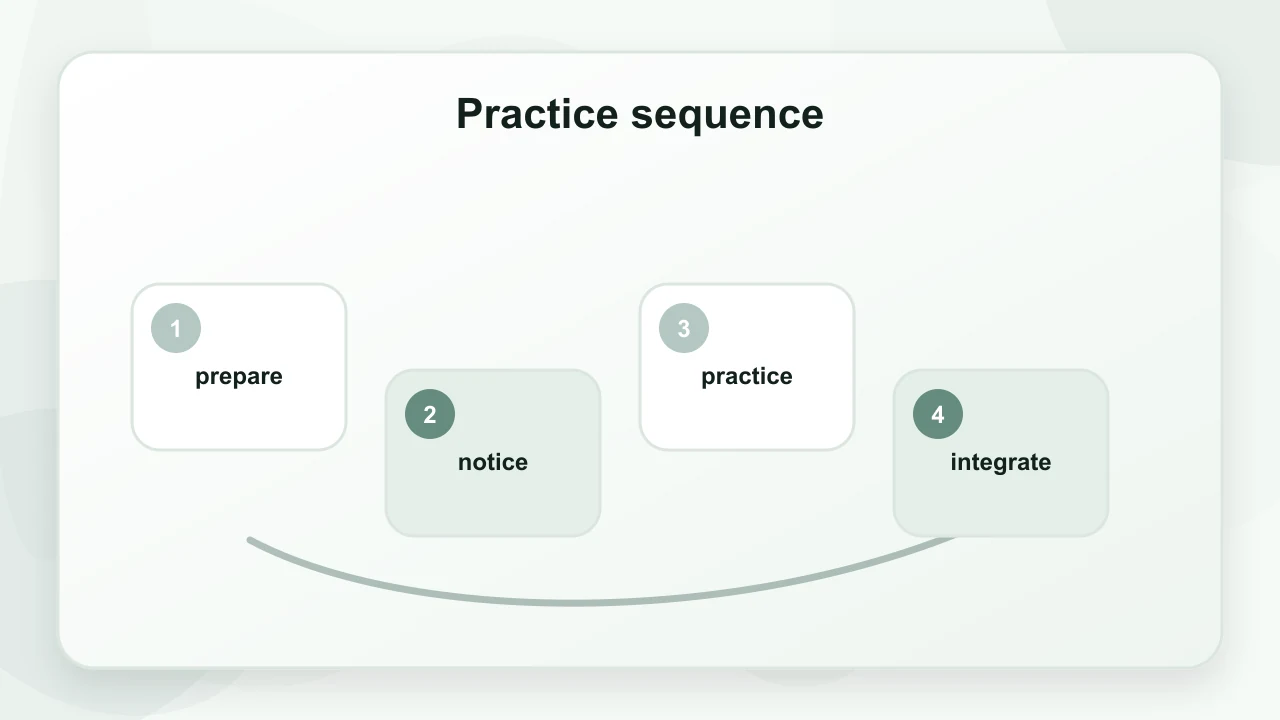
Visual summary
The infographic summarizes the article as prepare, notice, practice, integrate. It is a reading aid only and does not add new claims beyond the article.
Yoga for depression may provide a combination of physical activity, breathing, attention, routine, and—in a class setting—social contact. Research suggests that yoga may reduce depressive symptoms for some people, particularly as an addition to conventional care. The evidence is promising but not strong enough to treat yoga as a stand-alone cure.
Yoga does not need to be strenuous, spiritual, flexible, or performed in a studio to be useful.
What research suggests
Reviews of yoga studies have found reductions in depressive symptoms in some populations. However, many studies are small, differ in yoga style and duration, and do not provide enough safety information.
A careful conclusion is that yoga can be a supportive activity for some people. It is not proven to treat every form or severity of depression.
How yoga may support wellbeing
Yoga may help through:
- physical movement;
- reduced sedentary time;
- structured breathing;
- body awareness;
- routine and mastery;
- group participation;
- improved sleep or stress management for some people.
These pathways overlap with general exercise and relaxation benefits. They do not prove a unique mechanism.
Choosing a type of yoga
Gentle or restorative yoga
May suit low energy, pain, or beginners. Restorative classes often use supports and longer comfortable positions.
Hatha yoga
Usually includes postures and breathing at a moderate pace. Class intensity varies considerably.
Chair yoga
Allows many movements to be adapted for balance, mobility, fatigue, or disability.
More vigorous styles
Vinyasa, power, or heated yoga may appeal to some people but can be too demanding during fatigue, medication changes, dehydration, or medical illness.
Yoga breathing for depression
Breathing practices may support relaxation, but avoid forceful hyperventilation, prolonged holds, or techniques that cause dizziness, panic, or distress.
A simple option:
- Sit or lie in a supported position.
- Inhale gently without filling the lungs maximally.
- Exhale slightly more slowly.
- Repeat for one or two minutes.
- Stop if symptoms worsen.
A low-energy yoga routine
Try five to ten minutes:
- Sit or stand and notice support beneath the body.
- Roll the shoulders slowly.
- Reach the arms comfortably.
- Use a gentle seated or standing side bend.
- Move between a supported forward and upright position.
- Finish with ordinary, comfortable breathing.
No pose should be painful. The objective is movement and contact with the present—not performance.
How to start safely
- Tell the instructor about relevant health conditions.
- Use a beginner or gentle class.
- Avoid painful positions and extreme ranges.
- Use blocks, straps, chairs, or walls.
- Stay hydrated.
- Avoid heated classes when heat or medication effects are a concern.
- Ask a clinician about exercise restrictions when pregnant or managing significant medical conditions.
Yoga injuries are usually strains or sprains, though serious injuries can occur.
When yoga may not be a good fit
Yoga may be unhelpful when:
- inward attention increases trauma symptoms;
- body focus worsens eating-disorder distress;
- the class uses coercive or shaming language;
- breathing practices trigger panic;
- pain or medical conditions are not accommodated;
- the practice becomes compulsive or punitive.
Choose another form of activity when yoga does not feel safe or useful.
Yoga and professional treatment
Yoga may complement:
- psychotherapy;
- prescribed medication;
- medical evaluation;
- behavioral activation;
- sleep treatment;
- social support.
Do not stop medication or delay care because a teacher, influencer, or wellness provider claims yoga can cure depression.
When urgent help is needed
Seek urgent assistance for suicidal intent, self-harm, psychosis, mania, inability to eat or drink, or immediate danger.
In the United States, call or text 988.
Practical takeaway
Use yoga for depression as a flexible form of supportive movement. Begin gently, prioritize safety and accessibility, and judge the practice by whether it improves functioning—not whether it creates an immediate emotional transformation.
See Mood Regulation, Depression and Routine, and Exercise for Depression.
Sources
- NCCIH — Yoga: Effectiveness and Safety
- NCCIH — Depression and Complementary Health Approaches: What the Science Says
- National Institute of Mental Health — Depression
- World Health Organization — Depressive disorder