

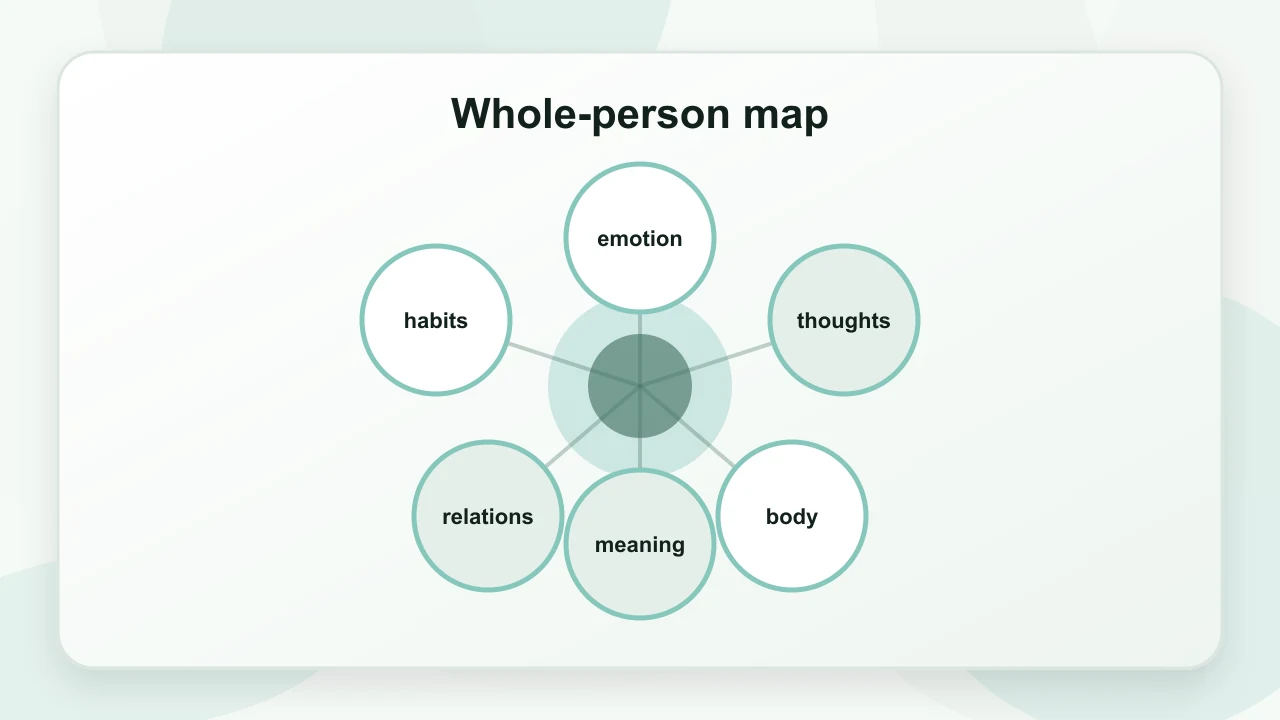
Visual summary
The infographic summarizes the article as emotion, thoughts, body, relations, habits, meaning. It is a reading aid only and does not add new claims beyond the article.
What is holistic psychology? It is an approach to understanding behavior and mental wellbeing by examining the person as an interconnected system. Instead of treating thoughts, emotions, bodily state, relationships, habits, environment, culture, and meaning as separate compartments, it asks how they influence one another.
Holistic psychology is not one standardized treatment and does not replace diagnosis, psychotherapy, psychiatry, or medical care. It is a perspective that can guide assessment and planning. Its quality depends on the specific methods used, the evidence supporting them, and the competence of the practitioner.
Definition: Holistic psychology is a whole-person perspective that studies mental wellbeing through interacting psychological, biological, relational, social, environmental, behavioral, and meaning-related factors. It aims to create a fuller explanation of a person’s experience while using interventions that are safe, evidence-aware, and appropriate to the person’s needs.
Educational information only; it is not a clinical assessment or treatment plan.
The scope of holistic psychology
The scope is broad, but it can be organized into seven domains.
1. Cognition
Thoughts, assumptions, attention, interpretation, memory, expectations, and problem-solving patterns.
2. Emotion
Feelings, emotional awareness, expression, avoidance, tolerance, and regulation.
3. Physical and biological factors
Sleep, movement, pain, illness, medication, hormones, nutrition, substance use, and autonomic arousal.
4. Behavior and routine
Habits, avoidance, work-rest balance, digital use, daily structure, and reinforcement patterns.
5. Relationships
Attachment, family dynamics, social support, conflict, boundaries, intimacy, and community connection.
6. Culture and environment
Beliefs, identity, socioeconomic conditions, discrimination, housing, safety, noise, nature, and access to resources.
7. Meaning and values
Purpose, identity, morality, spirituality, creativity, grief, responsibility, and desired direction in life.
A holistic formulation does not assume all seven domains are equally important. It looks for the smallest number of meaningful connections that explain what is happening and suggest useful next steps.
Holistic psychology versus holistic therapy
The terms overlap but are not identical.
- Holistic psychology is the broader perspective or conceptual framework.
- Holistic therapy usually refers to a practitioner’s method of treatment.
- Integrative psychotherapy often combines established therapeutic models based on the client’s needs.
- Complementary practices may include mindfulness, yoga, relaxation, art, or movement used alongside conventional care.
Because “holistic therapist” is not a single protected credential, consumers should examine the practitioner’s actual license, education, supervision, and scope rather than relying on the title.
Five practical examples
Example 1: Anxiety before work
A person experiences nausea and racing thoughts every weekday morning. A holistic view considers cognitive worry, workplace conflict, poor sleep, caffeine use, commuting stress, and fear of disappointing others. The plan might include medical evaluation if needed, reduced caffeine, sleep work, communication or boundary changes, and evidence-based anxiety treatment.
Example 2: Low mood after relocation
Someone feels unmotivated after moving to a new city. Instead of assuming a purely internal disorder, assessment includes loss of community, reduced daylight, disrupted routine, financial stress, loneliness, and identity change. Support may combine social reconnection, activity scheduling, grief acknowledgment, and clinical assessment if symptoms persist.
Example 3: Irritability in a parent
A parent reports anger and guilt. Relevant factors may include chronic sleep loss, sensory overload, unequal caregiving, no recovery time, perfectionistic standards, and an untreated health problem. A useful plan addresses logistics and support—not only emotion-control techniques.
Example 4: Repeated relationship conflict
A couple argues about small tasks. The visible topic may be dishes, while the deeper pattern involves attachment fears, unclear expectations, workload imbalance, financial stress, and poor repair after conflict. Holistic work connects the interaction pattern with the surrounding conditions.
Example 5: Difficulty concentrating
Concentration problems can relate to anxiety, depression, ADHD, sleep deprivation, medication effects, pain, substance use, grief, or environmental distraction. A holistic approach avoids prematurely assigning one explanation and supports appropriate assessment.
Methods that may be used
Depending on need and qualifications, a whole-person plan may draw from:
- cognitive and behavioral strategies;
- person-centered or humanistic therapy;
- family or relationship approaches;
- mindfulness and relaxation training;
- sleep and routine interventions;
- physical activity guidance consistent with health status;
- environmental modifications;
- expressive writing, art, music, or movement;
- medical, psychiatric, nutritional, or social-service referrals.
The National Center for Complementary and Integrative Health emphasizes that whole-person care can include biological, behavioral, social, and environmental domains. It also advises that unproven approaches should not delay established care.
Benefits of a holistic formulation
A good formulation can:
- validate the complexity of a person’s experience;
- reveal modifiable factors outside the therapy room;
- reduce false either-or choices between mind and body;
- improve coordination among professionals;
- connect symptom relief with functioning and quality of life;
- produce practical, personalized priorities.
Limitations and risks
The breadth of holistic psychology can also create problems.
Vague explanations
Terms such as “blocked energy,” “dysregulated system,” or “stored trauma” can sound meaningful while remaining too vague to test or act on.
Over-attribution
A practitioner may explain medical symptoms entirely through stress or trauma, potentially delaying medical diagnosis.
Overpromising
Claims to heal the “root cause” of every problem are not credible. Human difficulties often have multiple causes and require ongoing management rather than one cure.
Scope violations
Coaches, wellness providers, or bodyworkers may move into diagnosis or trauma treatment without appropriate qualifications.
Excessive burden on the client
Whole-person advice can become a long list of sleep, diet, exercise, mindfulness, supplements, journaling, and relationship tasks. A realistic plan should prioritize rather than overwhelm.
A simple holistic self-assessment
For a non-emergency concern, write one sentence for each prompt:
- Problem: What is happening, and how is it affecting daily life?
- Pattern: When is it better or worse?
- Body: What physical factors may be involved?
- Mind: What thoughts or interpretations maintain it?
- Relationships: Who or what affects the pattern?
- Environment: What conditions increase or reduce strain?
- Meaning: What value, loss, role, or conflict is involved?
- Priority: What one change would make the next week more manageable?
This exercise can organize information, but it cannot rule out a medical or psychiatric condition.
When to seek professional help
Consult a qualified professional when symptoms are severe, persistent, worsening, or impairing work, relationships, sleep, eating, self-care, or safety. Urgent support is needed for suicidal intent, self-harm risk, psychosis, mania, severe withdrawal, violence, or inability to care for basic needs. In the United States, call or text 988 in a mental-health crisis.
Practical takeaway
The practical value of holistic psychology is not that it explains everything. It is that it prevents important parts of the picture from being ignored. A useful whole-person plan identifies the strongest connections, chooses a few safe actions, and brings in qualified care where needed.
Conclusion
Holistic psychology expands the frame without abandoning rigor. It asks how multiple parts of life interact, then turns that understanding into a focused, realistic plan. Used carefully, it can make care more human and context-sensitive. Used carelessly, it can become vague or overpromising. The difference lies in evidence, ethics, competence, and clear limits.
Sources
- World Health Organization. Mental health
- National Center for Complementary and Integrative Health. Complementary, Alternative, or Integrative Health: What’s in a Name?
- National Center for Complementary and Integrative Health. Are You Considering a Complementary Health Approach?