

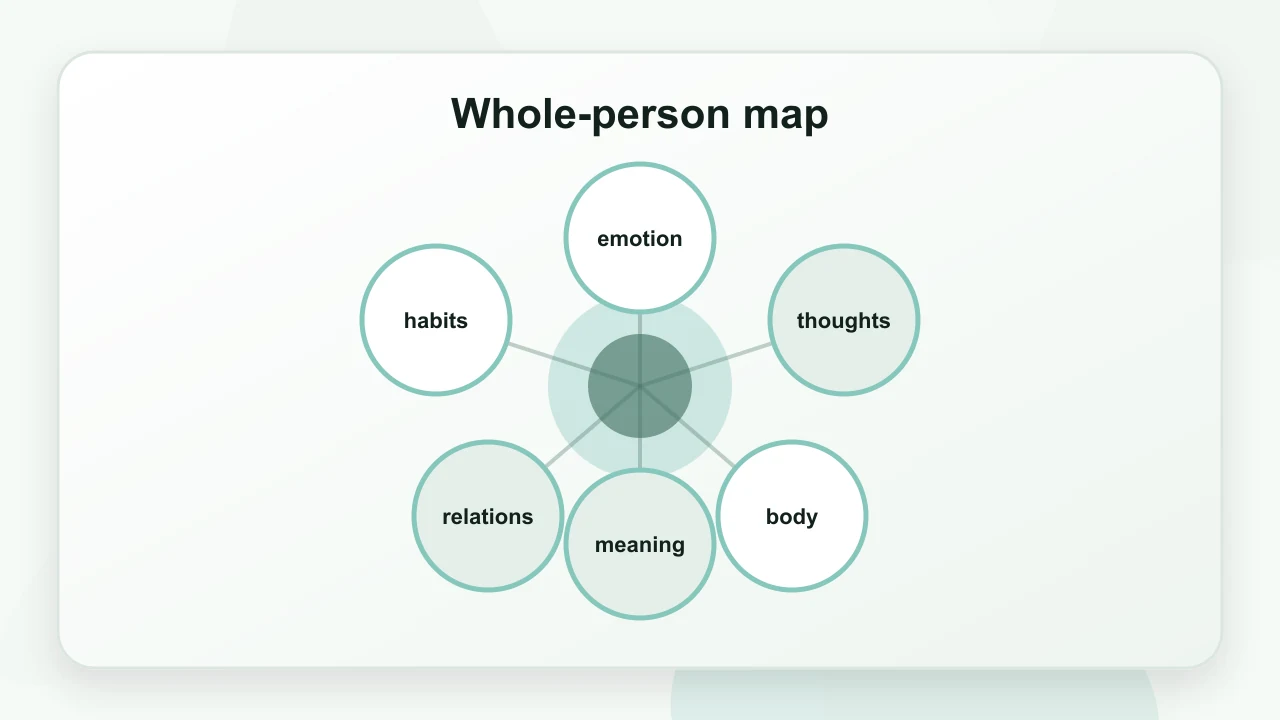
Visual summary
The infographic summarizes the article as emotion, thoughts, body, relations, habits, meaning. It is a reading aid only and does not add new claims beyond the article.
Holistic psychology is a way of understanding mental wellbeing by looking at the whole person rather than isolating one symptom. It considers how thoughts, emotions, physical health, nervous-system state, relationships, culture, daily habits, environment, identity, and meaning may interact.
This does not mean that every problem has a simple “root cause,” or that lifestyle changes can replace professional treatment. It means that a person’s experience is rarely explained by one factor alone. Holistic thinking asks a broader set of questions so that support can be more practical, personal, and context-aware.
This article provides general education, not diagnosis or individualized treatment advice.
What does “holistic” mean in psychology?
The word holistic comes from the idea of studying a whole system and the relationships among its parts. In psychology, it means asking not only “What symptom is present?” but also:
- What is happening emotionally and cognitively?
- What is happening in the body?
- How are sleep, movement, nutrition, substances, or illness contributing?
- What relationships or social pressures are involved?
- What does the person’s environment reinforce?
- What values, roles, losses, or questions of meaning are present?
The World Health Organization describes mental health as more than the absence of a disorder. It includes the capacity to cope, learn, work, realize abilities, and contribute to community. That broader view is compatible with holistic psychology, provided it remains careful about evidence and scope.
The main dimensions of a holistic view
Psychological
This includes thoughts, emotions, beliefs, memory, attention, coping habits, expectations, and learned responses. Conventional psychological models already address many of these areas.
Biological and physical
Sleep, pain, hormones, illness, medication effects, exercise, nutrition, and substance use can influence mood and cognition. A holistic practitioner should never assume that a physical symptom is “just emotional.” Medical evaluation may be necessary.
Relational
Attachment patterns, communication, conflict, family roles, loneliness, intimacy, caregiving, and social support all affect mental wellbeing.
Social and cultural
Income, housing, work conditions, discrimination, immigration stress, community safety, cultural beliefs, and access to care can shape distress and resilience.
Environmental
Noise, crowding, light, clutter, access to green space, digital overload, and the design of daily routines can influence stress and functioning.
Existential and values-based
People may struggle with purpose, identity, mortality, freedom, responsibility, or disconnection from what matters. These concerns are not always symptoms to eliminate; sometimes they are questions to explore.
How holistic psychology differs from a symptom-only approach
A symptom-only approach might ask, “How can we reduce anxiety?” A holistic approach might ask:
- When does the anxiety occur?
- What bodily sensations come first?
- Is the person sleeping?
- Is caffeine or another substance amplifying arousal?
- Is there an unsafe relationship or unstable work situation?
- Does the person have time to recover?
- What beliefs or avoidance patterns maintain the cycle?
- Is there a medical condition that should be ruled out?
The goal is not to make the explanation more complicated. It is to avoid treating one visible part while overlooking a major driver elsewhere.
What holistic psychology can include
A holistic plan might combine several appropriate supports:
- psychotherapy or counseling;
- medical assessment or medication management;
- sleep and routine changes;
- movement or exercise suited to the person’s health;
- stress-management skills;
- mindfulness or relaxation practices;
- relationship or family work;
- environmental changes;
- community, spiritual, or cultural resources chosen by the individual;
- coaching or education for nonclinical goals.
The National Center for Complementary and Integrative Health uses the term whole person health for work that considers interconnected biological, behavioral, social, and environmental domains. It also distinguishes integrative care—coordinated use of conventional and complementary approaches—from using an unproven alternative instead of established treatment.
What holistic psychology does not mean
The term is sometimes misused. Holistic psychology should not mean:
- blaming a person’s thoughts for illness;
- claiming trauma is stored in one exact body part;
- assuming one diet, supplement, breathwork method, or spiritual practice works for everyone;
- rejecting diagnosis when diagnosis is useful;
- treating serious symptoms without adequate training;
- promising to identify and remove a universal “root cause”;
- discouraging medication or professional care.
A broad perspective is not automatically a scientific one. Each specific claim still needs evaluation.
A practical example
Imagine someone who feels irritable, unmotivated, and mentally foggy. A narrow interpretation might label this as a mindset problem. A holistic assessment could reveal several interacting factors:
- chronic sleep restriction;
- grief after a recent loss;
- reduced social contact;
- a medication side effect;
- little daylight or movement;
- perfectionistic thinking;
- work demands that leave no recovery time.
No single intervention may solve everything. Yet improving sleep, consulting a prescriber, making room for grief, reconnecting socially, and addressing perfectionism could form a coherent plan.
How to choose a credible holistic practitioner
Ask concrete questions:
- What is your professional training and scope?
- Which parts of your method are supported by research?
- How do you assess risk and know when to refer?
- Will you coordinate with my physician or therapist when appropriate?
- What outcomes should I realistically expect?
- What are the costs, risks, and alternatives?
Be cautious when someone uses scientific language without clear meaning, dismisses all conventional care, guarantees rapid transformation, or pressures you into expensive packages.
When a holistic approach may help
It may be especially useful when:
- symptoms are connected with several life areas;
- previous advice felt generic or disconnected from context;
- a person wants preventive wellbeing support;
- medical and psychological needs must be coordinated;
- values, culture, or spirituality are important to the person;
- sustainable daily changes matter as much as insight.
When professional or urgent care is important
A whole-person perspective still requires appropriate escalation. Seek qualified clinical help for severe or persistent symptoms, major changes in sleep or behavior, suspected psychosis or mania, disordered eating, substance dependence, inability to function, or thoughts of self-harm. Immediate danger requires emergency support. In the United States, call or text 988 for the Suicide & Crisis Lifeline.
Practical takeaway
Holistic psychology is best understood as a disciplined habit of looking at connections. Start by mapping the problem across six areas: mind, body, relationships, environment, daily behavior, and meaning. Then identify one or two changes that are safe, specific, and proportionate. Broad understanding should lead to clearer action—not an endless search for hidden causes.
Conclusion
Holistic psychology does not offer a magical answer. It offers a more complete set of questions. By considering the whole person while preserving scientific caution and access to professional care, it can turn vague distress into a more understandable and workable picture.
Sources
- World Health Organization. Mental health
- National Center for Complementary and Integrative Health. Complementary, Alternative, or Integrative Health: What’s in a Name?
- National Center for Complementary and Integrative Health. Are You Considering a Complementary Health Approach?