

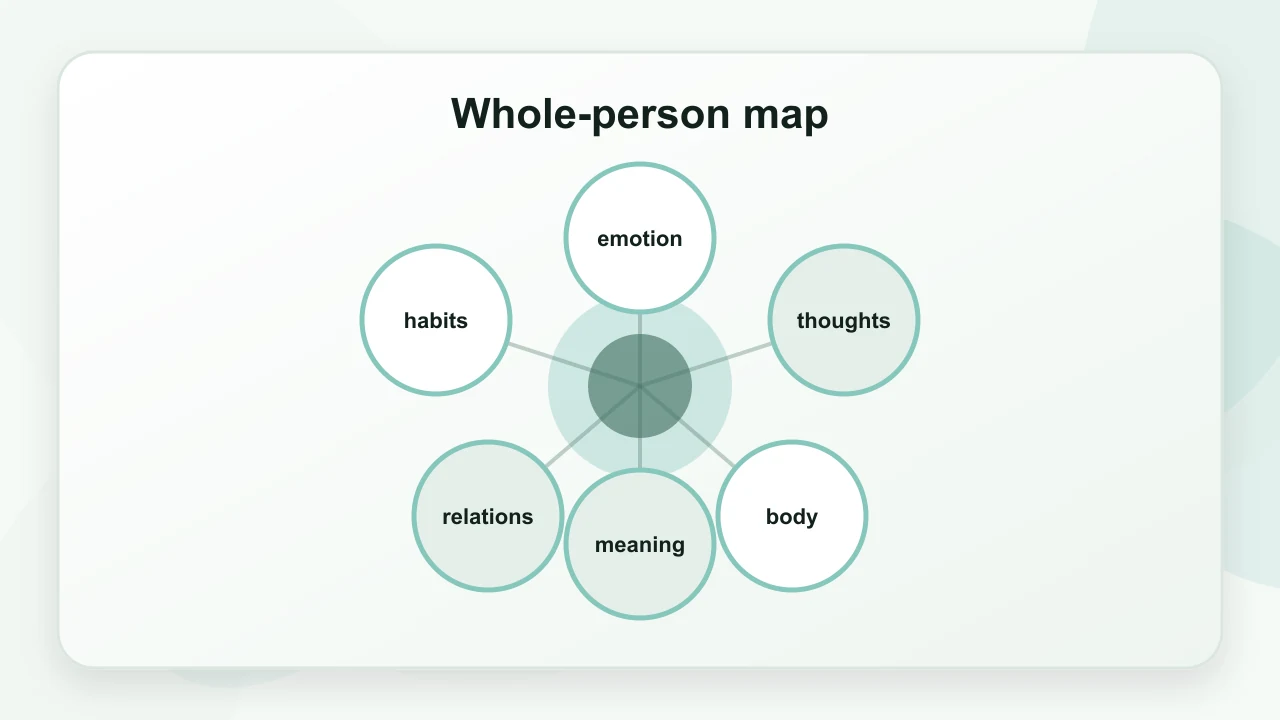
Visual summary
The infographic summarizes the article as emotion, thoughts, body, relations, habits, meaning. It is a reading aid only and does not add new claims beyond the article.
People often search for alternative psychology when standard mental-health advice feels too narrow, impersonal, or focused only on symptoms. The phrase can be useful, but it is not the name of one formally defined branch of psychology. It is better understood as an umbrella term for psychological ideas and wellbeing practices that look beyond a single diagnosis or treatment model.
A responsible alternative-psychology framework can include humanistic, holistic, somatic, mindfulness-based, lifestyle, relational, creative, and meaning-centered approaches. The important question is not whether an idea is “alternative,” but whether it is safe, appropriate, transparent about its limits, and supported by credible evidence.
This article is educational and is not a diagnosis or a substitute for care from a qualified health professional.
What does alternative psychology mean?
Unlike clinical psychology, developmental psychology, or cognitive psychology, “alternative psychology” does not have one universally accepted academic definition. Different people use it to describe different things:
- psychological approaches outside a strictly medical or diagnostic model;
- complementary practices used alongside therapy or medical care;
- whole-person approaches that connect mental wellbeing with sleep, movement, relationships, environment, and purpose;
- humanistic or existential ideas that emphasize agency, values, growth, and meaning;
- mind-body practices such as mindfulness, breathing, relaxation, or body awareness.
The distinction between alternative and complementary matters. The U.S. National Center for Complementary and Integrative Health describes a complementary approach as one used with conventional care, while an alternative approach is used instead of it. In mental health, replacement can carry real risk when a person has severe, persistent, or rapidly worsening symptoms.
A practical framework: six parts of the whole person
Alternative psychology is most useful when it helps a person examine several interacting areas rather than searching for one hidden cause.
1. Emotional experience
What feelings are present? Are they being named, suppressed, judged, or acted out? Emotional awareness does not solve every problem, but it can make patterns easier to recognize.
2. Thoughts and beliefs
How does the person interpret events? Are there rigid assumptions, catastrophic predictions, self-criticism, or learned narratives influencing behavior?
3. Body and nervous-system state
Stress can appear physically through muscle tension, restlessness, fatigue, disrupted sleep, or changes in appetite. Body-based practices may help some people notice and regulate arousal, but physical symptoms also deserve appropriate medical evaluation.
4. Relationships and social conditions
Mental wellbeing is shaped by connection, conflict, belonging, loneliness, caregiving demands, discrimination, financial strain, and community support. Not every difficulty is located “inside” the individual.
5. Daily environment and habits
Sleep, movement, food, substance use, work demands, screen exposure, access to nature, and the physical home environment can all affect how a person feels and functions.
6. Values, identity, and meaning
Some people are not only asking, “How do I stop feeling bad?” They are asking, “What matters to me?” “How do I want to live?” or “What kind of person am I becoming?” Humanistic and existential perspectives take these questions seriously.
What alternative psychology is not
A balanced framework should be clear about its boundaries.
Alternative psychology is not:
- proof that conventional psychology is useless;
- a promise that positive thinking, diet, meditation, or spirituality can cure a mental-health condition;
- permission for an unqualified practitioner to diagnose or treat beyond their competence;
- a reason to stop medication abruptly;
- a substitute for emergency, psychiatric, or medical care when safety is at risk;
- a claim that every illness is caused by unresolved emotions or personal attitude.
A method can feel natural, ancient, intuitive, or emotionally compelling and still be ineffective, inappropriate, or harmful. Credibility depends on evidence, practitioner competence, honest communication, and fit for the individual.
Examples of approaches that may fit the framework
Depending on how the term is used, alternative psychology may include:
- Humanistic psychology: emphasizes personal agency, dignity, growth, and the person’s lived experience.
- Holistic psychology: examines interacting biological, psychological, social, environmental, and meaning-related factors.
- Mindfulness-based practices: train attention and nonjudgmental awareness; evidence varies by condition and program.
- Somatic or body-awareness work: explores physical sensations and patterns associated with stress or emotion.
- Creative approaches: use art, music, movement, writing, or imagery to support expression and reflection.
- Lifestyle-based mental-health support: addresses sleep, activity, routine, nutrition, social connection, and stress management.
- Coaching or educational work: may help with goals, habits, decisions, or accountability when clinical treatment is not required.
These categories overlap. The label alone tells you little about quality. Two practitioners using the same term may have very different training, methods, and ethical standards.
How to evaluate an alternative approach
Before investing time, money, or trust, ask:
What exactly is being offered?
Look for a clear description of the method, expected process, practitioner role, and limits. Vague language about “reprogramming,” “detoxing trauma,” or “healing everything at the root” deserves caution.
What evidence supports it?
Evidence does not need to be perfect, but claims should match the strength of available research. Personal testimonials can describe an experience; they cannot prove that a method works generally.
What are the risks?
Consider physical risks, emotional destabilization, financial pressure, dependency on the practitioner, privacy, interactions with medication, and the cost of delaying effective care.
Is the practitioner qualified and accountable?
Ask about education, licensing where applicable, supervision, professional boundaries, informed consent, complaint procedures, and referrals when needs exceed their scope.
Does it complement or replace necessary care?
For mild wellbeing goals, self-guided practices may be reasonable. For significant impairment, trauma symptoms, mania, psychosis, severe depression, substance dependence, eating disorders, or suicidal thinking, qualified clinical assessment is important.
When alternative psychology may be useful
A broader framework may help when someone wants to:
- understand recurring patterns rather than only suppress a symptom;
- connect emotional wellbeing with sleep, relationships, work, or environment;
- clarify values, identity, or life direction;
- build supportive routines and coping skills;
- add safe complementary practices to existing treatment;
- find language for experiences that feel poorly captured by generic advice.
It may be less useful when the label becomes an identity battle—“natural versus medical,” “holistic versus scientific,” or “therapy versus self-reliance.” Good care often combines perspectives rather than forcing a false choice.
A safe next step
Start with one concrete question: What area of my life is most affecting my ability to function right now? It might be sleep, panic, conflict, isolation, grief, workload, physical illness, substance use, or a loss of meaning.
Then choose the least risky, most proportionate next step. That could be tracking a pattern, improving one daily routine, discussing complementary practices with a clinician, consulting a licensed professional, or seeking urgent support if safety is involved.
Practical takeaway
Use alternative psychology as a lens, not as a guarantee. A useful approach should help you understand the whole person, make practical changes, and preserve access to appropriate professional care. It should increase informed choice—not fear, dependence, or unrealistic certainty.
Conclusion
Alternative psychology can offer a broader way to think about mental wellbeing by including the body, relationships, environment, habits, values, and meaning. Its value depends on how carefully it is used. The safest approach is curious but not credulous, open-minded but evidence-aware, and willing to combine practical self-support with professional care when needed.
Sources
- National Center for Complementary and Integrative Health. Complementary, Alternative, or Integrative Health: What’s in a Name?
- National Center for Complementary and Integrative Health. Are You Considering a Complementary Health Approach?
- World Health Organization. Mental health
- American Psychological Association. Psychology topics