
Visual summary
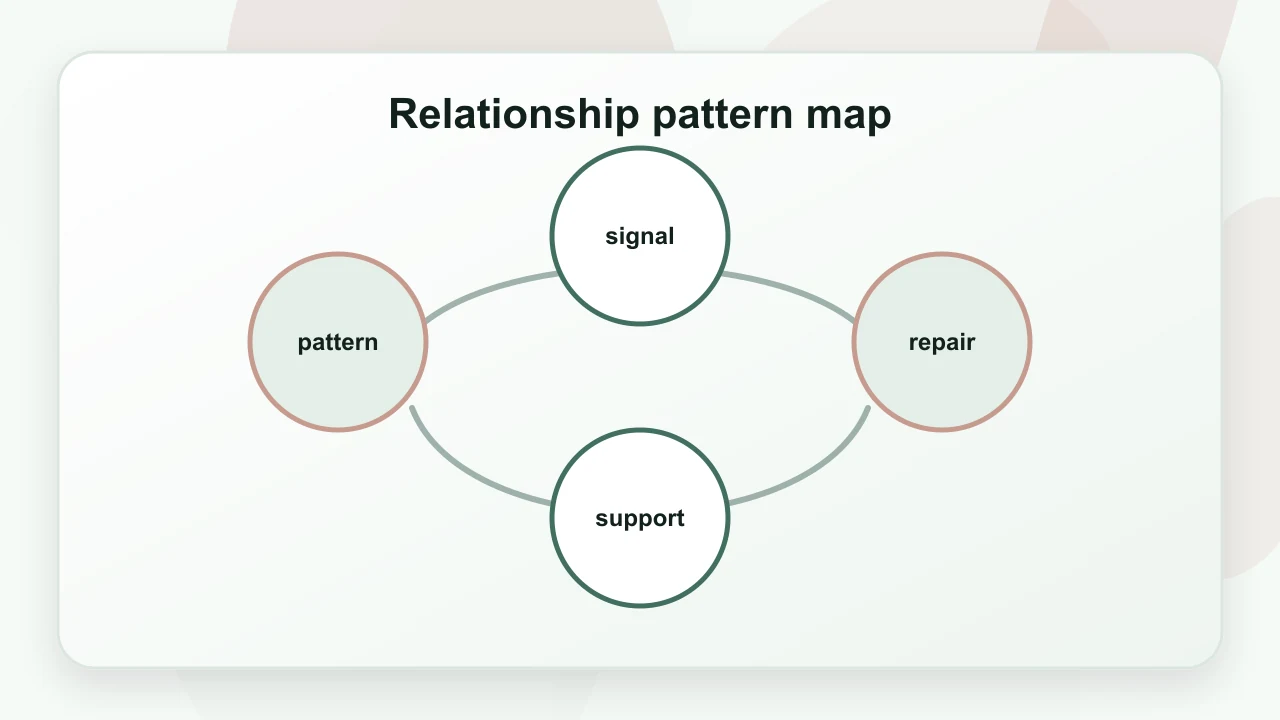
The infographic summarizes the article as pattern, signal, repair, support. It is a reading aid only and does not add new claims beyond the article.
Attachment styles are patterns in how people seek closeness, respond to uncertainty, and manage dependence and distance in important relationships. Popular psychology usually describes secure, anxious, avoidant, and fearful or disorganized patterns.
These categories can help people notice recurring relationship habits, but they are not diagnoses or fixed identities. Adult attachment is often better understood along dimensions—especially anxiety and avoidance—and may vary between relationships and across time.
What are the attachment styles?
Secure attachment
A securely attached person is generally able to value closeness while maintaining autonomy. They may ask for support directly, tolerate ordinary separation, and repair conflict without assuming the relationship is ending.
Security does not mean never feeling jealous, hurt, or afraid. It describes relative flexibility rather than perfect behavior.
Anxious attachment
An anxious attachment pattern may involve heightened sensitivity to signs of rejection, strong reassurance-seeking, difficulty tolerating ambiguity, and rapid escalation when connection feels uncertain.
Avoidant attachment
An avoidant pattern may involve discomfort with dependence, minimizing emotional needs, withdrawing during conflict, or relying heavily on self-sufficiency.
Fearful or disorganized attachment
This label is often used for a pattern in which a person strongly wants closeness but also experiences closeness as threatening. In adult popular psychology, terminology is not always used consistently, and online quizzes may oversimplify it.
Are attachment styles categories or dimensions?
Many adult attachment researchers use two dimensions:
- Attachment anxiety: worry about rejection or abandonment.
- Attachment avoidance: discomfort with closeness or reliance on others.
A person can be low or high on either dimension. This explains why real people may not fit neatly into one box.
Where attachment styles come from
Early caregiving experiences can matter, but they are not the only influence. Adult attachment may also reflect:
- later friendships and romantic relationships;
- betrayal, loss, or trauma;
- temperament;
- cultural expectations;
- current stress;
- a partner’s behavior;
- mental and physical health;
- learned communication patterns.
Avoid reducing every adult relationship difficulty to childhood.
How attachment styles may appear in relationships
The same event can trigger different responses.
Example: a delayed reply
- An anxious response may interpret the delay as rejection and send repeated messages.
- An avoidant response may dismiss the need for contact and disengage.
- A secure response may notice concern, consider several explanations, and ask directly later.
These examples describe tendencies, not proof of a type.
Can my attachment style change?
Attachment patterns can change. Research suggests that adult attachment reflects both earlier development and current relationship experiences. Greater security may develop through:
- consistent, trustworthy relationships;
- recognizing triggers;
- clearer communication;
- tolerating uncertainty gradually;
- boundaries that protect safety and autonomy;
- psychotherapy when patterns are persistent or painful.
Change usually comes from repeated experience, not simply choosing a new label.
Attachment style therapy
There is no single standardized treatment called attachment style therapy. Therapists may use attachment-informed concepts within couples therapy, psychodynamic therapy, cognitive behavioral approaches, trauma treatment, or other evidence-based methods.
A useful therapist should help you understand concrete patterns rather than telling you that one attachment label explains your entire life.
What attachment styles do not tell you
Attachment styles cannot reliably determine:
- whether a relationship will succeed;
- whether someone is compatible with you;
- whether a partner is abusive;
- whether childhood memories are accurate;
- which treatment you need;
- whether one person is to blame.
Attachment language should never excuse manipulation, coercion, stalking, violence, or repeated dishonesty.
A practical reflection exercise
Choose one recent relationship difficulty and write:
- What happened?
- What did I assume it meant?
- What feeling appeared first?
- What did I do next?
- Did that response increase or reduce clarity?
- What could a more secure response look like?
Focus on behavior you can observe and change.
When professional support may help
Consider professional support when relationship patterns repeatedly cause intense distress, major conflict, avoidance, panic, self-harm, or inability to function. Seek specialized safety support when there is abuse or fear of retaliation.
Practical takeaway
Use attachment styles as a map, not a verdict. Notice whether anxiety, avoidance, or flexible security appears in a particular relationship. Then work on specific behaviors: direct requests, realistic reassurance, boundaries, conflict repair, and choosing reliable people.
See Relationship Psychology, Attachment Theory, and Anxious Attachment Styles.
Sources
- APA Dictionary of Psychology — Attachment Style
- APA Dictionary of Psychology — Attachment Theory
- Fraley, Attachment in Adulthood: Recent Developments, Emerging Debates, and Future Directions
- Chopik et al., The Development of Adult Attachment Styles: Four Lessons
- NIMH — Caring for Your Mental Health