

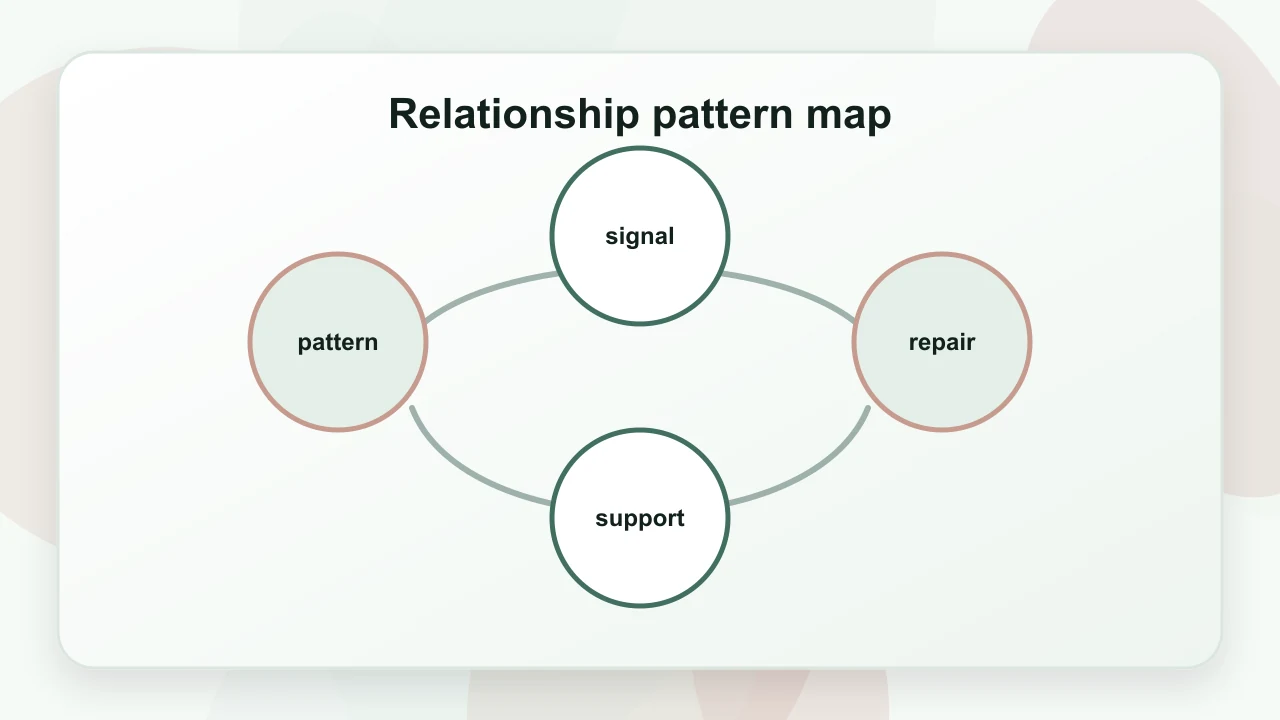
Visual summary
The infographic summarizes the article as pattern, signal, repair, support. It is a reading aid only and does not add new claims beyond the article.
Attachment theory is a psychological framework explaining why close emotional bonds matter and how people seek protection, comfort, and connection during stress. John Bowlby developed the theory, and Mary Ainsworth’s observational research helped identify different infant-caregiver attachment patterns.
The theory began as an account of childhood development. Later researchers applied attachment concepts to adult romantic relationships, friendship, emotion regulation, and caregiving. These extensions are influential, but attachment theory should not be used as a complete explanation for personality or relationship outcomes.
Who developed attachment theory?
Psychiatrist and psychoanalyst John Bowlby argued that attachment is an adaptive behavioral system rather than merely dependence or learned reward. Psychologist Mary Ainsworth expanded the work through naturalistic observation and the Strange Situation procedure.
Later researchers studied adult attachment using interviews, questionnaires, and observations of close relationships.
Core ideas in attachment theory
Attachment behavior
Attachment behavior includes actions aimed at gaining or maintaining closeness to a trusted person, especially during fear, illness, separation, or uncertainty.
Safe haven
An attachment figure may provide comfort and protection during distress.
Secure base
A reliable relationship can support exploration, learning, and independent activity.
Internal working models
People may develop expectations about whether others are available and whether they themselves are worthy of care. These expectations can influence attention and behavior, but they are not unchangeable scripts.
Attachment theory in childhood
Infant research commonly describes secure, avoidant, resistant or ambivalent, and disorganized patterns. These classifications describe observed behavior under specific conditions. They are not diagnoses of the child or moral judgments about the caregiver.
Caregiving matters, but family stress, temperament, health, culture, and measurement conditions also affect behavior.
Attachment theory in adults
Adult attachment research often focuses on anxiety and avoidance.
- Higher anxiety may involve fear of rejection and strong reassurance-seeking.
- Higher avoidance may involve discomfort with closeness and dependence.
- Lower anxiety and avoidance generally correspond to greater security.
Adult romantic attachment measures are related to, but not identical with, infant attachment classifications or the Adult Attachment Interview.
What attachment theory can explain
It may help explain:
- why separation activates strong emotion;
- why some people pursue while others withdraw;
- how trust shapes help-seeking;
- why reliable responsiveness may support security;
- how relationship expectations influence attention and interpretation.
What attachment theory cannot explain by itself
It cannot fully explain:
- compatibility;
- abuse;
- personality;
- mental illness;
- cultural differences;
- sexual behavior;
- every conflict;
- whether a relationship should continue.
A theory can identify one layer of a problem without explaining the whole problem.
Common misunderstandings
“Your first years determine everything”
Early relationships may matter, but development continues. Later relationships and experiences can alter expectations and behavior.
“Everyone has one fixed type”
Adult attachment may differ between relationships and can change over time.
“An attachment label explains harmful behavior”
It does not excuse coercion, violence, infidelity, manipulation, or refusal to take responsibility.
“Attachment theory proves repressed memories”
It does not establish the accuracy of a specific memory or allegation.
Practical application
Use attachment theory by asking:
- What happens when I need support?
- What do I expect from the other person?
- Do I ask directly, protest, withdraw, or minimize?
- Is my expectation based on current evidence or an older pattern?
- Is this relationship actually safe and reliable?
- What specific behavior would create more clarity?
When therapy may help
Attachment-informed therapy may be useful when repeated patterns cause distress or interfere with close relationships. The therapist should work collaboratively, avoid deterministic labels, and use methods appropriate to the person’s actual needs.
Practical takeaway
Attachment theory is most helpful when it converts vague relationship distress into observable patterns. Use it to understand proximity, trust, support, and conflict responses while keeping culture, current circumstances, and individual behavior in view.
See Attachment Styles, Anxious Attachment Styles, and Relationship Psychology.
Sources
- APA Dictionary of Psychology — Attachment Theory
- APA Dictionary of Psychology — Internal Working Model of Attachment
- Fraley, Attachment in Adulthood: Recent Developments, Emerging Debates, and Future Directions
- Crowell et al., Adult Attachment Processes: Individual and Couple Perspectives
- NIMH — Caring for Your Mental Health