
Visual summary
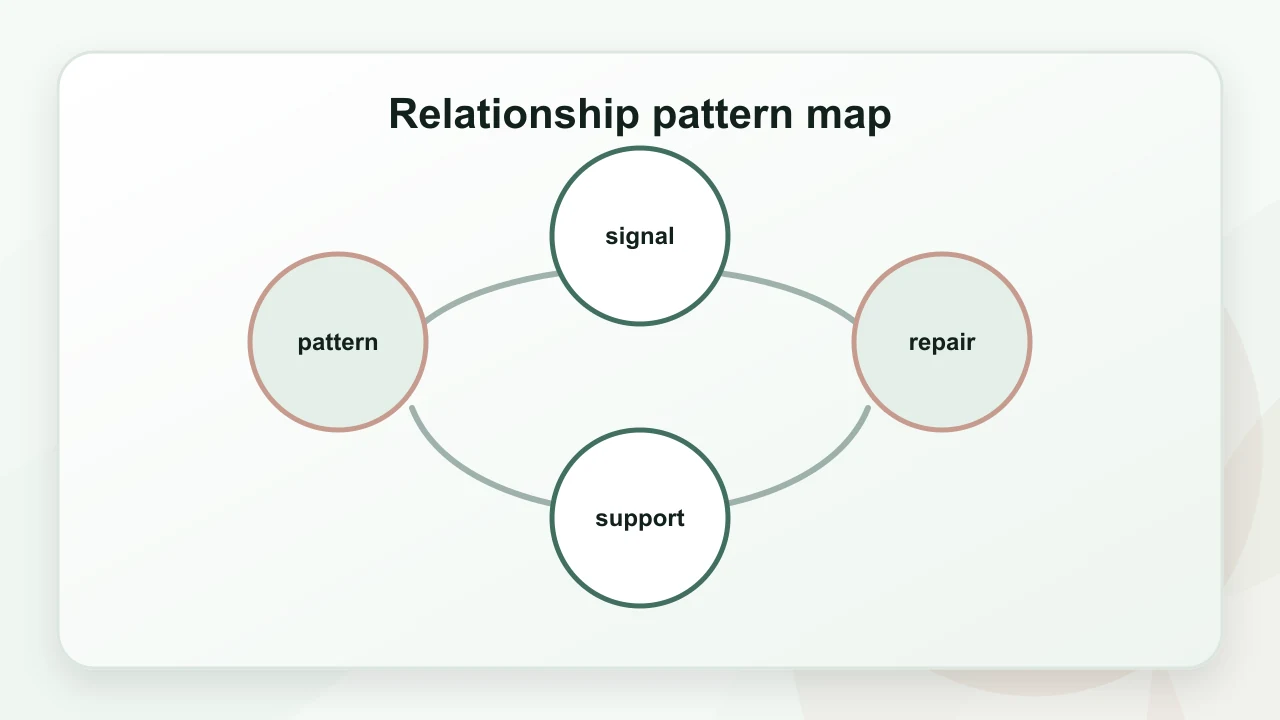
The infographic summarizes the article as pattern, signal, repair, support. It is a reading aid only and does not add new claims beyond the article.
Relationship psychology examines how people form, maintain, and sometimes end close relationships. It draws from social, developmental, cognitive, clinical, and personality psychology to study attachment, attraction, communication, trust, conflict, intimacy, boundaries, commitment, and repair.
The field does not provide a formula for a perfect relationship. It offers frameworks for understanding patterns and choosing more constructive responses.
What relationship psychology includes
Attachment and security
Attachment theory examines how people seek closeness and respond to separation, uncertainty, and support. Attachment patterns can influence relationships, but they are not permanent personality labels.
Communication
Relationship communication includes listening, expressing needs, interpreting tone, nonverbal behavior, timing, and repair after misunderstanding.
Trust
Trust develops through consistent behavior, honesty, reliability, and responsiveness. It can be damaged by betrayal, secrecy, coercion, or repeated broken agreements.
Conflict
Conflict is not automatically a sign of a bad relationship. Important questions include:
- Is disagreement safe?
- Can each person speak?
- Are insults, threats, or intimidation present?
- Can the issue be revisited?
- Does repair occur?
- Are agreements followed?
Boundaries
Boundaries describe what a person is willing to participate in, accept, disclose, or take responsibility for. A boundary is not a method for controlling another person.
Intimacy and connection
Intimacy may be emotional, physical, intellectual, practical, or spiritual. People differ in desired closeness, privacy, affection, and communication frequency.
What psychology says about healthy relationships
Research and clinical practice generally emphasize:
- respect;
- emotional and physical safety;
- responsiveness;
- realistic expectations;
- shared and individual identity;
- communication that is direct but not degrading;
- capacity for repair;
- flexibility during life transitions;
- consent and autonomy.
A healthy relationship does not require constant agreement or happiness.
Common relationship patterns
Pursue-and-withdraw
One person seeks immediate discussion while the other pulls away. The pursuit may intensify withdrawal, and withdrawal may intensify pursuit.
A better approach is a planned pause with a specific return time.
Mind-reading
A person assumes they know the other’s intention: “You do not care,” or “You are trying to control me.” Replacing certainty with a question can reduce escalation.
Scorekeeping
Both people track sacrifices and failures while positive actions become invisible. Regularly discussing workload and expectations may be more useful than silently accumulating resentment.
Conflict avoidance
Avoiding every disagreement can preserve short-term peace while allowing unresolved issues to grow.
Reassurance cycles
Repeated reassurance may temporarily reduce anxiety but fail to build durable trust. Clear agreements and consistent behavior matter more.
Practical relationship psychology tools
Use observable language
Say, “You arrived an hour later than we agreed and did not message,” rather than, “You never respect me.”
State the need or request
Try, “Please message if you will be more than 15 minutes late.”
Reflect before responding
Summarize what you heard before defending your position.
Separate intention from impact
A person may not intend harm but still need to acknowledge the effect of their behavior.
Create a repair process
A useful repair may include:
- describing what happened;
- acknowledging impact;
- taking responsibility;
- making a specific change;
- following through.
What relationship psychology cannot do
It cannot:
- prove compatibility from one quiz;
- diagnose a partner from online behavior;
- guarantee that communication will fix abuse;
- determine who is right in every conflict;
- make one person responsible for changing both people;
- replace legal, medical, or safety support.
When couples advice is unsafe
Ordinary communication tools are not sufficient when there is:
- physical or sexual violence;
- threats;
- stalking;
- coercive control;
- intimidation;
- financial control;
- fear of retaliation.
Joint counseling may be inappropriate in some abusive situations. Specialized domestic-violence support and individualized safety planning may be needed.
When professional support may help
A qualified couples therapist or individual clinician may help when conflict is repetitive, trust has been damaged, communication repeatedly fails, or mental-health symptoms are affecting the relationship.
Professional support cannot guarantee reconciliation. Sometimes the healthiest goal is clarity, boundaries, or safe separation.
Practical takeaway
Use relationship psychology to identify patterns, not to label people. Focus on observable behavior, emotional safety, clear requests, realistic boundaries, and repair. A useful framework should increase understanding and choice—not excuse harmful conduct.
See Attachment Styles, Attachment Theory, and Anxious Attachment Styles.
Sources
- American Psychological Association — Relationships
- American Psychological Association — Parenting
- National Institute of Mental Health — Caring for Your Mental Health