
Visual summary
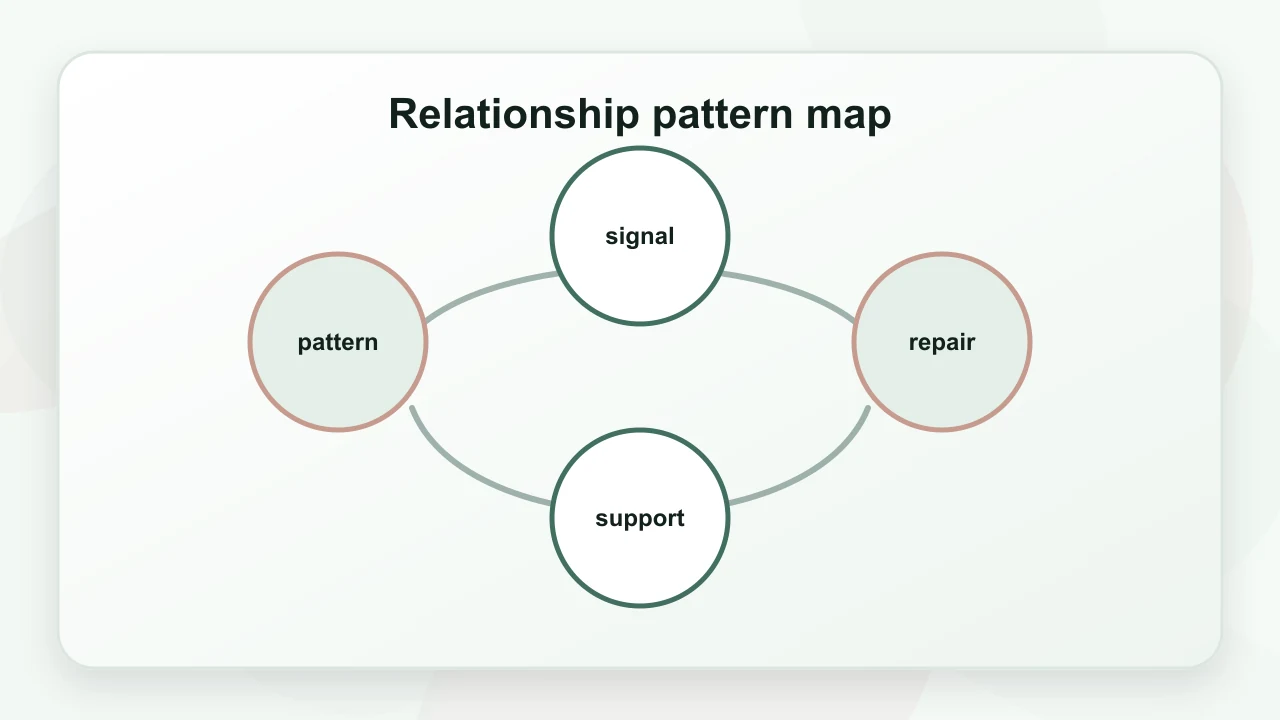
The infographic summarizes the article as pattern, signal, repair, support. It is a reading aid only and does not add new claims beyond the article.
Anxious attachment styles describe patterns of heightened concern about rejection, abandonment, or a partner’s availability. A person may want closeness strongly while finding uncertainty difficult to tolerate.
Common signs may include frequent reassurance-seeking, interpreting ambiguity as rejection, monitoring a partner’s responsiveness, difficulty calming after conflict, or sacrificing boundaries to preserve connection. These patterns are understandable responses, not a diagnosis or proof that something is permanently wrong.
Definition of anxious attachment style
In adult attachment research, anxiety refers to concern about whether a close other will be available, responsive, or committed. The person may hold a negative expectation about their own worth or about the stability of the relationship.
Anxious attachment is sometimes called anxious-preoccupied or anxious-ambivalent attachment, although terms vary across childhood and adult models.
Common signs in relationships
Possible signs include:
- needing repeated confirmation that the relationship is secure;
- feeling highly distressed by delayed messages;
- assuming conflict means abandonment;
- closely monitoring changes in tone or affection;
- overexplaining or repeatedly apologizing;
- escalating contact when a partner withdraws;
- suppressing needs until resentment builds;
- difficulty maintaining boundaries;
- rapid idealization or fear-driven conclusions.
One behavior alone does not establish an attachment pattern.
Anxious attachment style in childhood
In developmental research, resistant or ambivalent attachment describes a pattern observed in structured infant-caregiver assessments. It should not be casually diagnosed from a few childhood stories.
An adult anxious attachment pattern may be influenced by early caregiving, but later relationships, betrayal, loss, temperament, current partner behavior, and stress also matter.
The anxious-avoidant cycle
A common relationship cycle develops when one person pursues connection while the other withdraws.
- Uncertainty activates the anxious partner.
- They increase contact, questions, or protest.
- The other person feels pressured and pulls away.
- Withdrawal confirms the first person’s fear.
- Both behaviors intensify.
The cycle is the problem—not necessarily either person’s character.
What helps build greater security
Check the current evidence
Ask whether the relationship is actually reliable. Anxious feelings are not always inaccurate. Inconsistency, deception, or emotional unavailability can reasonably create uncertainty.
Make a direct request
Replace indirect protest with a specific request:
- “Please tell me when you need space and when we will reconnect.”
- “Could we agree on how we communicate during travel?”
- “I need clarity about whether we are exclusive.”
Delay repetitive reassurance
Use one clear question rather than repeated checking. Then observe whether the other person follows through consistently.
Strengthen life outside the relationship
Maintain friendships, interests, work, rest, and independent decisions. Independence is not emotional distance; it reduces the pressure on one relationship to regulate everything.
Practice emotional regulation
Grounding, comfortable breathing, journaling, movement, and cognitive reframing may help lower immediate intensity before a conversation.
Set boundaries
Security is not achieved by tolerating repeated disrespect. A boundary identifies what you will do when a pattern continues.
Therapy for anxious attachment
Therapy may help explore relationship expectations, emotional regulation, trauma, self-worth, communication, and partner selection. Different approaches may be appropriate depending on the person.
Avoid therapists or coaches who claim they can identify your attachment style instantly or guarantee “secure attachment” through one proprietary method.
When the relationship itself is unsafe
Anxious attachment language should never be used to minimize:
- coercive control;
- stalking;
- threats;
- physical or sexual violence;
- repeated deception;
- financial abuse;
- fear of retaliation.
In unsafe relationships, prioritize specialized support and safety planning rather than simply trying to become less anxious.
Practical takeaway
An anxious attachment pattern is not a life sentence. Focus on three questions:
- Is this relationship genuinely reliable?
- Can I communicate needs directly?
- Can I protect my boundaries while tolerating ordinary uncertainty?
See Attachment Theory, Therapy for Trust Issues, and Attachment Styles.
Sources
- APA Dictionary of Psychology — Attachment Style
- Mikulincer and Shaver, Adult Attachment, Stress, and Romantic Relationships
- Chopik et al., The Development of Adult Attachment Styles: Four Lessons
- NIMH — Caring for Your Mental Health