

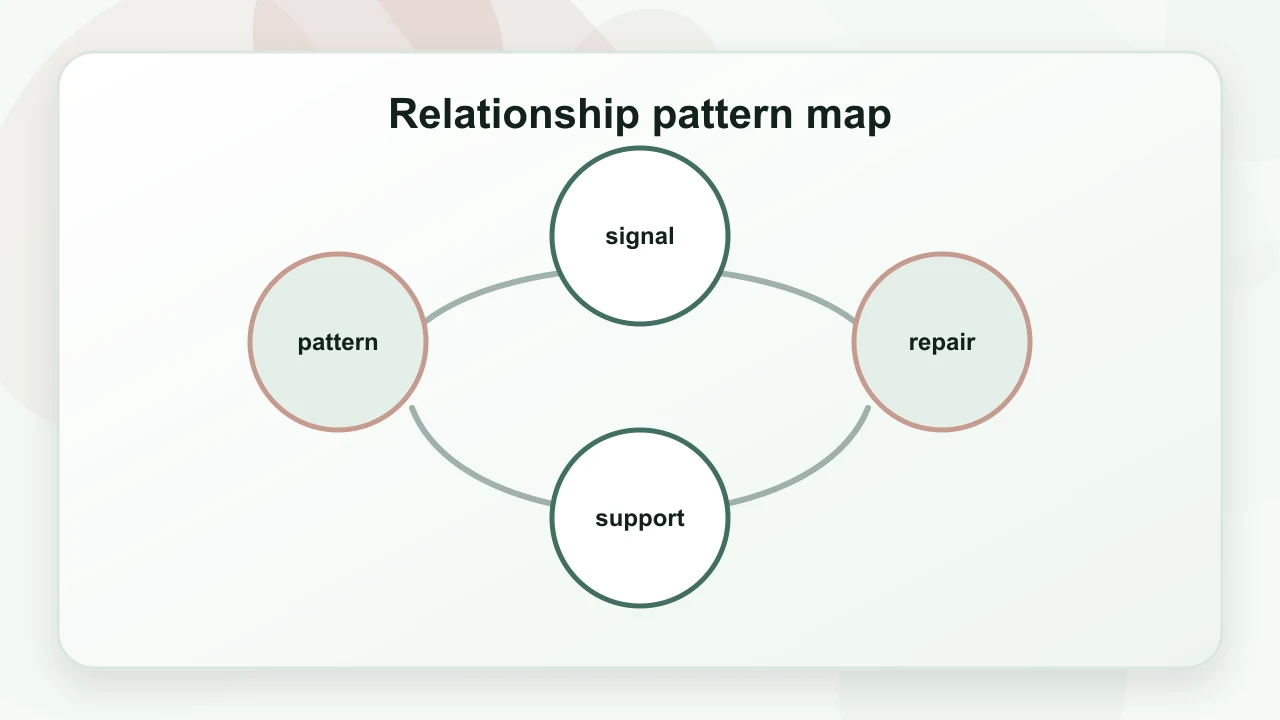
Visual summary
The infographic summarizes the article as pattern, signal, repair, support. It is a reading aid only and does not add new claims beyond the article.
Attachment theory explains how people seek closeness, protection, comfort, and security in important relationships. Attachment styles describe recurring patterns in how that system is expressed. Common labels include secure, anxious, avoidant, and disorganized or fearful-avoidant.
The theory began with infant-caregiver research and was later extended to adult relationships. These patterns can help explain behavior under stress, but they are not diagnoses, fixed personality types, or complete explanations for relationship problems.
Attachment theory and attachment styles
The theory includes several core ideas:
- proximity seeking;
- safe haven;
- secure base;
- separation distress;
- internal working models.
Attachment styles describe how these processes may appear in behavior.
The main attachment styles
Secure attachment
Generally comfortable with closeness and autonomy. A secure person may ask directly for support, tolerate reasonable separation, and repair conflict.
Anxious attachment
May involve fear of rejection, repeated reassurance-seeking, sensitivity to delayed contact, and difficulty tolerating ambiguity.
Avoidant attachment
May involve discomfort with dependence, minimizing needs, withdrawing during conflict, and emphasizing self-reliance.
Disorganized or fearful-avoidant attachment
May involve wanting closeness while also fearing it. In adult models, fearful avoidance is often described as high anxiety and high avoidance.
Styles of attachment theory in childhood and adulthood
Childhood attachment classifications and adult romantic attachment models are related but not identical.
Infant classifications are based on behavior in structured observations. Adult attachment is often assessed through interviews or questionnaires.
Avoid assuming that one childhood pattern directly predicts every adult relationship.
Attachment theory and parenting styles
Attachment and parenting style are different concepts.
Attachment concerns the child’s bond and security behavior toward a caregiver.
Parenting style describes broader patterns of warmth, responsiveness, control, expectations, and discipline.
They may influence one another, but they should not be treated as the same framework.
Relationship styles and attachment theory
Attachment may influence:
- reassurance-seeking;
- withdrawal;
- conflict behavior;
- trust;
- help-seeking;
- comfort with vulnerability;
- balance between closeness and independence.
Current partner behavior matters. Anxiety in an unreliable relationship is not automatically an internal attachment problem.
Are attachment styles fixed?
No. Attachment patterns may shift through:
- reliable relationships;
- betrayal or loss;
- therapy;
- communication skills;
- boundaries;
- stress;
- changing life circumstances;
- repeated experiences of repair.
A person may also show different patterns with different people.
What attachment theory does not explain
It does not by itself determine:
- compatibility;
- abuse;
- whether someone will cheat;
- whether a relationship should continue;
- personality as a whole;
- a psychiatric diagnosis;
- the accuracy of childhood memories;
- who is responsible for harmful behavior.
Common misuse
Be cautious when attachment language is used to:
- diagnose a partner from social media;
- excuse cruelty or ghosting;
- blame parents for everything;
- promise guaranteed “secure attachment”;
- pressure someone to remain in an unsafe relationship;
- sell one proprietary healing method.
A practical way to use the framework
Ask:
- What happens when connection feels uncertain?
- Do I pursue, withdraw, freeze, or ask directly?
- Is the other person actually reliable?
- What need or boundary is present?
- What would a more secure behavior look like?
- Is professional support needed?
When therapy may help
Attachment-informed therapy may help when patterns repeatedly cause distress, isolation, panic, or destructive conflict. A clinician should use the framework flexibly and assess trauma, culture, current relationships, and safety.
Joint therapy may be unsafe where violence or coercive control is present.
Practical takeaway
Use attachment theory and attachment styles as a map:
- identify anxiety and avoidance;
- examine current evidence;
- communicate directly;
- protect boundaries;
- practice repair;
- avoid treating labels as destiny.
See Attachment Theory Disorganized, Attachment Theory Fearful Avoidant, and Relationship Problems Counselling.
Sources
- American Psychological Association — Relationships
- American Psychological Association — Parenting
- Peer-reviewed attachment research
- National Institute of Mental Health — Caring for Your Mental Health