
Visual summary
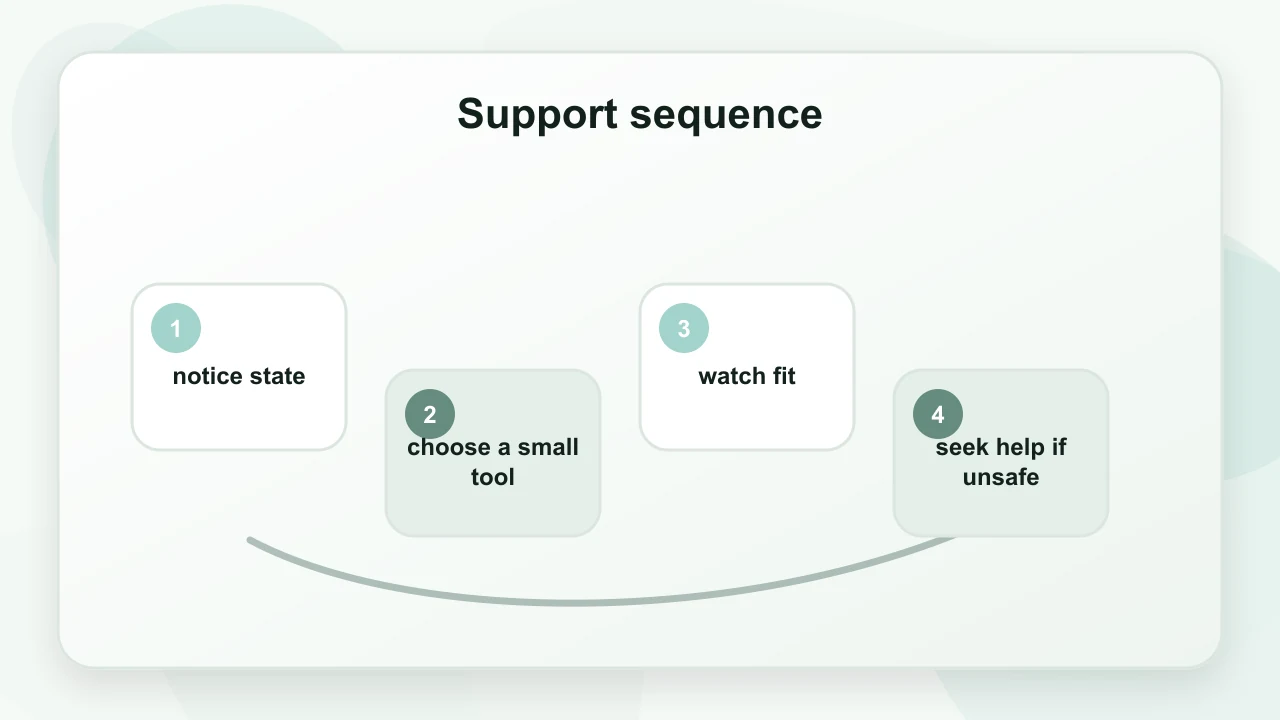
The infographic summarizes the article as notice state, choose a small tool, watch fit, seek help if unsafe. It is a reading aid only and does not add new claims beyond the article.
Deep breathing for anxiety is often recommended because breathing and physical arousal influence each other. A slower, more comfortable breathing pattern may help some people reduce tension and interrupt the rapid breathing that can accompany stress or panic.
But “take a huge breath” is not always good advice. Repeatedly inhaling too much air can increase lightheadedness, tingling, chest discomfort, and a sense of unreality. For anxiety, the useful target is usually slower and gentler breathing, not the deepest possible breath.
Why anxiety changes breathing
During stress, breathing may become faster, shallower, or irregular. This can happen before you consciously notice anxiety. Rapid breathing may then produce sensations such as:
- lightheadedness;
- tingling;
- tightness;
- breathlessness;
- blurred focus;
- a feeling of losing control.
Those sensations can be misread as proof that something dangerous is happening, which increases fear and further changes breathing.
Breathing is only one part of anxiety. Thoughts, avoidance, sleep, substances, health conditions, and life circumstances also matter.
Deep breathing for anxiety: a safer starting method
Try this for one to three minutes:
- Sit or stand in a supported position.
- Let the shoulders drop.
- Breathe in gently through the nose for about three or four seconds.
- Exhale comfortably for about four to six seconds.
- Pause only if it feels natural.
- Keep the breath quiet and moderate rather than very large.
- Stop if symptoms worsen.
The exact count is not important. The exhale can be slightly longer than the inhale, but the pattern should not feel forced.
Diaphragmatic breathing without overdoing it
“Belly breathing” describes allowing the diaphragm to move while the upper chest stays relatively relaxed. Place one hand on the lower ribs or abdomen and notice mild movement.
Do not push the abdomen outward dramatically or try to fill the lungs to maximum capacity. Comfortable breathing is more useful than performing the exercise perfectly.
What may help
Practice when calm
Breathing exercises are easier to learn before a panic peak. Practice for one or two minutes during an ordinary part of the day.
Pair breathing with external grounding
Look at a stable object, feel both feet on the floor, or name sounds in the room. This helps people who become more anxious when focusing only on internal sensations.
Use a simple cue
Try: “Easy inhale, longer exhale,” or “I do not need a perfect breath.”
Keep the session short
Long sessions can create pressure or hyperfocus. A minute of comfortable breathing may be enough.
What often does not help
Huge repeated inhalations
Overbreathing can worsen dizziness and tingling.
Rigid counting
A strict count may become another performance demand. Shorten the count or stop counting.
Breath-holding during panic
Long holds can feel suffocating and intensify fear. They are not necessary.
Treating breathing as a cure
Breathing may lower immediate arousal, but it does not resolve trauma, unsafe conditions, persistent avoidance, medical problems, or an anxiety disorder by itself.
Forcing breathwork after it increases symptoms
Some people experience increased anxiety, intrusive thoughts, or fear of losing control during relaxation practices. Stop and use an outward-focused technique instead.
A one-minute anxiety breathing exercise
- Look at one object in front of you.
- Feel the chair or floor supporting you.
- Inhale gently.
- Exhale a little more slowly.
- Repeat five times.
- Reorient to the room.
- Decide on one practical next action.
The last step matters. Regulation should help you return to life, not keep you endlessly monitoring your breathing.
Deep breathing during a panic attack
During panic, use the smallest intervention possible. Sit somewhere safe, loosen restrictive clothing, and slow the breathing without gulping air. Remind yourself that panic sensations often pass.
However, chest pain, fainting, severe breathing difficulty, a first episode with uncertain cause, or symptoms that could be medical should be evaluated urgently. Do not assume every episode is anxiety.
When breathing exercises should be modified
Speak with a health professional when you have significant heart or lung disease, pregnancy-related complications, recurrent fainting, epilepsy, or symptoms triggered by trauma-focused inward attention.
A clinician may recommend a different pace, posture, or coping strategy.
Practical takeaway
For deep breathing for anxiety, think slow and easy, not big and forceful:
- Support the body.
- Inhale gently.
- Let the exhale run slightly longer.
- Keep attention partly outside the body.
- Stop if dizziness or panic increases.
- Seek appropriate care for severe or persistent symptoms.
See Emotional Regulation Techniques, Breathing Exercises for Anxiety, and Nervous System Regulation.
Sources
- NIMH - Anxiety Disorders
- NCCIH - Relaxation Techniques: What You Need To Know
- NCCIH - Anxiety and Complementary Health Approaches
- VA National Center for PTSD - Coping With Traumatic Stress Reactions