
Visual summary
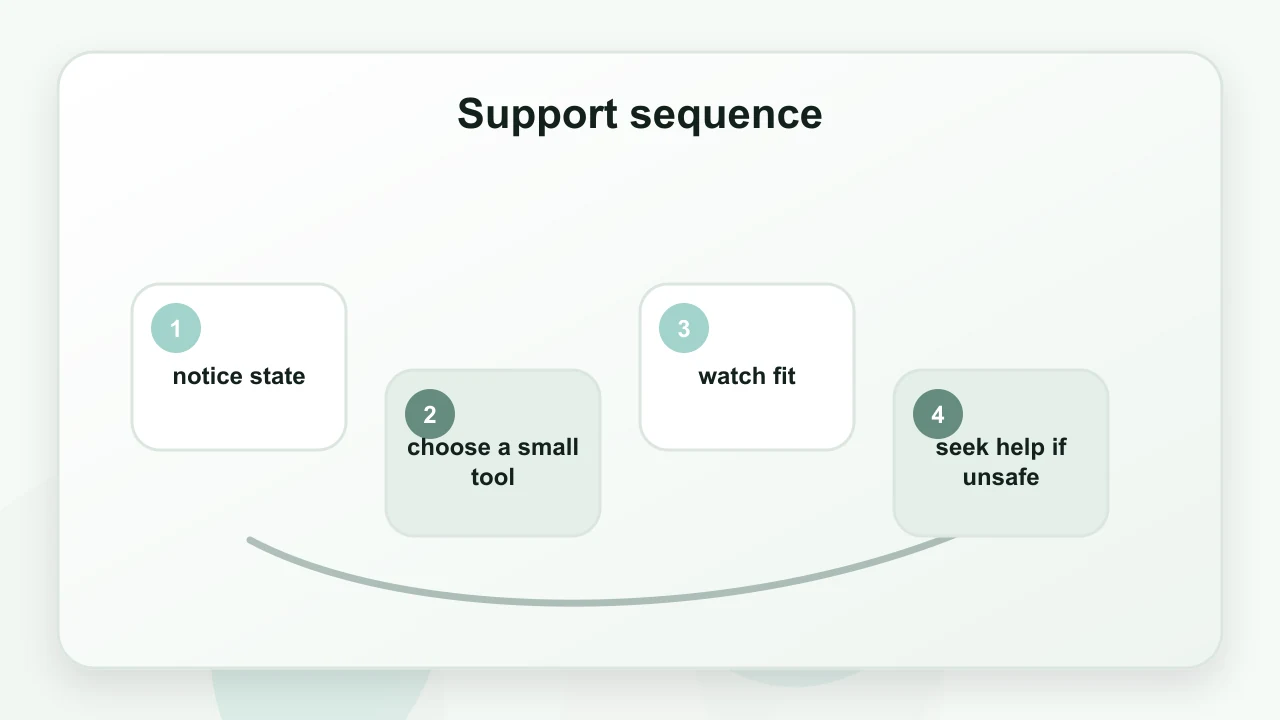
The infographic summarizes the article as notice state, choose a small tool, watch fit, seek help if unsafe. It is a reading aid only and does not add new claims beyond the article.
Emotional regulation techniques are practical ways to notice, understand, and respond to strong emotions without pretending they are not there. The goal is not to stay calm every minute or force yourself to “think positively.” It is to create enough space between a feeling and an action so that you can respond more deliberately.
These skills may help with anxiety, frustration, shame, anger, overwhelm, and stress. They can also make it easier to communicate, recover after conflict, and return to daily tasks. Some techniques work quickly; others become useful only after repeated practice.
What emotional regulation is
Emotional regulation is the ability to influence how you experience and express an emotion. It includes:
- noticing what is happening;
- identifying the emotion and its likely trigger;
- tolerating the feeling long enough to avoid an impulsive reaction;
- choosing an action that fits the situation;
- recovering after the emotion passes.
Good regulation does not mean suppressing sadness, anger, fear, or disappointment. It means using emotions as information without automatically letting them control the next decision.
What emotional regulation is not
Emotional regulation is not:
- denying legitimate problems;
- excusing harmful behavior;
- staying calm in an unsafe situation;
- forcing forgiveness;
- treating every reaction as a personal failure;
- using self-help techniques instead of medical or psychological care.
Sometimes an emotion is proportionate to the situation. The useful question is not “How do I get rid of this?” but “What does this feeling tell me, and what response will help?”
Emotional regulation techniques for daily life
1. Name the emotion precisely
Instead of “I feel bad,” try:
- disappointed;
- embarrassed;
- threatened;
- lonely;
- overloaded;
- resentful;
- uncertain.
Precise language can make an experience feel more understandable and may clarify what is needed. “Overloaded” may call for fewer demands; “hurt” may call for a conversation; “unsafe” may call for distance or help.
2. Check the body before solving the story
Strong emotion often comes with physical activation: shallow breathing, a tight jaw, heat, trembling, or a racing heart. Before analyzing the entire situation, try one physical adjustment:
- unclench the hands;
- place both feet on the floor;
- lower the shoulders;
- take a slower, comfortable exhale;
- drink water;
- step outside or change rooms.
This does not solve the problem. It may simply make the problem easier to think about.
3. Use sensory grounding
Grounding techniques for emotional regulation redirect attention toward the present environment. Try naming:
- five things you can see;
- four things you can feel;
- three things you can hear;
- two things you can smell;
- one thing you can taste.
A shorter version is often enough: identify one thing you see, one thing you hear, and one thing you physically feel.
4. Separate facts from interpretations
Write two short columns:
What happened: “They did not reply today.”
What my mind added: “They are angry. I ruined everything.”
Then ask:
- What evidence supports that interpretation?
- What else could explain the situation?
- What information is missing?
- What would I tell a friend in the same position?
This resembles cognitive behavioral therapy techniques for emotional regulation, but a worksheet is not a substitute for CBT delivered by a qualified professional.
5. Delay high-impact actions
When possible, postpone irreversible decisions during peak emotion. Create a rule such as:
- do not send the message for 30 minutes;
- draft the email but do not send it;
- do not make a major purchase tonight;
- leave the argument and agree on a time to return;
- ask another person to review the decision.
Delay is not avoidance when it is used to prevent an impulsive reaction and followed by a planned next step.
6. Choose a regulating action, not just a distraction
A distraction can be useful during a short emotional peak. Afterward, choose an action related to the actual need:
- fear may call for information or support;
- anger may call for a boundary;
- guilt may call for repair;
- loneliness may call for contact;
- exhaustion may call for rest or reduced commitments;
- confusion may call for time and clarification.
7. Use opposite action carefully
Sometimes the emotion pushes behavior that strengthens the problem. Anxiety may encourage total avoidance; shame may encourage hiding; low mood may encourage staying in bed all day.
A small “opposite action” could be:
- attending for ten minutes rather than canceling;
- sending one honest message;
- showering and stepping outside;
- beginning one small task.
Do not use opposite action to override legitimate danger or physical limits.
8. Build a personal regulation plan
Write down:
- Early warning signs.
- Common triggers.
- Techniques that usually help.
- Techniques that make things worse.
- People you can contact.
- Situations that require professional or emergency help.
A plan is easier to use when it is created before a crisis.
Why a technique may not work
A skill may fail because:
- the emotion is already at its peak;
- the technique feels artificial;
- you are hungry, sleep-deprived, ill, or overstimulated;
- the situation is genuinely unsafe;
- the method directs too much attention inward;
- the underlying problem requires action, not calming;
- symptoms are part of a condition needing treatment.
Try smaller, more external techniques first: orient to the room, move the body, use cold or warm water safely, call someone, or reduce stimulation.
When professional help is appropriate
Seek qualified help when emotions are repeatedly disrupting work, school, relationships, sleep, eating, or basic self-care. Professional support is especially important for persistent panic, trauma symptoms, severe depression, mania, psychosis, substance withdrawal, self-harm, or suicidal thoughts.
In the United States, call or text 988 for crisis support. Call emergency services when there is immediate danger or a medical emergency.
Practical takeaway
Start with one sequence:
- Name the emotion.
- Notice the body.
- Ground in the present.
- Separate facts from assumptions.
- Choose the smallest useful action.
- Review what helped afterward.
Emotional regulation skills improve through repetition, not perfection.
For related guidance, see Nervous System Regulation, Deep Breathing for Anxiety, and What Is Alternative Psychology?.
Sources
- National Institute of Mental Health - Anxiety Disorders
- American Psychological Association - Anxiety
- NCCIH - Relaxation Techniques: What You Need To Know