
Visual summary
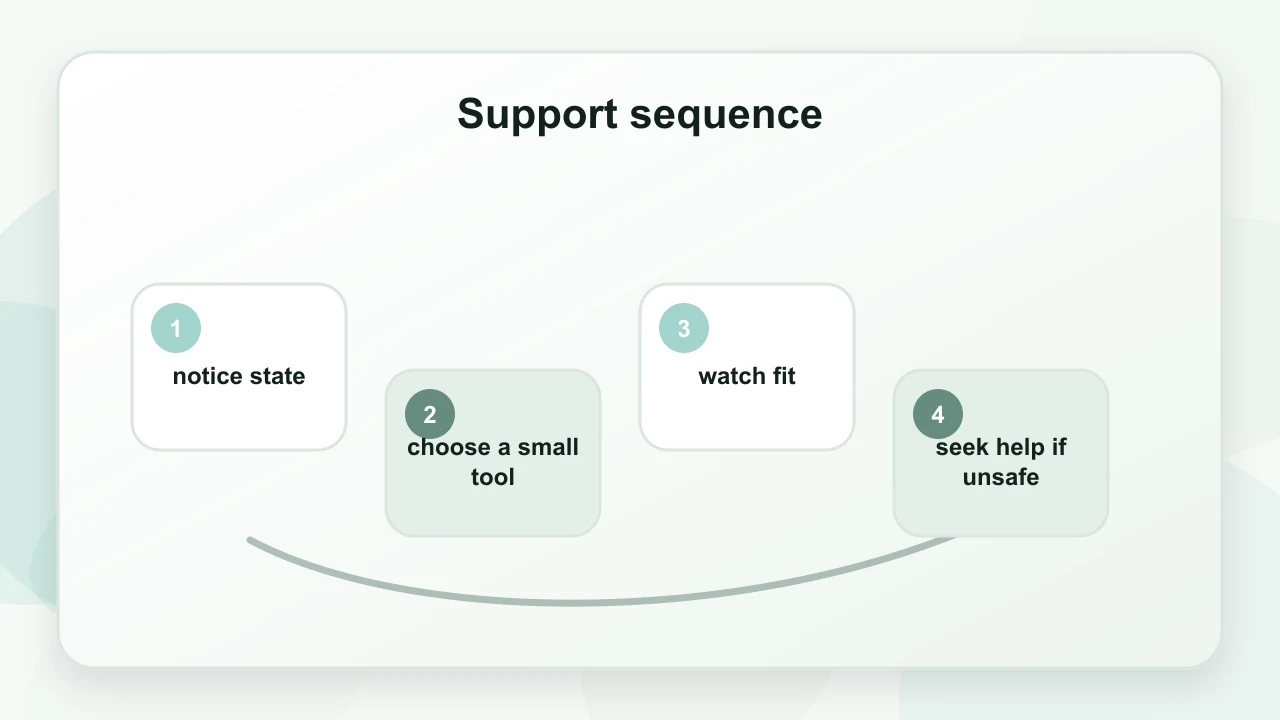
The infographic summarizes the article as notice state, choose a small tool, watch fit, seek help if unsafe. It is a reading aid only and does not add new claims beyond the article.
Emotional regulation is the ability to notice, understand, tolerate, and respond to emotions in ways that fit the situation and support long-term goals. It does not mean suppressing feelings, staying calm at all times, or never becoming overwhelmed.
Healthy regulation may involve calming down, expressing emotion clearly, changing the situation, asking for support, tolerating discomfort, or taking action. The goal is flexibility: choosing a response rather than being completely controlled by the first impulse.
What emotional regulation includes
Emotional regulation may involve:
- recognizing an emotion;
- identifying its trigger;
- understanding bodily activation;
- changing attention;
- reinterpreting a situation;
- accepting an emotion temporarily;
- communicating a need;
- solving a practical problem;
- delaying an impulsive response;
- seeking support.
Emotional regulation examples
Anxiety
Noticing rising panic, orienting to the room, slowing behavior, and choosing whether the situation is dangerous or merely uncomfortable.
Anger
Taking a structured pause before sending a message, then returning to state the problem directly.
Sadness
Allowing grief while maintaining food, sleep, connection, and necessary responsibilities.
Shame
Questioning global self-judgment and identifying one specific behavior that can be repaired.
Excitement
Enjoying positive emotion without making impulsive decisions that create harm.
What emotional regulation is not
It is not:
- emotional suppression;
- forced positivity;
- constant calm;
- ignoring injustice;
- tolerating abuse;
- never crying;
- controlling another person;
- avoiding all distress;
- proof of moral maturity.
Sometimes anger, fear, or sadness accurately signals a problem.
Emotional regulation in relationships
Relationship regulation may include:
- using direct requests;
- taking time-limited pauses;
- listening before defending;
- avoiding threats and contempt;
- distinguishing feelings from conclusions;
- repairing after conflict;
- respecting boundaries.
One partner should not be responsible for regulating the other person’s entire emotional state.
Depression and emotional regulation
Depression may involve rumination, emotional numbness, self-criticism, irritability, or difficulty shifting attention. Regulation does not mean choosing happiness. Helpful strategies may include behavioral activation, routine, social support, psychotherapy, and treatment of depression itself.
Emotional regulation in teens
Teenagers are still developing emotional, cognitive, and social capacities. Helpful adult support includes:
- calm boundaries;
- predictable routines;
- naming emotions without ridicule;
- collaborative problem-solving;
- adequate sleep;
- reducing public humiliation;
- modelling repair.
Severe aggression, self-harm, substance use, or major functional decline requires professional assessment.
Adderall and emotional regulation
Stimulant medication may improve attention and impulse control for some people with ADHD, which may indirectly support emotional regulation. It may also cause or worsen irritability, anxiety, sleep problems, appetite changes, or rebound symptoms in some people.
Medication effects are individual. Do not change dose or stop treatment without consulting the prescriber.
Practical emotional-regulation tools
Name the emotion
Use one or two words: anxious, angry, ashamed, overwhelmed.
Lower the immediate demand
Ask: “What must happen in the next ten minutes?”
Change the body state safely
Walk, stretch, eat, hydrate, rest, or use gentle grounding.
Separate facts from interpretation
Write:
- what happened;
- what I assume it means;
- what evidence is missing.
Choose one effective action
The action may be communication, withdrawal from danger, problem-solving, rest, or professional help.
What does not help
- suppressing emotion until it explodes;
- alcohol or drug use as the main strategy;
- blaming every reaction on the nervous system;
- expecting another person to provide constant reassurance;
- using grounding as a compulsory ritual;
- treating medication as the only regulation skill;
- shaming people for dysregulation.
When professional care matters
Seek help when emotional responses lead to self-harm, suicidal thoughts, violence, severe relationship damage, substance use, repeated panic, mania, psychosis, or inability to function.
In the United States, call or text 988 for crisis support.
Practical takeaway
A simple regulation sequence:
- Notice the emotion.
- Name the trigger.
- Check actual safety.
- lower immediate activation.
- choose one useful response.
- review what happened later.
- seek qualified care when the pattern remains severe.
See Breathing Exercise For Nerves, Grounding Techniques, and Grounding Methods.
Sources
- National Institute of Mental Health — Anxiety Disorders
- American Psychological Association — Emotion and anxiety resources
- NCCIH — Relaxation Techniques: What You Need to Know
- National Institute of Mental Health — ADHD information