
Visual summary
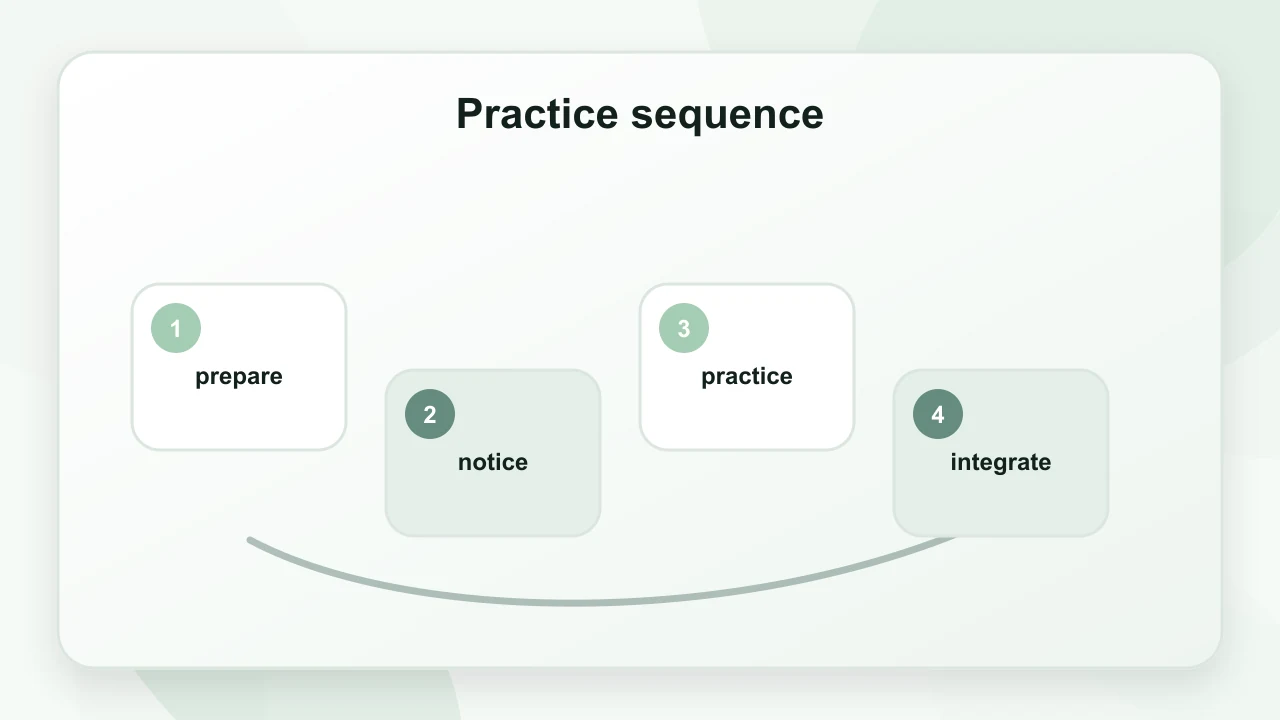
The infographic summarizes the article as prepare, notice, practice, integrate. It is a reading aid only and does not add new claims beyond the article.
Mindfulness for mental health means intentionally paying attention to present experience with less automatic judgment. It may involve noticing thoughts, emotions, body sensations, sounds, or ordinary activities such as walking and eating.
Research suggests mindfulness-based programs may help some people with stress, anxiety, depression symptoms, and quality of life. Benefits are usually modest, vary between individuals, and depend on the program and condition. Mindfulness is not a universal cure and can feel uncomfortable or destabilizing for some people.
What mindfulness includes
Mindfulness may involve:
- noticing the breath;
- observing thoughts as mental events;
- paying attention to sounds;
- scanning body sensations;
- walking slowly with awareness;
- eating with attention;
- noticing emotion without immediate action;
- returning attention after distraction.
The goal is not to empty the mind.
Mindfulness meditation and mental health
Mindfulness meditation is one way to practice mindfulness. Formal programs may include guided meditation, body awareness, movement, discussion, and home practice.
Common approaches include mindfulness-based stress reduction and mindfulness-based cognitive therapy. These are structured programs, not simply a meditation app.
Potential benefits
Mindfulness may support:
- reduced stress;
- greater awareness of emotional triggers;
- less automatic rumination;
- improved coping;
- greater tolerance of uncomfortable feelings;
- better attention for some people;
- relapse prevention in selected clinical contexts when delivered appropriately.
Evidence varies by condition and comparison group. Strong claims that mindfulness changes the brain permanently or works for everyone are not justified.
A simple mindfulness exercise
Try for one minute:
- Keep the eyes open or softly focused.
- Notice three sounds.
- Feel the support beneath the body.
- Notice one breath without changing it.
- Name the current emotion, if clear.
- Choose the next practical action.
This combines mindfulness with grounding and reduces pressure to become calm.
Informal mindfulness practices
Formal meditation is optional. Try:
- noticing water temperature while washing dishes;
- walking without using the phone for five minutes;
- listening fully during one conversation;
- eating the first three bites slowly;
- observing tension before responding to a message;
- pausing between tasks.
When mindfulness can feel worse
Mindfulness may increase:
- anxiety;
- body monitoring;
- intrusive memories;
- dissociation;
- self-criticism;
- fear of losing control;
- distress during silence.
Possible reasons include trauma, panic sensitivity, severe depression, psychosis risk, or a practice that is too long or inward-focused.
Stop the exercise, open the eyes, move, orient to the environment, and seek professional guidance if symptoms persist.
Common mindfulness myths
“Mindfulness means no thoughts”
Thoughts are expected. Practice involves noticing and returning attention.
“Mindfulness should always calm you”
Sometimes it reveals discomfort that was already present.
“More practice is always better”
Longer sessions may be unnecessary or counterproductive.
“Mindfulness replaces therapy”
It may complement treatment but should not replace appropriate care.
“Mindfulness is morally superior”
It is a skill, not a measure of character.
How to start safely
- Begin with one to three minutes.
- Keep the eyes open if preferred.
- Use sound or movement rather than body focus.
- Avoid forcing the breath.
- Stop if distress increases.
- Choose a qualified instructor for clinical symptoms.
- Discuss practice with a clinician when managing trauma, psychosis, severe panic, or other complex conditions.
Mindfulness and professional care
Mindfulness may be integrated into psychotherapy or used as a complementary self-care practice. It should not delay assessment for persistent anxiety, depression, trauma symptoms, substance use, mania, psychosis, or suicidal thoughts.
In the United States, call or text 988 for crisis support.
Practical takeaway
Use mindfulness as a brief attention skill:
- Notice what is present.
- Reduce judgment.
- Keep part of your attention in the environment.
- Stop if distress increases.
- Return to a meaningful action.
See Progressive Muscle Relaxation, Somatic Psychology, and Meditation for Mental Health.
Sources
- NCCIH — Meditation and Mindfulness: Effectiveness and Safety
- American Psychological Association — Mindfulness Meditation
- National Institute of Mental Health — Caring for Your Mental Health