

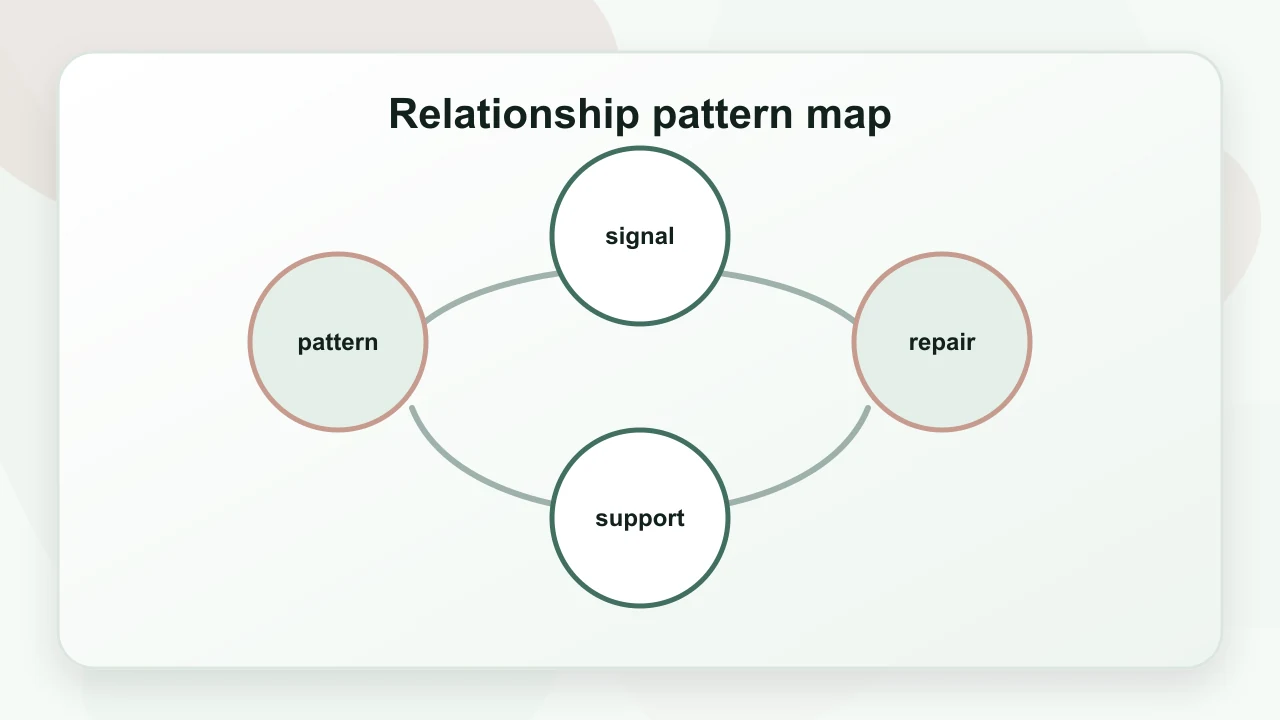
Visual summary
The infographic summarizes the article as pattern, signal, repair, support. It is a reading aid only and does not add new claims beyond the article.
Therapy for trust issues can help a person understand why trust feels difficult, distinguish realistic caution from fear-driven assumptions, and develop safer ways to evaluate relationships. Trust problems may follow betrayal, abuse, inconsistent caregiving, repeated dishonesty, trauma, or current relationships that are genuinely unreliable.
The goal is not to make someone trust everyone. Healthy trust is selective, evidence-based, and connected to boundaries.
What are trust issues?
“Trust issues” is an informal phrase, not a diagnosis. It may refer to:
- assuming others will betray or abandon you;
- difficulty accepting reassurance;
- checking messages or devices repeatedly;
- avoiding closeness;
- testing a partner;
- jealousy;
- withholding information;
- expecting hidden motives;
- staying hyperalert after betrayal.
Mistrust can sometimes be protective and accurate. The clinical task is not simply to eliminate it.
What therapy may explore
A therapist may help examine:
- what happened in previous relationships;
- whether current fears fit current evidence;
- how the person responds to uncertainty;
- patterns of reassurance, checking, withdrawal, or control;
- trauma symptoms;
- boundaries and partner selection;
- communication after betrayal;
- self-trust and decision-making.
CBT for trust issues
Cognitive behavioral therapy may examine automatic thoughts such as:
- “If I relax, I will be betrayed.”
- “A delayed reply proves they are lying.”
- “I cannot survive another disappointment.”
- “Everyone eventually leaves.”
CBT does not require replacing these thoughts with unrealistic positivity. It may involve checking evidence, considering alternatives, reducing compulsive checking, and testing new behaviors gradually.
Attachment-informed therapy
Attachment concepts may help explain sensitivity to rejection, discomfort with dependence, or pursuit-withdrawal patterns. Attachment language should remain flexible and should not reduce every trust concern to childhood.
Trauma-focused treatment
When mistrust follows trauma or abuse, a qualified clinician may use a trauma-focused treatment. The pace should protect safety and avoid pressuring the person into premature vulnerability or reconciliation.
Couples therapy for trust issues
Couples therapy may be appropriate when both partners want to repair a relationship and there is enough safety for honest participation. Work may include:
- establishing facts and accountability;
- setting communication agreements;
- clarifying boundaries;
- reducing secrecy;
- rebuilding predictability;
- monitoring whether behavior actually changes.
Joint therapy may be inappropriate when there is coercive control, intimidation, or fear of retaliation.
What good therapy should not do
A therapist should not:
- insist that mistrust is irrational without examining evidence;
- pressure reconciliation;
- treat forgiveness as mandatory;
- excuse deception through attachment labels;
- tell a client to disclose information that creates danger;
- guarantee that trust will return;
- encourage surveillance as a permanent solution.
How to choose a therapist
Ask:
- What experience do you have with betrayal, trauma, or couples work?
- How do you distinguish anxiety from legitimate safety concerns?
- What approach do you use?
- How will we measure progress?
- What happens if symptoms worsen?
- How do you handle confidentiality in couples therapy?
A good therapeutic relationship should feel respectful, transparent, and collaborative.
Practical steps outside therapy
- Define the specific behavior that damaged trust.
- Separate promises from repeated evidence.
- Ask for clear agreements.
- Decide what boundary follows another violation.
- Reduce compulsive checking gradually when it is not needed for safety.
- Keep independent support and practical options.
- Reassess whether the relationship is becoming more reliable.
When urgent or specialized support is needed
Seek specialized help for stalking, coercion, violence, threats, financial control, or fear of retaliation. Therapy focused only on “trust” may be unsafe when the underlying problem is abuse.
For acute mental-health danger in the United States, call or text 988.
Practical takeaway
Therapy for trust issues should improve both self-trust and relationship discernment. The aim is not blind trust. It is the ability to notice evidence, communicate directly, set boundaries, tolerate reasonable uncertainty, and leave situations that remain unsafe or deceptive.
See Anxious Attachment Styles, Marriage Counseling Alternatives, and Attachment Theory.
Sources
- NIMH — Psychotherapies
- NIMH — Caring for Your Mental Health
- APA — Relationships
- Mikulincer and Shaver, research on adult attachment, stress, and romantic relationships
- AAMFT — professional resources on couple and family therapy