

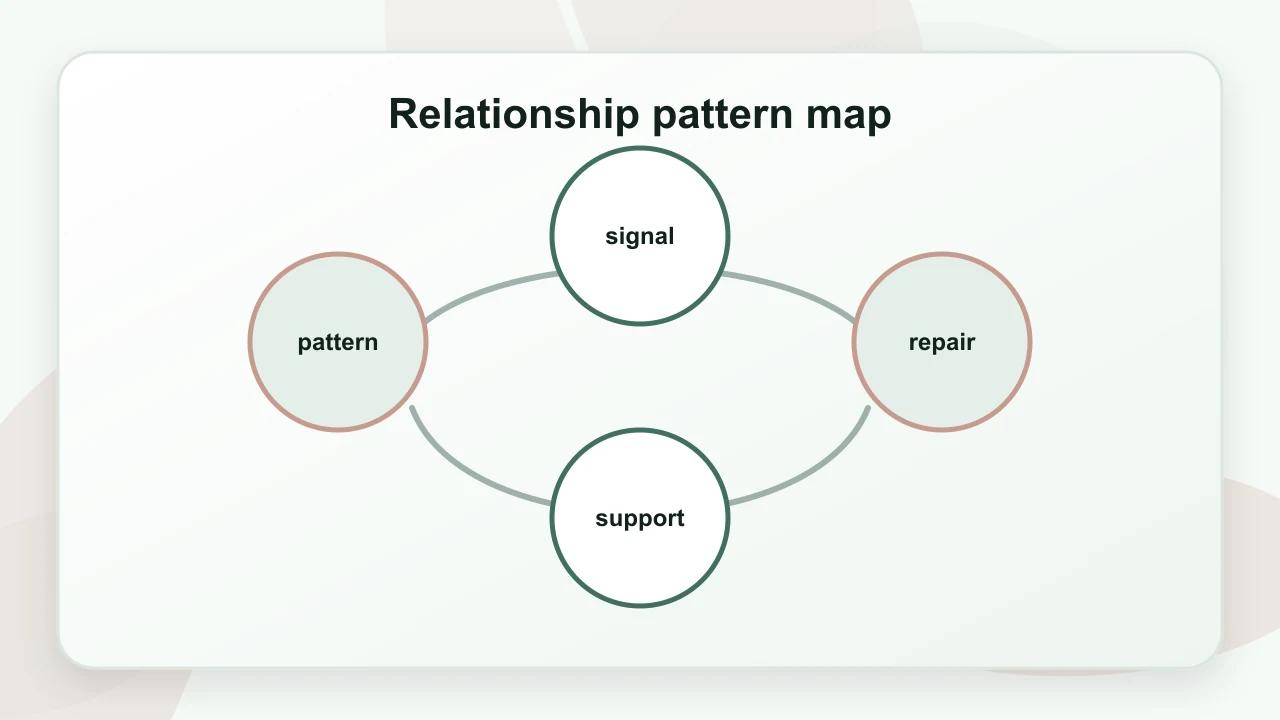
Visual summary
The infographic summarizes the article as pattern, signal, repair, support. It is a reading aid only and does not add new claims beyond the article.
In psychology, attachment is an enduring emotional bond in which another person becomes important as a source of comfort, protection, reassurance, and connection. Attachment is especially activated during stress, separation, illness, fear, or uncertainty.
Attachment theory began with research on infants and caregivers, but later work applied attachment concepts to adult romantic relationships and other close bonds. Attachment is not the same as dependence, attraction, love, or neediness, although these experiences may overlap.
The psychological attachment meaning
Attachment involves more than liking someone. It usually includes several functions:
- seeking closeness;
- turning to the person during distress;
- experiencing the person as a safe haven;
- using the relationship as a secure base for exploration;
- reacting emotionally to separation or loss.
These functions are most clearly studied in caregiver-child relationships but also appear in adult relationships.
Core attachment concepts
Proximity seeking
A person moves toward, contacts, or checks for an attachment figure when threatened or uncertain.
Safe haven
The attachment figure provides comfort or protection during distress.
Secure base
A reliable bond supports exploration, independence, learning, and return.
Separation distress
Distance from an attachment figure may produce concern, protest, or sadness.
Internal working models
People may develop expectations about whether others are available and whether they themselves are worthy of care. These expectations can influence later relationships but are not unchangeable scripts.
Attachment in childhood
Attachment research in childhood examines how children respond to caregivers, separation, reunion, and unfamiliar situations.
Common classifications include:
- secure;
- avoidant;
- resistant or ambivalent;
- disorganized.
These are research classifications, not psychiatric diagnoses. A child should not be labeled from one behavior or a casual observation.
Attachment in adulthood
Adult attachment often focuses on two dimensions:
- attachment anxiety: fear of rejection, abandonment, or insufficient reassurance;
- attachment avoidance: discomfort with closeness, dependence, or emotional disclosure.
Lower anxiety and avoidance generally correspond to greater security. A person may show different patterns across relationships.
What attachment is not
Attachment is not automatically:
- love;
- compatibility;
- healthy dependence;
- proof of trauma;
- proof of good or bad parenting;
- one permanent style;
- a diagnosis;
- an excuse for harmful behavior.
A strong attachment can exist in an unhealthy or unsafe relationship. Bond strength and relationship quality are not the same.
Attachment versus bonding
“Bonding” is often used broadly for emotional connection. Attachment has a more specific psychological meaning related to protection, proximity, distress, and security.
A parent may feel bonded with a baby, while attachment research often examines the child’s organized behavior toward the caregiver.
Attachment versus dependency
Dependency means relying on another person for support, decisions, resources, or functioning. Attachment is the emotional system governing closeness and security.
Secure attachment can support healthy independence rather than prevent it.
Why attachment matters
Attachment may influence:
- how people ask for help;
- how they interpret delayed contact;
- how they handle separation;
- how they respond during conflict;
- their comfort with vulnerability;
- how they balance closeness and autonomy.
It is one factor among many, including temperament, culture, current relationships, trauma, stress, and social conditions.
Common misunderstandings
“Your childhood fixes your attachment forever”
Early relationships may matter, but adult attachment can change through later experiences, reliable relationships, learning, and therapy.
“Every relationship problem is attachment”
Communication, values, abuse, addiction, finances, incompatibility, and current behavior may be more central.
“One quiz reveals your attachment style”
Online tools may encourage reflection but do not provide a complete assessment.
“Secure attachment means never needing reassurance”
Secure people still need care and reassurance. The difference is usually greater flexibility and directness.
A practical reflection
Think of one moment when connection felt uncertain:
- What happened?
- What did you assume it meant?
- Did you pursue, withdraw, freeze, or ask directly?
- Was the other person actually reliable?
- What would a clearer response look like?
- What boundary or request is needed?
When professional support may help
Consider professional support when attachment-related patterns repeatedly create severe distress, panic, destructive conflict, avoidance, self-harm, or difficulty functioning.
Attachment language should not replace specialized safety support when a relationship includes coercion, stalking, threats, or violence.
Practical takeaway
Use the attachment definition in psychology as a framework for understanding how people seek safety and connection under stress. Focus on observable patterns rather than turning a label into identity.
See Avoidant Attachment Psychology Definition, Psychology and Psychiatry, and Attachment Styles.
Sources
- American Psychological Association Dictionary of Psychology — Attachment
- American Psychological Association Dictionary of Psychology — Attachment Theory
- Peer-reviewed adult attachment research
- World Health Organization — Mental health