

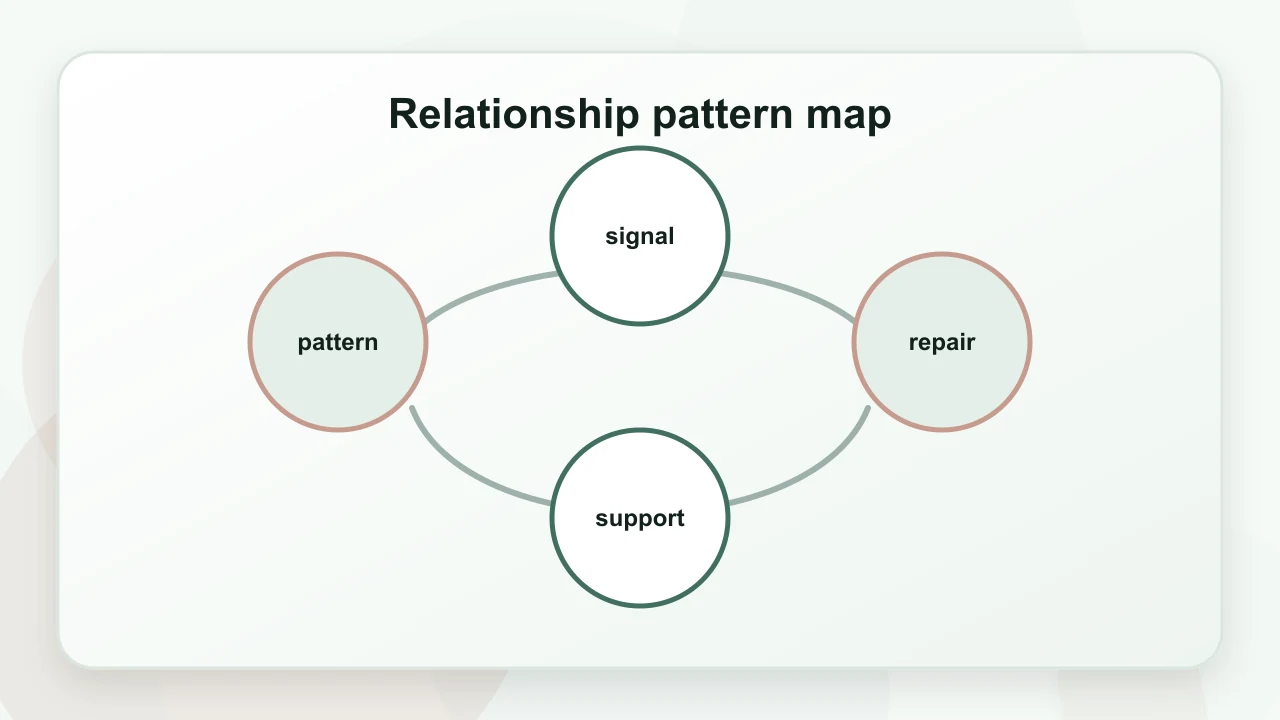
Visual summary
The infographic summarizes the article as pattern, signal, repair, support. It is a reading aid only and does not add new claims beyond the article.
In psychology, avoidant attachment describes a pattern of discomfort with closeness, emotional dependence, vulnerability, or relying on other people. A person with higher attachment avoidance may minimize emotional needs, withdraw during conflict, emphasize self-sufficiency, or become uncomfortable when another person seeks reassurance.
Avoidant attachment is not the same as being introverted, independent, emotionally calm, or uninterested in relationships. It is a broad attachment pattern, not a diagnosis or permanent identity.
Avoidant attachment psychology definition
Attachment avoidance refers to the degree to which a person feels uncomfortable depending on others or allowing others to depend on them.
Possible behaviors include:
- withdrawing during conflict;
- minimizing feelings;
- avoiding requests for support;
- becoming uncomfortable with emotional disclosure;
- viewing needs as weakness;
- prioritizing independence over connection;
- ending conversations when closeness intensifies;
- feeling crowded by ordinary reassurance needs.
One behavior alone does not establish an avoidant pattern.
Avoidant attachment in childhood
In infant research, avoidant attachment describes a pattern in which a child shows relatively little overt proximity-seeking or distress during a structured separation-and-reunion assessment.
This does not mean the child has no attachment or no internal stress. Childhood attachment classification should be made only through appropriate research or clinical methods, not casual observation.
Avoidant attachment in adults
Adult attachment research usually examines avoidance along a continuum. A person may be:
- low in avoidance and comfortable with closeness;
- moderately avoidant in certain relationships;
- highly avoidant across many intimate relationships;
- both avoidant and anxious.
Adult patterns are shaped by early experience, later relationships, temperament, culture, trauma, and the actual behavior of current partners.
Dismissive-avoidant attachment
A dismissive-avoidant pattern is commonly described as:
- high attachment avoidance;
- strong self-reliance;
- low reported need for closeness;
- minimizing emotional dependency;
- discomfort with vulnerability.
The person may appear unaffected while using distance to manage activation.
Fearful-avoidant attachment
Fearful avoidance generally involves both high anxiety and high avoidance. The person may want closeness but also expect rejection, harm, or loss of control.
This may produce alternating pursuit and withdrawal.
Avoidant attachment versus healthy independence
Healthy independence includes the ability to function alone and ask for support when needed.
Avoidant attachment may make support-seeking feel unsafe, weak, or intrusive even in a reliable relationship.
A secure person can say:
“I need some time alone, and I will reconnect this evening.”
An avoidant response may involve disappearing, minimizing the problem, or refusing to return to the conversation.
Avoidant attachment versus lack of interest
Not every emotionally distant person is avoidantly attached. Other explanations include:
- incompatibility;
- low interest;
- stress;
- depression;
- neurodivergence;
- cultural communication style;
- relationship dissatisfaction;
- fear;
- an unsafe partner;
- limited communication skills.
Attachment should not be used to explain away current evidence.
The anxious-avoidant cycle
Avoidance often becomes visible in interaction. One person seeks more reassurance, the other withdraws, and each response intensifies the other.
The cycle may improve when:
- requests become direct and specific;
- pauses include a return time;
- both people reduce character attacks;
- the relationship becomes more predictable;
- boundaries are respected;
- each person takes responsibility for their behavior.
Can avoidant attachment change?
Attachment avoidance can change. Helpful experiences may include:
- reliable, noncoercive relationships;
- gradual emotional disclosure;
- learning to identify bodily and emotional cues;
- practicing direct requests;
- tolerating manageable dependence;
- setting boundaries without disappearing;
- psychotherapy when patterns are persistent.
Change does not require becoming emotionally available to unsafe or disrespectful people.
What attachment language should not do
Avoidant attachment should not be used to:
- excuse ghosting or cruelty;
- diagnose a partner online;
- pressure someone into unwanted intimacy;
- claim childhood explains every behavior;
- deny incompatibility;
- ignore coercion or abuse;
- guarantee that patience will change another person.
A practical exercise
During a moment of withdrawal, ask:
- What am I feeling beneath the urge to leave?
- Is the situation unsafe, overwhelming, or merely uncomfortable?
- Can I state one need directly?
- Can I take a time-limited pause?
- What would respectful reconnection look like?
- Is the relationship itself reliable?
When professional support may help
Therapy may help when avoidance contributes to repeated relationship breakdown, isolation, severe conflict, panic around intimacy, trauma symptoms, or difficulty functioning.
Joint therapy may be inappropriate when there is violence, coercion, or fear of retaliation.
Practical takeaway
Avoidant attachment is best understood as a pattern of managing closeness through distance and self-reliance. Focus less on the label and more on specific behavior: asking for space clearly, returning after pauses, communicating needs, and choosing safe relationships.
See Attachment Definition Psychology, Psychology and Psychiatry, and Attachment Theory Anxious Avoidant.
Sources
- American Psychological Association Dictionary of Psychology — Attachment Style
- Peer-reviewed adult attachment literature
- World Health Organization — Mental health