

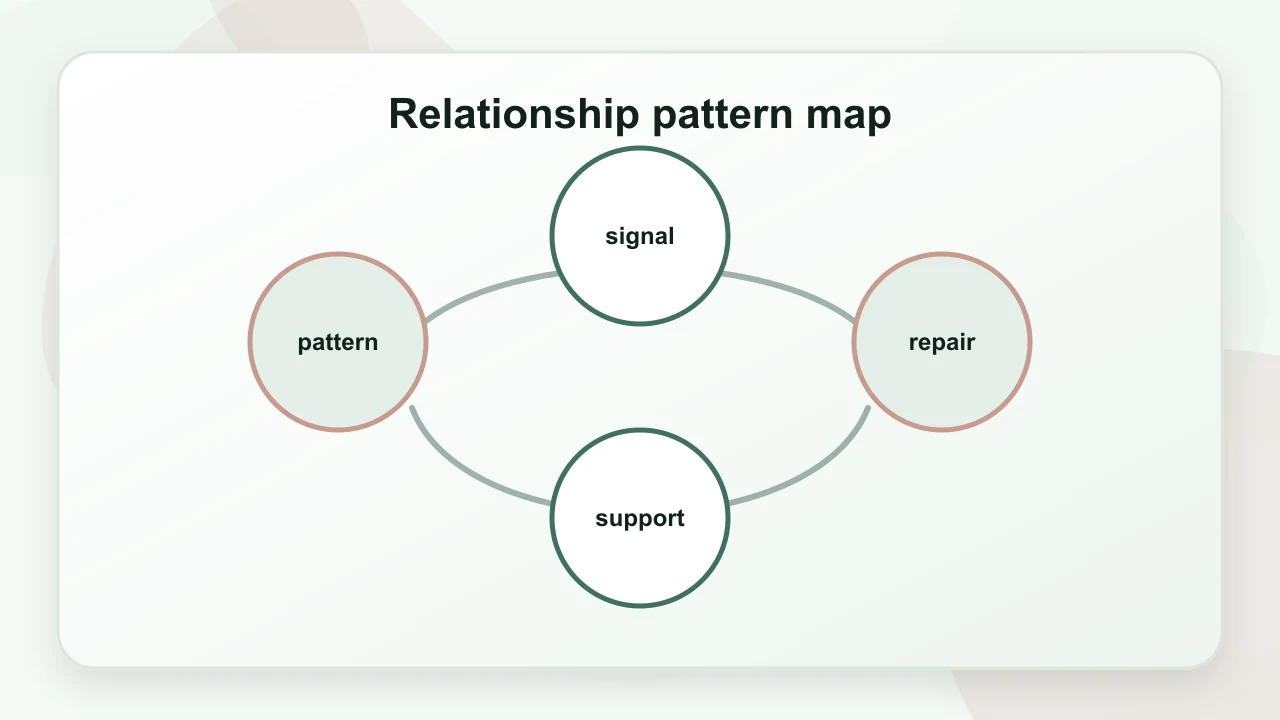
Visual summary
The infographic summarizes the article as pattern, signal, repair, support. It is a reading aid only and does not add new claims beyond the article.
In attachment theory, disorganized attachment describes a pattern in which seeking closeness and protecting oneself from closeness can conflict. In childhood research, a child may show contradictory, confused, or interrupted behavior toward a caregiver during stress or reunion. In adult discussions, the term is often linked with fearful-avoidant patterns, but childhood and adult models are not identical.
Disorganized attachment is not a psychiatric diagnosis, proof of trauma, or permanent identity. It is a framework for understanding behavior under relational stress.
What disorganized attachment means
Attachment behavior is usually organized around maintaining safety and connection. In a disorganized pattern, no consistent strategy appears to resolve distress.
Possible examples include:
- moving toward someone and then abruptly pulling away;
- seeking comfort while appearing frightened;
- freezing during conflict;
- becoming disoriented when closeness intensifies;
- alternating between reassurance-seeking and emotional shutdown.
These behaviors can have many causes and should be interpreted cautiously.
Disorganized attachment in childhood
Mary Main and Judith Solomon later expanded attachment classification work associated with John Bowlby and Mary Ainsworth by describing disorganized or disoriented behavior in the Strange Situation.
This classification is based on structured observation. It should not be assigned casually from one tantrum, one parenting mistake, or a social-media description.
Disorganized attachment in adults
Adult attachment research often uses the dimensions of anxiety and avoidance. A fearful-avoidant pattern is commonly described as high in both.
Possible adult experiences include:
- wanting intimacy but expecting harm;
- difficulty trusting reassurance;
- intense distress during conflict;
- withdrawal after emotional closeness;
- unstable beliefs about self and others;
- difficulty asking for support directly.
Is disorganized attachment caused by trauma?
Trauma, frightening caregiving, loss, instability, or unresolved fear may contribute in some cases, but the relationship is not one-to-one.
Disorganized attachment does not prove that abuse occurred, and trauma does not automatically produce one attachment pattern. Temperament, family stress, current relationships, culture, and later experiences also matter.
Disorganized versus ambivalent attachment
Ambivalent or resistant attachment generally involves intensified proximity-seeking and difficulty settling after reunion.
Disorganized attachment involves a breakdown or conflict in the attachment strategy itself, such as contradictory, frozen, or disoriented behavior.
What this pattern does not mean
It does not mean that someone:
- is dangerous;
- cannot love;
- has a personality disorder;
- will always have unstable relationships;
- definitely experienced abuse;
- should stay in an unsafe relationship;
- can be accurately diagnosed online.
Practical ways to build greater security
Identify the sequence
Notice what happens before pursuit, shutdown, or freezing.
Use time-limited pauses
Say:
“I need 20 minutes, and I will return at 7:30.”
Make one direct request
Replace testing or indirect protest with a specific request.
Evaluate current safety
Attachment language should not distract from actual deception, coercion, violence, or boundary violations.
Build predictable support
Consistency matters more than dramatic reassurance.
Consider therapy
A qualified clinician may help with trauma, emotional regulation, communication, and relationship patterns.
When professional support matters
Seek help when relationship stress causes severe panic, dissociation, self-harm, repeated destructive conflict, or inability to function.
Joint therapy may be unsafe where violence or coercive control is present.
Practical takeaway
Use the concept as a map, not a verdict:
- Notice contradictory approach-and-avoid patterns.
- Identify triggers.
- communicate one need clearly.
- Use structured pauses.
- assess whether the relationship is genuinely safe.
- seek qualified support when patterns remain intense.
See Attachment Theory Attachment Styles, Attachment Theory Fearful Avoidant, and Relationship Problems Counselling.
Sources
- American Psychological Association — Relationships
- American Psychological Association — Parenting
- National Institute of Mental Health — Caring for Your Mental Health
- Peer-reviewed attachment literature on disorganization