
Visual summary
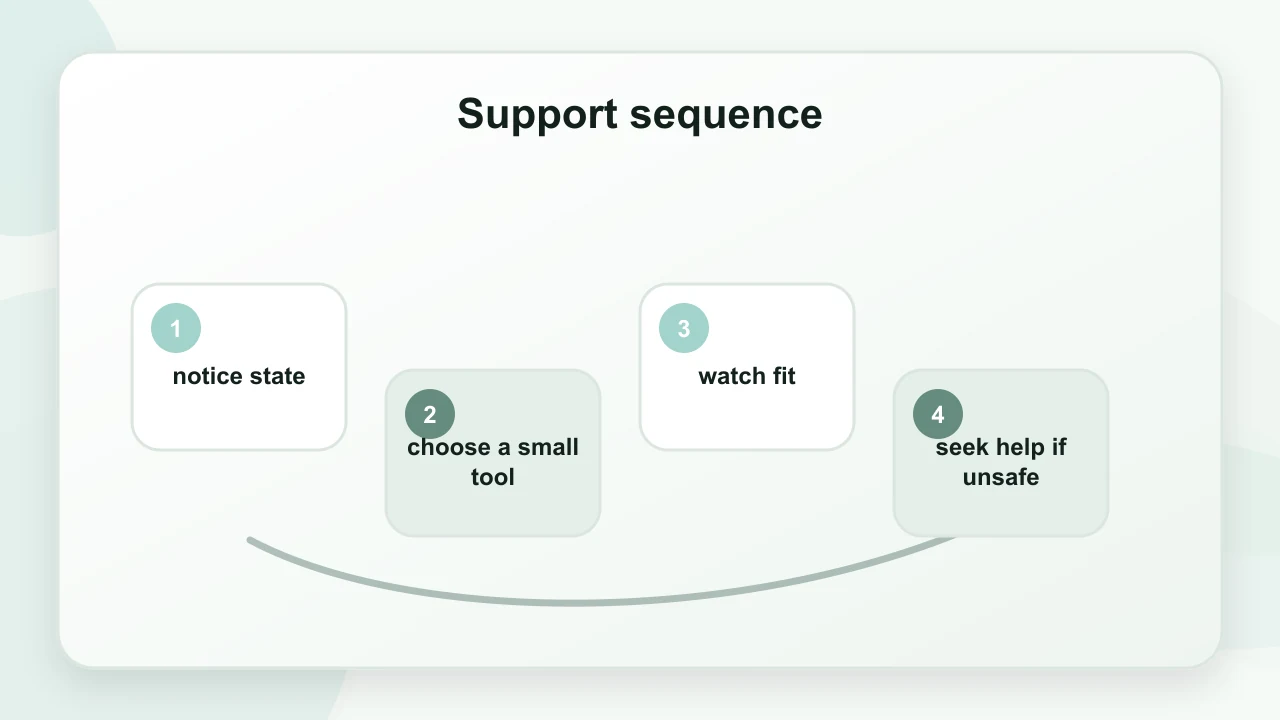
The infographic summarizes the article as notice state, choose a small tool, watch fit, seek help if unsafe. It is a reading aid only and does not add new claims beyond the article.
A breathing exercise for nerves may help reduce rapid breathing, physical tension, and the sense of being overwhelmed. The safest approach is usually gentle rather than dramatic: a moderate inhale, relaxed shoulders, and a slightly slower exhale.
Repeated maximum breaths, fast breathing, or long holds may increase dizziness, tingling, air hunger, or panic. Breathing exercises can support short-term regulation, but they do not treat every cause of anxiety and should not delay medical assessment for new or severe symptoms.
A simple breathing exercise to calm nerves
- Sit or stand with support.
- Relax the jaw and shoulders.
- Look at one stable object.
- Inhale gently through the nose if comfortable.
- Exhale a little more slowly.
- Repeat five times.
- Return to ordinary breathing.
- Choose one practical next action.
Do not try to empty or fill the lungs completely.
Why breathing for nerves may help
A gentle practice may:
- reduce rapid breathing;
- lower muscular effort;
- provide a simple focus;
- interrupt escalating worry;
- support grounding;
- create a repeatable pause before responding.
Effects are usually short-term and vary by person.
Breathing exercise for calmness
A useful calmness exercise should feel:
- easy;
- moderate;
- brief;
- optional;
- physically comfortable;
- easy to stop.
The goal is not perfect calm. A small reduction in intensity may be enough.
Breathing exercise for panic
During panic:
- make breaths smaller, not bigger;
- keep the eyes open;
- use external grounding;
- avoid long holds;
- stop if symptoms worsen;
- seek medical help for unfamiliar or severe symptoms.
Do not use paper-bag breathing. Symptoms may have a medical cause.
Breathing and grounding exercises
Breathing grounding exercises combine breath with sensory orientation:
- Name three things you see.
- Feel both feet.
- Take one gentle inhale.
- Exhale slowly.
- Identify one sound.
- State the next safe action.
Breathing is optional. Use sensory grounding alone if breath focus increases anxiety.
What does not help
Very deep inhalations
Large repeated breaths may contribute to overbreathing.
Long breath holds
They may create air hunger.
Rigid counting
Exact counts can increase performance anxiety.
Practicing until all anxiety disappears
This may turn the exercise into a compulsory safety behavior.
Assuming every symptom is nerves
Breathing and chest symptoms can have medical causes.
When breathing exercises may backfire
Possible reasons include:
- overbreathing;
- panic sensitivity;
- trauma-related body focus;
- asthma or lung disease;
- cardiac symptoms;
- forced posture;
- fear of losing control.
Stop and return to ordinary breathing.
When medical assessment is needed
Seek urgent care for:
- severe or unfamiliar chest pain;
- fainting;
- blue or gray lips;
- severe breathing difficulty;
- new weakness or confusion;
- allergic-reaction symptoms;
- a first unexplained severe episode.
How breathing fits into anxiety care
Breathing may complement:
- psychotherapy;
- exposure-based treatment;
- medication;
- grounding;
- sleep support;
- exercise;
- reduction of caffeine or substance effects;
- treatment of trauma or depression.
It is one tool, not a complete care plan.
When urgent mental-health help is needed
Seek urgent help for suicidal intent, self-harm, psychosis, mania, or inability to remain safe. In the United States, call or text 988.
Practical takeaway
For a breathing exercise for nerves:
- Support the body.
- Relax the shoulders.
- Inhale moderately.
- Exhale slightly more slowly.
- use only a few cycles.
- keep attention partly outside the body.
- stop if symptoms worsen.
- seek professional care when anxiety persists.
See Emotional Regulation, Grounding Techniques, and Grounding Methods.
Sources
- National Institute of Mental Health — Anxiety Disorders
- American Psychological Association — Anxiety
- NCCIH — Relaxation Techniques: What You Need to Know