

Visual summary
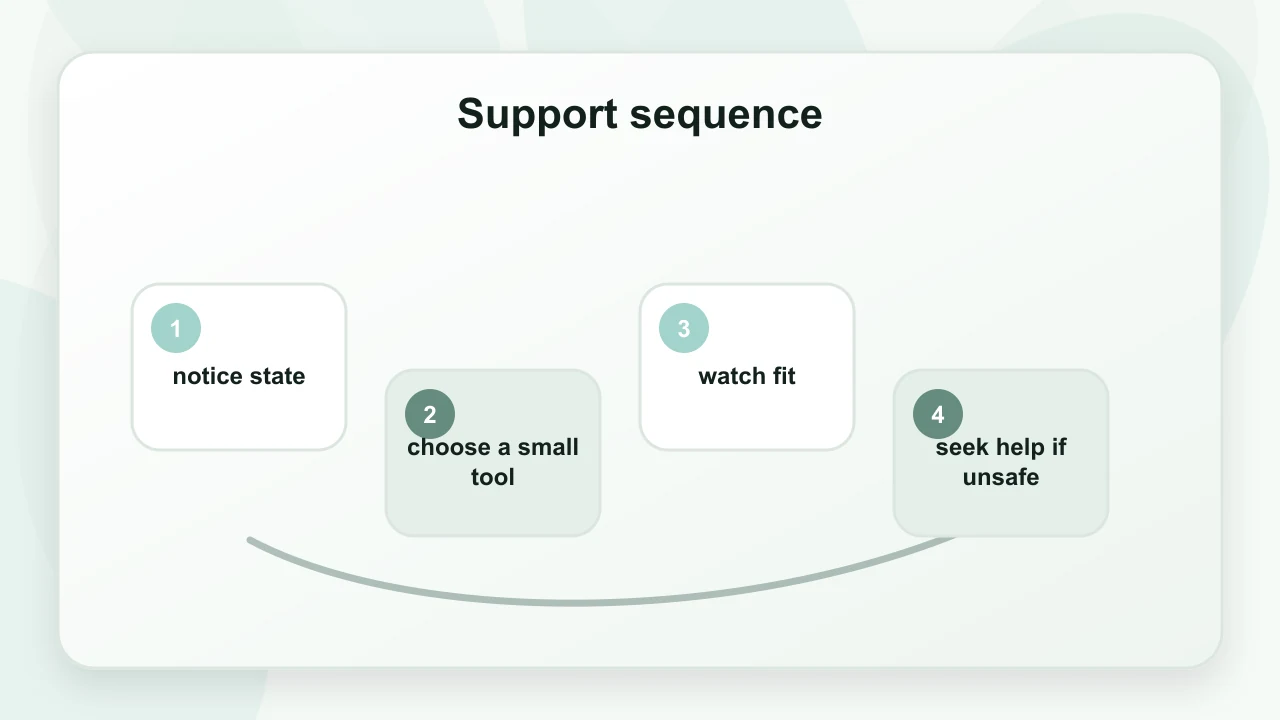
The infographic summarizes the article as notice state, choose a small tool, watch fit, seek help if unsafe. It is a reading aid only and does not add new claims beyond the article.
Anxiety grounding exercises are short practices that redirect attention toward the present environment, physical support, and the next manageable action. They may be useful when worry, panic, intrusive memories, or dissociation make it difficult to stay oriented.
Grounding is not a cure and does not prove that a situation is safe. Its purpose is to increase awareness and choice. Some people prefer sensory exercises; others respond better to movement, factual statements, or brief breathing. The right exercise is one that helps without becoming painful, compulsive, or overwhelming.
1. The 5-4-3-2-1 grounding exercise
Name:
- five things you can see;
- four things you can feel;
- three things you can hear;
- two things you can smell;
- one thing you can taste.
This 54321 grounding exercise can be shortened. Naming three things you see and two sounds may be enough.
2. Feet-on-floor grounding
Sit or stand safely.
- Feel both feet making contact.
- Press gently for three seconds.
- Release.
- Notice the chair, floor, or shoes.
- Name one next action.
This can be less demanding than scanning all five senses.
3. Object-description exercise
Choose a neutral object and describe:
- color;
- shape;
- texture;
- material;
- size;
- practical function.
Detailed description shifts attention toward external information.
4. Movement grounding
Try:
- slow walking;
- shoulder rolls;
- pushing the palms together;
- carrying a light object;
- stretching within a comfortable range;
- a simple household task.
Somatic grounding exercises should remain gentle and should not involve pain, extreme cold, or forced shaking.
5. Factual orientation
State:
- your name;
- current date;
- location;
- what happened immediately before the anxiety;
- what you know;
- what you are assuming;
- the next safe step.
This may help when thoughts feel detached from current reality.
Grounding exercises for dissociation
Dissociation may involve feeling unreal, disconnected, numb, or distant from the environment. External exercises are often easier than intense body scanning.
Try:
- keeping the eyes open;
- naming signs, furniture, or colors;
- touching a familiar textured object;
- moving slowly;
- speaking with a trusted person;
- using a written orientation card.
Avoid sudden pain, ice burns, or overwhelming sensory stimulation.
Anxiety-attack grounding
During an anxiety attack:
- Move to a physically safe location.
- Keep the eyes open.
- Identify three stable objects.
- Feel the floor or chair.
- Use one gentle exhale if helpful.
- Avoid repeated large breaths.
- Seek medical help for severe or unfamiliar symptoms.
Grounding should not delay urgent care for chest pain, fainting, severe breathlessness, or neurological symptoms.
Breathing exercises for grounding
Breathing can be paired with external focus:
- Look at one object.
- Inhale gently.
- Exhale slightly more slowly.
- Feel both feet.
- Name one sound.
Skip breathing exercises when breath focus increases panic or air hunger.
What does not help
Grounding may become unhelpful when it:
- becomes a required ritual;
- is used to avoid every anxious situation;
- involves pain or extreme temperature;
- creates pressure to calm down;
- intensifies body monitoring;
- replaces professional treatment;
- is performed while the environment is genuinely unsafe.
How to choose an exercise
Use:
- sensory grounding for racing thoughts;
- movement for agitation;
- factual orientation for confusion or dissociation;
- breathing only when it feels comfortable;
- social grounding when isolation increases symptoms.
Start with one method, not a long checklist.
When professional care matters
Seek qualified help when anxiety, panic, dissociation, trauma symptoms, avoidance, sleep disruption, self-harm, or suicidal thoughts interfere with functioning.
In the United States, call or text 988 for crisis support. Use emergency services for immediate danger.
Practical takeaway
Choose one anxiety grounding exercise you can remember:
- Notice three visible objects.
- Feel both feet.
- State one known fact.
- Take one safe next action.
See Grounding Methods for Anxiety, Grounding Strategies for Anxiety, and Deep Breathing for Anxiety Attack.
Sources
- National Institute of Mental Health — Anxiety Disorders
- American Psychological Association — Anxiety
- NCCIH — Relaxation Techniques: What You Need to Know