

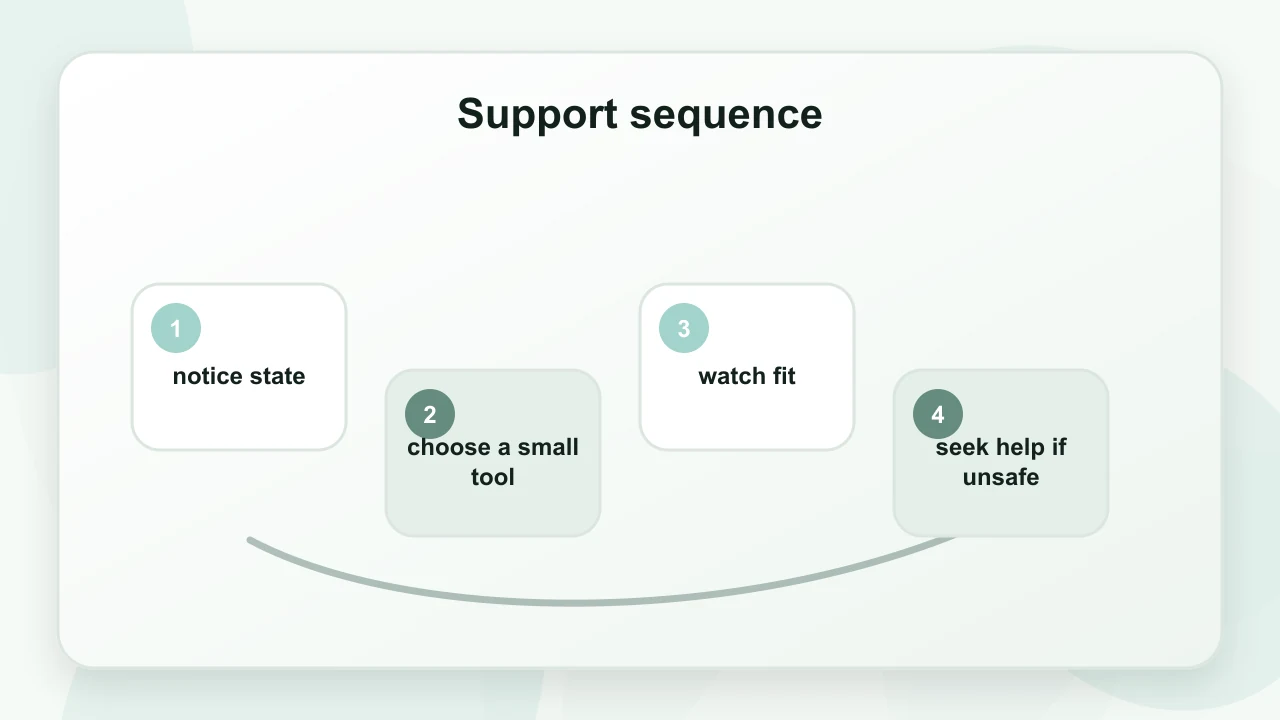
Visual summary
The infographic summarizes the article as notice state, choose a small tool, watch fit, seek help if unsafe. It is a reading aid only and does not add new claims beyond the article.
Grounding methods for anxiety are short practices designed to reconnect attention with the present environment, physical support, and immediate choices. They may help when anxiety pulls attention toward catastrophic thoughts, intrusive memories, or intense bodily sensations.
Grounding does not erase anxiety or prove that danger is absent. Its purpose is to increase orientation and choice. Some people respond better to external sensory methods than to breathing or body-focused techniques.
What grounding in anxiety means
Grounding means orienting to what is happening now rather than becoming fully absorbed in feared possibilities, memories, or internal sensations.
Useful grounding can involve:
- vision;
- sound;
- touch;
- movement;
- factual statements;
- practical action;
- breathing;
- social contact.
Sensory grounding methods
5-4-3-2-1
Name:
- five things you see;
- four things you feel;
- three things you hear;
- two things you smell;
- one thing you taste.
Modify the count when the full sequence feels too demanding.
Object description
Choose one object and describe its shape, color, texture, and function.
Temperature
Hold a cool or warm object that is safe for the skin. Avoid extreme temperatures.
Sound orientation
Identify one near sound and one distant sound.
Physical grounding methods
- press both feet into the floor;
- sit against a supportive chair;
- stretch gently;
- walk slowly;
- hold a textured object;
- push the palms together;
- carry out a simple household task.
Movement may be more effective than stillness when anxiety is highly activated.
Cognitive grounding methods
State:
- your name;
- current date;
- location;
- what happened immediately before the anxiety;
- what is known;
- what is assumed;
- the next safe action.
This can reduce mental drift without arguing with every thought.
Breathing methods for anxiety as grounding
Breathing can be combined with external orientation:
- Look at one object.
- Inhale gently.
- Exhale slightly more slowly.
- Feel the chair or floor.
- Name one sound.
Breathing is optional. Skip it when breath focus worsens panic.
The grounding method: is there one official technique?
No. “The grounding method” may refer to 5-4-3-2-1, physical grounding, trauma-oriented grounding, or another short technique.
The best method is the one that:
- increases orientation;
- remains safe;
- is easy to stop;
- does not become a ritual;
- fits the person’s symptoms and environment.
What grounding does not do
Grounding does not:
- guarantee calm;
- treat the cause of an anxiety disorder;
- prove that a feared event cannot happen;
- make an unsafe environment safe;
- replace exposure therapy;
- replace medication or psychotherapy;
- permanently reset the nervous system.
When grounding may backfire
Grounding can increase distress when:
- sensory scanning becomes compulsive;
- body focus triggers panic;
- touch or temperature activates trauma memories;
- the exercise is too complicated;
- the person feels pressured to calm down;
- the method is used to avoid every feared situation.
Simplify or stop the method when this happens.
Grounding tips for anxiety
- Start with one sense, not five.
- Keep the eyes open.
- Use neutral rather than pleasant sensations.
- Pair grounding with one practical action.
- Avoid extreme cold, pain, or breath holding.
- Practice when calm enough to learn.
- Do not grade yourself on success.
- Seek treatment when anxiety remains persistent or disabling.
Grounding versus avoidance
Grounding may help a person remain in a safe situation long enough to learn that anxiety can rise and fall. If it is used to escape every sensation or situation, it may reinforce avoidance.
The goal is flexibility, not complete control.
When professional care matters
Seek qualified support when anxiety causes major avoidance, repeated panic, sleep disruption, work or relationship impairment, trauma symptoms, substance use, self-harm, or suicidal thoughts.
In the United States, call or text 988 for crisis support.
Practical takeaway
Choose one grounding method from each category:
- Sensory: name three visible objects.
- Physical: feel both feet.
- Cognitive: state one known fact.
- Action: complete one safe next step.
See Deep Breathing for Anxiety Attack, Anxiety Grounding Exercises, and Deep Breathing Techniques for Anxiety.
Sources
- National Institute of Mental Health — Anxiety Disorders
- American Psychological Association — Anxiety
- NCCIH — Relaxation Techniques: What You Need to Know