
Visual summary
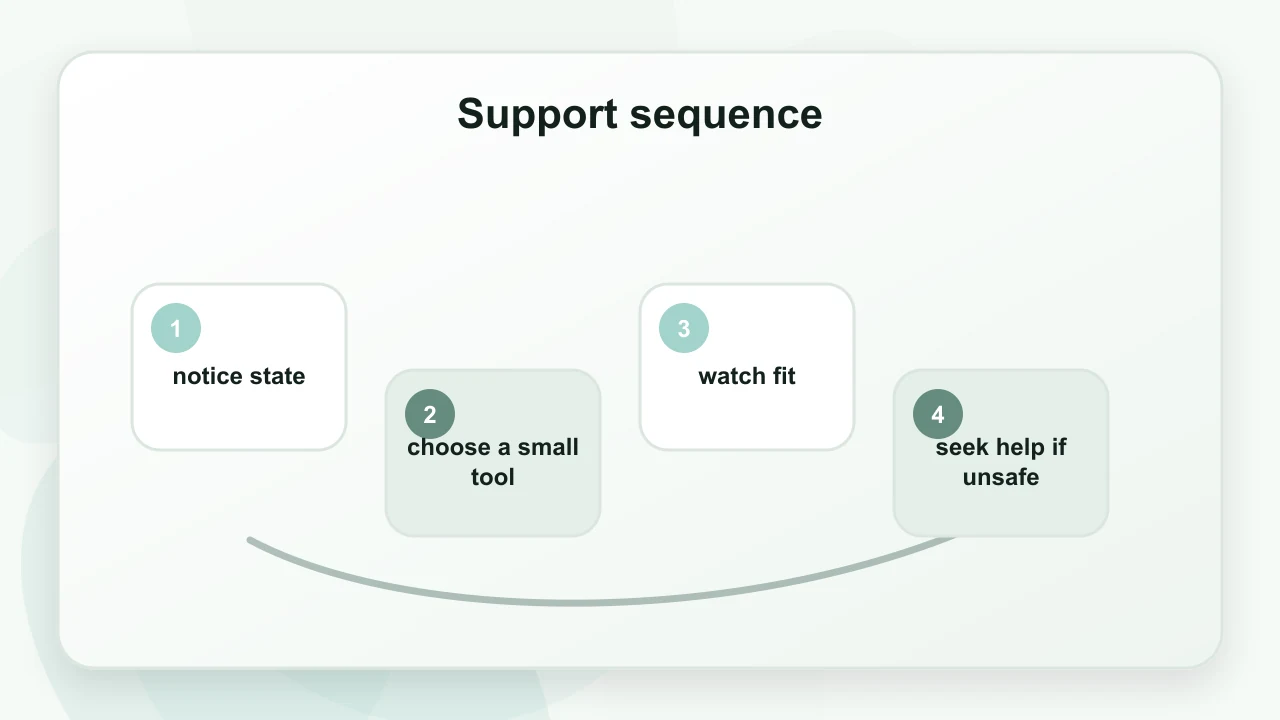
The infographic summarizes the article as notice state, choose a small tool, watch fit, seek help if unsafe. It is a reading aid only and does not add new claims beyond the article.
During an anxiety or panic attack, breathing may become fast, heavy, irregular, or intensely monitored. Deep breathing can help some people, but very large repeated breaths may make dizziness, tingling, chest tightness, and feelings of unreality worse.
The safest approach is not to “fill the lungs completely.” Use a small, gentle inhale, a comfortable slower exhale, and external grounding. If symptoms are severe, new, or medically uncertain, seek urgent assessment.
What happens to breathing during an anxiety attack?
Possible changes include:
- rapid breathing;
- heavy breathing;
- repeated sighing;
- breath-holding;
- chest tightness;
- air hunger;
- dizziness or tingling;
- fear that breathing will stop.
Some of these sensations may result from overbreathing, but similar symptoms can also occur in medical emergencies.
A short breathing sequence during an attack
- Sit or stand somewhere physically safe.
- Keep the eyes open.
- Drop the shoulders.
- Take a moderate—not huge—inhale.
- Exhale slightly more slowly.
- Repeat three to five times.
- Name three visible objects.
- Return to ordinary breathing.
Do not continue indefinitely.
What helps during heavy breathing anxiety attacks
External orientation
Look at the room, name the date or location, and feel physical support.
Smaller breaths
If you are already breathing heavily, larger breaths may worsen symptoms.
Slower exhale
A gentle exhale may reduce respiratory urgency.
Simple language
Use one sentence:
“This is intense, and I can take one safe step at a time.”
Reduce stimulation
Move away from crowds, heat, or noise when safe.
What does not help
Breathing into a paper bag
This can be unsafe because symptoms may have a medical cause. It is not recommended as a general response.
Repeated maximum inhalations
These may increase overbreathing.
Long holds
They can create air hunger.
Arguing with yourself
Trying to prove that every sensation is harmless can increase monitoring.
Assuming it is definitely anxiety
A first severe episode or unusual symptoms need medical evaluation.
Why deep breathing makes anxiety worse sometimes
Possible reasons include:
- overbreathing;
- fear of bodily sensations;
- forced technique;
- breath holds;
- trauma-related body focus;
- asthma, cardiac, or respiratory illness;
- a ritualized belief that the breathing must work.
Stop the technique rather than pushing harder.
Anxiety attack or medical emergency?
Seek urgent medical care for:
- crushing or unfamiliar chest pain;
- fainting;
- blue or gray lips;
- severe breathing difficulty;
- new weakness or confusion;
- symptoms after an allergic reaction;
- significant heart or lung disease;
- a first unexplained severe episode.
It is appropriate to seek medical help even if the symptoms later prove to be panic.
After the attack
Once symptoms settle:
- drink water if appropriate;
- avoid driving until steady;
- note possible triggers;
- review caffeine, substances, sleep, and medication;
- schedule professional assessment if attacks recur;
- avoid reorganizing your entire life around preventing another attack.
Treatment for repeated attacks
Repeated panic attacks may be treated with psychotherapy, particularly CBT and exposure-based approaches, medication, and evaluation for medical or substance-related contributors.
Breathing techniques may be included, but they are not the entire treatment.
When crisis support is needed
Seek urgent mental-health help if the attack includes suicidal intent, self-harm, psychosis, mania, or inability to remain safe. In the United States, call or text 988.
Practical takeaway
For deep breathing during an anxiety attack:
- Make the breath smaller, not bigger.
- Slow the exhale slightly.
- Keep the eyes open.
- Ground in the environment.
- Stop if symptoms intensify.
- Seek medical care when symptoms are new, severe, or uncertain.
- Get professional treatment when attacks recur.
See Deep Breathing Techniques for Anxiety, Grounding Methods for Anxiety, and Deep Breathing Exercises for Anxiety.
Sources
- National Institute of Mental Health — Anxiety Disorders
- National Institute of Mental Health — Panic Disorder information
- American Psychological Association — Anxiety
- NCCIH — Relaxation Techniques: What You Need to Know