

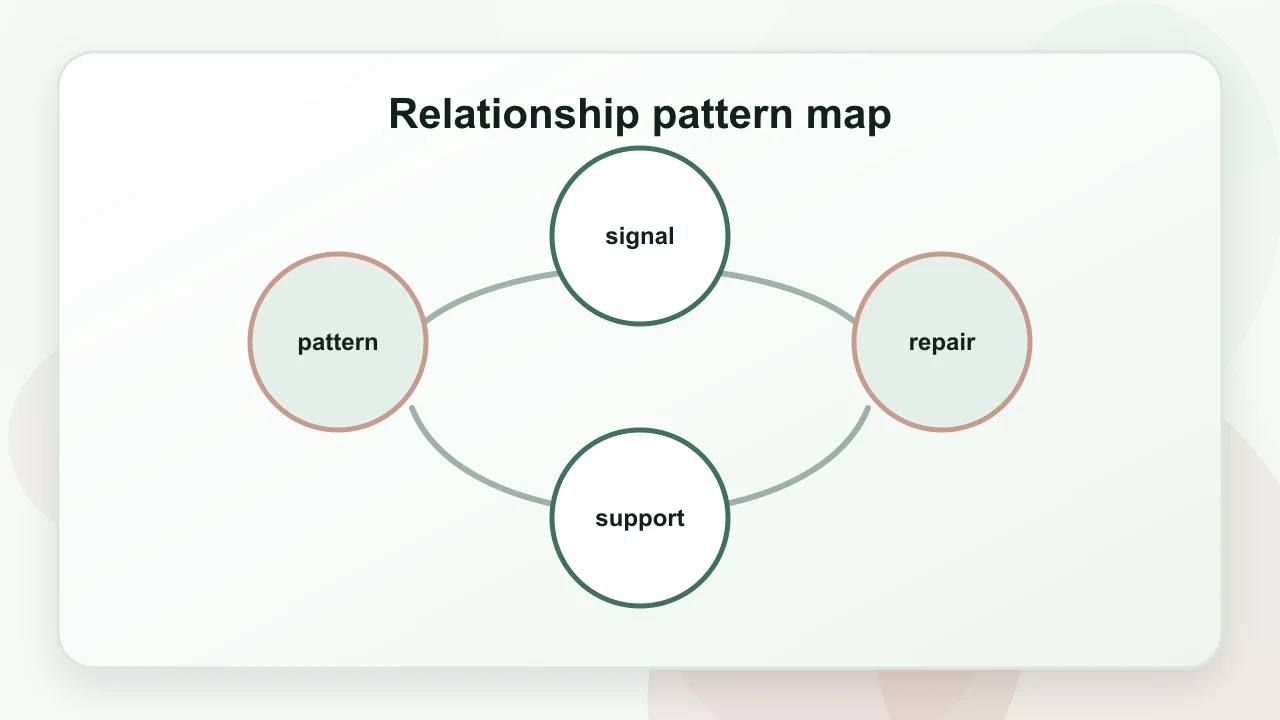
Visual summary
The infographic summarizes the article as pattern, signal, repair, support. It is a reading aid only and does not add new claims beyond the article.
In attachment theory, anxious and avoidant patterns describe different ways people may respond when closeness feels uncertain. An anxious pattern often intensifies contact and reassurance-seeking. An avoidant pattern often reduces contact, minimizes needs, or creates distance.
When these responses occur together, they can form a self-reinforcing cycle: one person pursues connection, the other withdraws, and each response confirms the other person’s fear.
Anxious attachment theory
Attachment anxiety may involve:
- fear of abandonment;
- close monitoring of communication;
- strong distress during uncertainty;
- repeated reassurance-seeking;
- interpreting distance as rejection;
- difficulty calming after conflict.
This does not mean every concern is irrational. Inconsistent or deceptive behavior can create understandable anxiety.
Attachment theory avoidant patterns
Attachment avoidance may involve:
- discomfort with dependence;
- minimizing emotional needs;
- withdrawing during conflict;
- reluctance to ask for support;
- feeling crowded by ordinary closeness;
- prioritizing self-sufficiency.
Avoidance may look calm externally while still reflecting stress or fear internally.
Dismissive and fearful avoidance
A dismissive-avoidant pattern is commonly associated with high avoidance and lower reported anxiety. A person may strongly value independence and downplay closeness.
A fearful-avoidant pattern is commonly associated with both high anxiety and high avoidance. A person may want closeness but fear being hurt, controlled, or rejected.
These labels are broad descriptions, not clinical diagnoses.
The anxious-avoidant cycle
A common sequence is:
- A delayed response or conflict creates uncertainty.
- The anxious partner increases contact or demands immediate discussion.
- The avoidant partner feels pressured and withdraws.
- Withdrawal confirms the anxious partner’s fear.
- Increased pursuit confirms the avoidant partner’s fear of being controlled.
- Both people become more rigid.
The cycle can occur regardless of gender and is shaped by current behavior, not only childhood.
What helps interrupt the cycle
Replace protest with a direct request
Instead of repeated messages or accusations:
“I feel uncertain when communication stops. Please tell me when you need space and when we will reconnect.”
Replace disappearance with a structured pause
Instead of leaving indefinitely:
“I need 30 minutes to settle down. I will return at 7:30 so we can continue.”
Evaluate actual reliability
Attachment language should not be used to tolerate lying, contempt, coercion, or repeated broken agreements. Security requires dependable behavior.
Build tolerance gradually
The anxious person may practice waiting without repeated checking. The avoidant person may practice staying present for a short, manageable conversation.
Maintain autonomy and connection
Healthy security includes both closeness and independent identity.
Attachment theory anxious ambivalent
The phrase anxious-ambivalent is often used in discussions of childhood attachment and sometimes loosely applied to adults. Adult research more often measures attachment anxiety and avoidance as dimensions.
Using precise terms helps prevent confusion between infant classifications, adult romantic attachment, and popular online labels.
What attachment labels cannot tell you
They cannot determine:
- whether a relationship is healthy;
- whether someone will cheat;
- whether a person has a mental disorder;
- who is responsible for harmful behavior;
- whether reconciliation is appropriate;
- whether childhood caused the current problem.
When therapy may help
Individual or couples therapy may help when the cycle is repetitive, distressing, or damaging. Therapy may focus on emotional regulation, communication, trauma, boundaries, and creating consistent experiences of responsiveness.
Joint therapy may be unsafe in relationships involving coercive control, violence, or fear of retaliation.
Practical takeaway
Do not ask only, “Which attachment style am I?” Ask:
- What happens when closeness feels uncertain?
- Do I pursue, withdraw, or alternate?
- Is the current relationship actually reliable?
- What concrete behavior would create more clarity?
- What boundary is needed if the pattern does not change?
See Security Attachment Style, Relationship Problems Therapy, and Attachment Styles.
Sources
- APA Dictionary of Psychology — Attachment Theory
- Fraley — Adult Attachment: Recent Developments and Future Directions
- Mikulincer and Shaver — Adult Attachment, Stress, and Romantic Relationships
- NIMH — Caring for Your Mental Health