

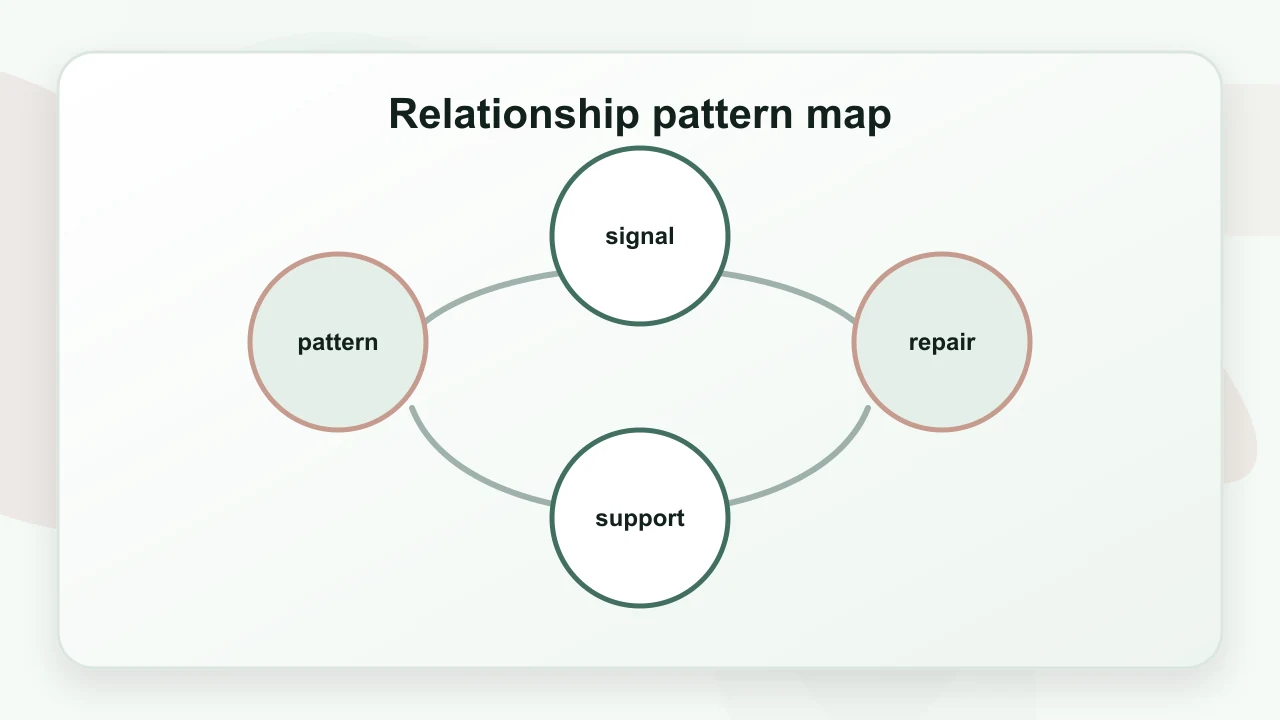
Visual summary
The infographic summarizes the article as pattern, signal, repair, support. It is a reading aid only and does not add new claims beyond the article.
Relationship problems therapy is professional support focused on recurring difficulties between partners or other close family members. It may help people understand conflict patterns, communicate more clearly, rebuild trust, make decisions, and address the effects of stress, betrayal, parenting demands, illness, or mental-health symptoms on a relationship.
It is not a guaranteed way to preserve every relationship. Good therapy may lead to repair, clearer boundaries, a decision to separate, or recognition that a situation is unsafe.
What relationship problems therapy includes
Depending on the goal, therapy may address:
- repeated arguments;
- emotional distance;
- trust after betrayal;
- jealousy or reassurance cycles;
- sexual or affectionate disconnection;
- parenting disagreements;
- money and household responsibilities;
- extended-family pressure;
- major life transitions;
- mental-health or substance-use effects;
- uncertainty about staying together.
A competent therapist should define the problem in observable terms rather than reducing everything to one personality label.
Common therapy formats
Couples therapy
Both partners attend and work on the interaction between them. The therapist is not a judge deciding who is right.
Family therapy
Several family members may participate when the problem involves parenting, caregiving, intergenerational conflict, or a broader family system.
Individual therapy
One person can work on boundaries, communication, trauma, decision-making, or emotional regulation even when the other person will not attend.
Discernment-focused support
When one person is uncertain about the relationship, short-term work may focus on clarity rather than immediate repair.
What happens in relationship therapy?
Early sessions usually clarify:
- What each person believes the main problem is.
- Whether both people can participate safely and honestly.
- What patterns keep repeating.
- What outcome each person wants.
- How progress will be evaluated.
The therapist may observe a cycle such as criticism and withdrawal, pursuit and distance, secrecy and checking, or avoidance followed by explosive conflict.
Approaches that may be used
Relationship therapists may draw from:
- emotionally focused couples therapy;
- behavioral and cognitive-behavioral couples therapy;
- integrative behavioral couple therapy;
- systemic family therapy;
- attachment-informed work;
- communication and problem-solving training;
- trauma-informed individual treatment.
The label matters less than the therapist’s training, transparency, and ability to match the approach to the problem.
Signs therapy may be helping
Progress may include:
- less escalation;
- clearer requests;
- more accurate listening;
- reduced contempt or intimidation;
- greater accountability;
- specific agreements that are followed;
- improved ability to pause and return to a discussion;
- clearer decisions, even when reconciliation is not the outcome.
Feeling uncomfortable in therapy is not automatically evidence of harm, but persistent humiliation, fear, confusion, or deterioration should be discussed and reviewed.
What relationship therapy cannot do
Therapy cannot:
- force honesty;
- make one person change;
- guarantee trust will return;
- erase incompatible values;
- make abuse safe through better communication;
- substitute for legal or medical help;
- guarantee that a relationship should continue.
When joint therapy may be unsafe
Standard couples work may be inappropriate when there is:
- physical or sexual violence;
- stalking;
- coercive control;
- threats;
- financial restriction;
- fear of retaliation;
- pressure to reveal information that could increase danger.
Specialized domestic-violence resources and individual safety planning may be more appropriate.
How to choose a therapist
Ask:
- Are you licensed in this jurisdiction?
- What training do you have in couples or family therapy?
- How do you assess for abuse and coercion?
- What model do you use?
- How do you handle secrets in couples therapy?
- How will we know whether therapy is helping?
- What happens if one person wants to stop?
A good answer should be specific and understandable.
A practical first step
Before the first appointment, each person can write:
- the main repeating problem;
- what happens immediately before it;
- their own typical response;
- what they would like to do differently;
- one safety or boundary concern;
- one realistic sign of progress.
When urgent help is needed
Seek urgent support for immediate violence, suicidal intent, psychosis, mania, severe intoxication, dangerous withdrawal, or inability to remain safe. In the United States, call or text 988 for a mental-health crisis and contact emergency services for immediate danger.
Practical takeaway
Relationship problems therapy is most useful when it turns vague distress into specific patterns, responsibilities, and choices. Look for trained support, clear goals, measurable progress, and strong safety boundaries.
See Marriage Counseling Alternatives, Attachment Theory Anxious Avoidant, and Therapy for Trust Issues.
Sources
- American Psychological Association — Relationships
- National Institute of Mental Health — Psychotherapies
- American Association for Marriage and Family Therapy — Consumer resources
- National Institute of Mental Health — Caring for Your Mental Health