
Visual summary
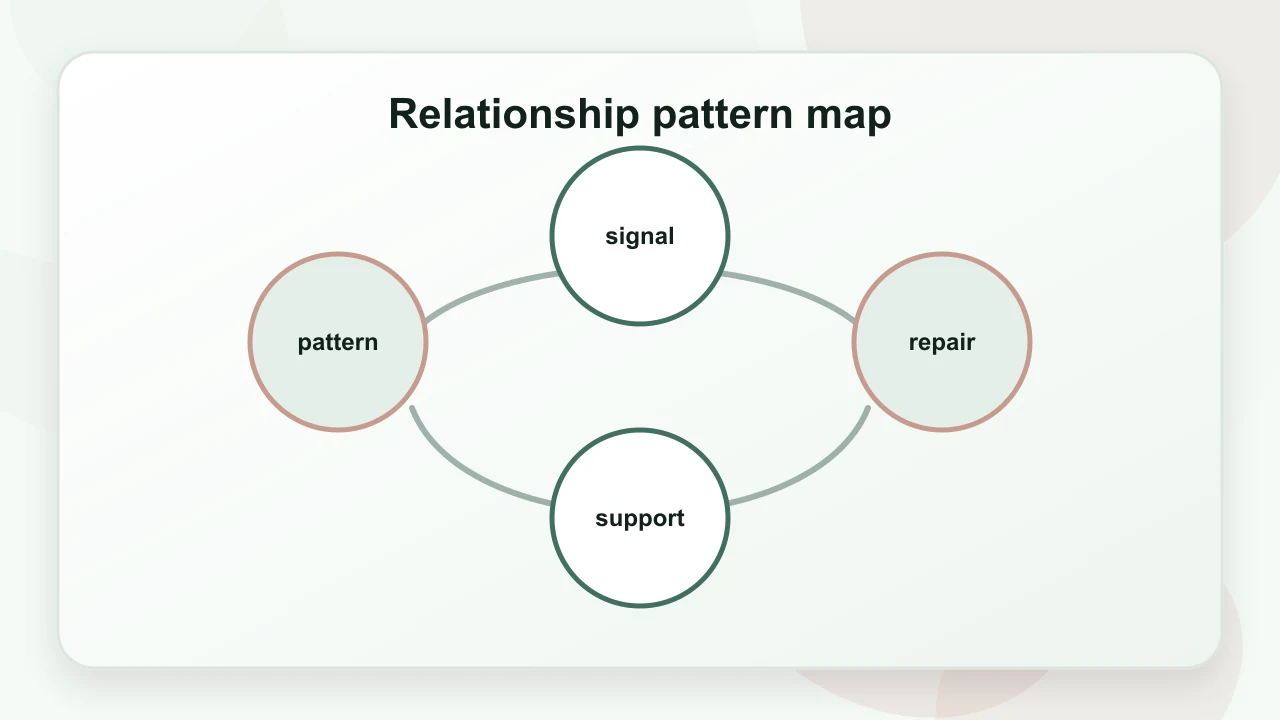
The infographic summarizes the article as pattern, signal, repair, support. It is a reading aid only and does not add new claims beyond the article.
A security attachment style—more commonly called a secure attachment style—describes relative comfort with closeness, trust, dependence, and autonomy in important relationships. Securely attached people can still feel jealous, angry, hurt, or afraid. The difference is usually greater flexibility in how they respond.
Security is not perfection. It is the capacity to seek support, communicate directly, tolerate ordinary distance, maintain boundaries, and repair conflict without treating every difficulty as proof that the relationship is ending.
Signs of secure attachment
Possible signs include:
- asking for support directly;
- tolerating reasonable periods of separation;
- maintaining friendships and interests outside the relationship;
- expressing needs without threats or tests;
- listening without immediately becoming defensive;
- apologizing and repairing;
- recognizing both strengths and limits in a partner;
- leaving relationships that remain unsafe or chronically unreliable.
A person may show security in one relationship and more anxiety or avoidance in another.
Secure attachment versus anxious attachment
Anxious attachment tends to involve heightened sensitivity to rejection and strong reassurance-seeking. Secure attachment is more likely to involve a direct request and the ability to consider several explanations for uncertainty.
Example:
- Anxious response: “You did not reply, so you must be losing interest.”
- Secure response: “I noticed the delay and felt concerned. Is everything okay?”
Secure attachment versus dismissive attachment style
A dismissive attachment style often emphasizes self-sufficiency and minimizes emotional dependence. Secure attachment allows independence without treating needs or closeness as weakness.
Security means being able to say both:
- “I can handle some things myself.”
- “I need support with this.”
Secure attachment versus ambivalent patterns
An ambivalent or anxious pattern may alternate between seeking closeness and expressing anger when reassurance feels insufficient. Secure behavior is more likely to name the underlying concern directly and evaluate the other person’s actual response.
How secure attachment develops
Early caregiving may contribute, but security can also develop later through:
- consistent and responsive relationships;
- trustworthy friendships;
- effective therapy;
- improved emotional regulation;
- better boundaries;
- choosing reliable partners;
- learning to tolerate ordinary uncertainty;
- repeated repair after conflict.
This is sometimes called “earned security,” though the term is used differently across attachment research and clinical practice.
Practical ways to build greater security
Use direct communication
State the observation, feeling, and request:
“When plans change without notice, I feel uncertain. Please message me as soon as you know.”
Separate feelings from conclusions
“I feel rejected” does not automatically mean “I have been rejected.”
Observe consistency over time
Trust should be based on repeated behavior rather than promises, chemistry, or attachment labels.
Practice reliable boundaries
A secure boundary is clear and enforceable:
“I will continue this conversation when we can speak without insults.”
Allow a structured pause
Healthy relationships can include temporary space when there is a clear plan to reconnect.
Maintain independent functioning
Friendships, interests, work, rest, and personal decisions support security rather than threatening it.
Unhealthy uses of attachment language
Be cautious when people use attachment labels to:
- diagnose a partner;
- excuse emotional unavailability;
- pressure someone to tolerate mistreatment;
- claim that jealousy proves love;
- present security as never needing reassurance;
- market one guaranteed “healing” method.
Does secure attachment mean staying in a relationship?
No. A secure response can include leaving when trust is repeatedly broken, values are incompatible, or the relationship is unsafe. Security includes self-protection as well as connection.
When professional help may be useful
Therapy may help when anxiety, avoidance, trauma, or repetitive conflict interferes with close relationships. Look for a clinician who uses attachment concepts flexibly and does not treat a label as destiny.
Practical takeaway
A secure attachment style is best understood through behavior:
- ask directly;
- listen accurately;
- maintain boundaries;
- observe consistency;
- tolerate ordinary uncertainty;
- repair when possible;
- leave when safety or dignity cannot be protected.
See Attachment Theory Anxious Avoidant, Relationship Problems Therapy, and Attachment Theory.
Sources
- APA Dictionary of Psychology — Attachment Style
- Fraley — Attachment in Adulthood
- Chopik et al. — Development of Adult Attachment Styles
- NIMH — Caring for Your Mental Health