

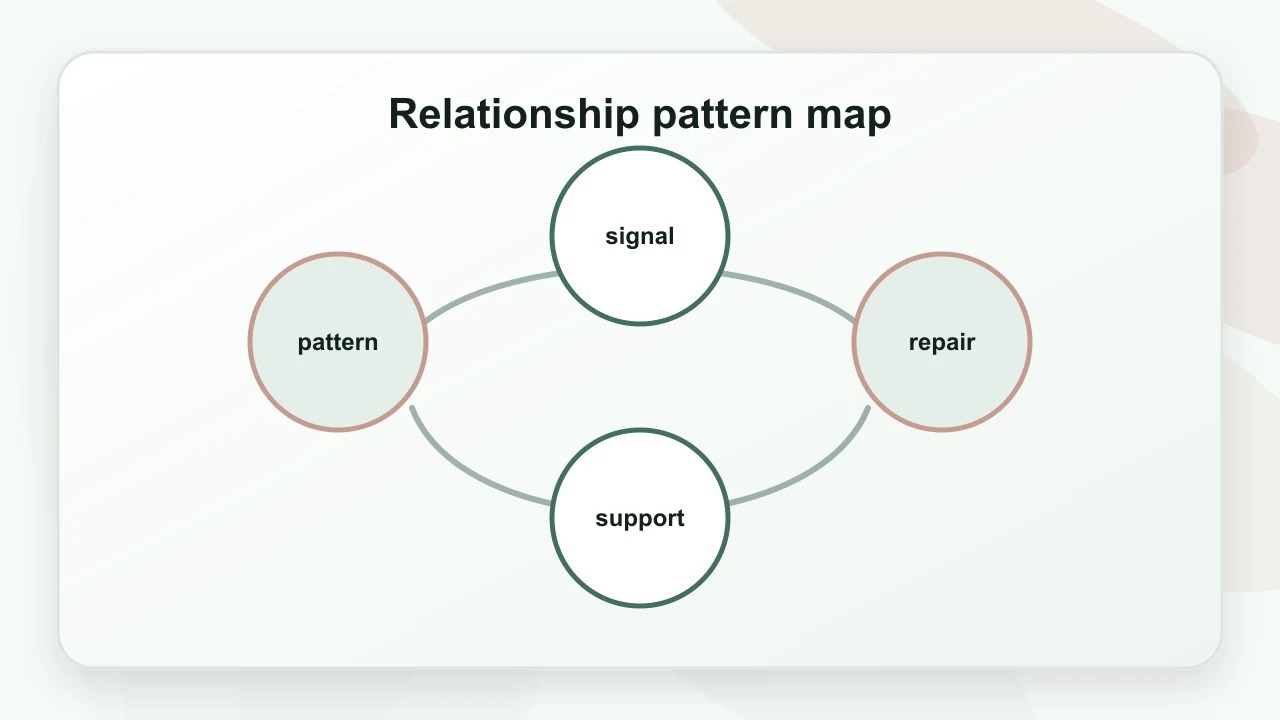
Visual summary
The infographic summarizes the article as pattern, signal, repair, support. It is a reading aid only and does not add new claims beyond the article.
Conflict within family is common because family relationships combine emotional history, practical dependence, expectations, identity, money, caregiving, and long-term roles. Conflict is not automatically unhealthy. The important questions are how often it happens, whether people feel safe, whether the same pattern repeats, and whether repair is possible.
Some family conflict can be resolved through clearer communication and practical agreements. Other conflict reflects deeper incompatibility, chronic boundary violations, mental-health concerns, substance use, or abuse.
Common causes of conflict within family
Unclear expectations
Family members may assume others should know what is expected without discussing it.
Unequal responsibilities
Conflict often develops when caregiving, housework, money, or emotional labor feels unfairly distributed.
Changing roles
Marriage, aging, illness, divorce, children leaving home, or adult children returning can destabilize old roles.
Boundary disagreements
Family members may disagree about privacy, money, visits, childcare, advice, or decision-making.
Old unresolved injuries
A current dispute may reactivate earlier experiences of favoritism, neglect, betrayal, or exclusion.
Different values
Political, religious, cultural, lifestyle, or parenting differences may become identity-level conflicts.
What family conflict looks like
Conflict may appear as:
- repeated arguments;
- avoidance or silent treatment;
- sarcasm or contempt;
- alliances and gossip;
- pressure on one person to keep the peace;
- children being used as messengers;
- repeated boundary violations;
- financial manipulation;
- threats to withdraw love or contact.
Not all of these are equal. Some are communication problems; others may be forms of coercion or abuse.
Family conflict solution: start with diagnosis of the pattern
Before choosing a solution, ask:
- What is the specific issue?
- What happens immediately before the conflict?
- Who becomes louder, quieter, or leaves?
- Is the disagreement practical, emotional, or both?
- Is anyone afraid?
- Has a clear request already been made?
- What would a realistic improvement look like?
Conflict resolution within the family
A basic process includes:
- choose one issue;
- speak about behavior rather than character;
- allow each person uninterrupted time;
- summarize before responding;
- identify needs and limits;
- create several options;
- choose one trial agreement;
- set a review date.
For detailed techniques, see Family Conflict Resolution.
When a mediator for family conflict may help
A mediator may be useful for:
- inheritance disagreements;
- elder-care responsibilities;
- parenting schedules;
- shared property;
- financial arrangements;
- communication between separated relatives.
A mediator helps structure negotiation but does not provide therapy or legal representation. Each person may need separate legal advice.
When family therapy may help
Family therapy may be appropriate when:
- conflict reflects a repeating relationship cycle;
- a child or adolescent is affected;
- grief or illness has changed the family;
- communication repeatedly collapses;
- roles are rigid;
- family members want to rebuild connection.
When less contact may be healthier
Not every family conflict should end in closeness. Reduced contact may be appropriate when there are repeated severe boundary violations, manipulation, abuse, or refusal to take responsibility.
Boundaries can include:
- shorter visits;
- no discussion of certain topics;
- communication only in writing;
- no unsupervised contact with children;
- temporary or permanent no contact.
How to avoid putting children in the middle
Adults should not ask children to:
- carry messages;
- report on another parent;
- choose sides;
- provide emotional comfort about adult conflict;
- keep unsafe secrets;
- confirm an adult’s version of events.
Children need reassurance that the conflict is not their responsibility.
When urgent or specialized help is needed
Seek specialized support for violence, sexual abuse, child or elder abuse, stalking, coercive control, suicidal risk, psychosis, or immediate danger.
Ordinary family communication advice is not enough in these situations.
Practical takeaway
When conflict within family becomes repetitive, focus on the pattern rather than the latest argument. Define one issue, clarify the boundary or need, choose an appropriate process, and involve a mediator, therapist, legal professional, or safety resource when required.
See Family Conflict Resolution, Family Connection, and Family Psychology.
Sources
- American Psychological Association — Relationships
- American Psychological Association — Parenting
- National Institute of Mental Health — Caring for Your Mental Health