

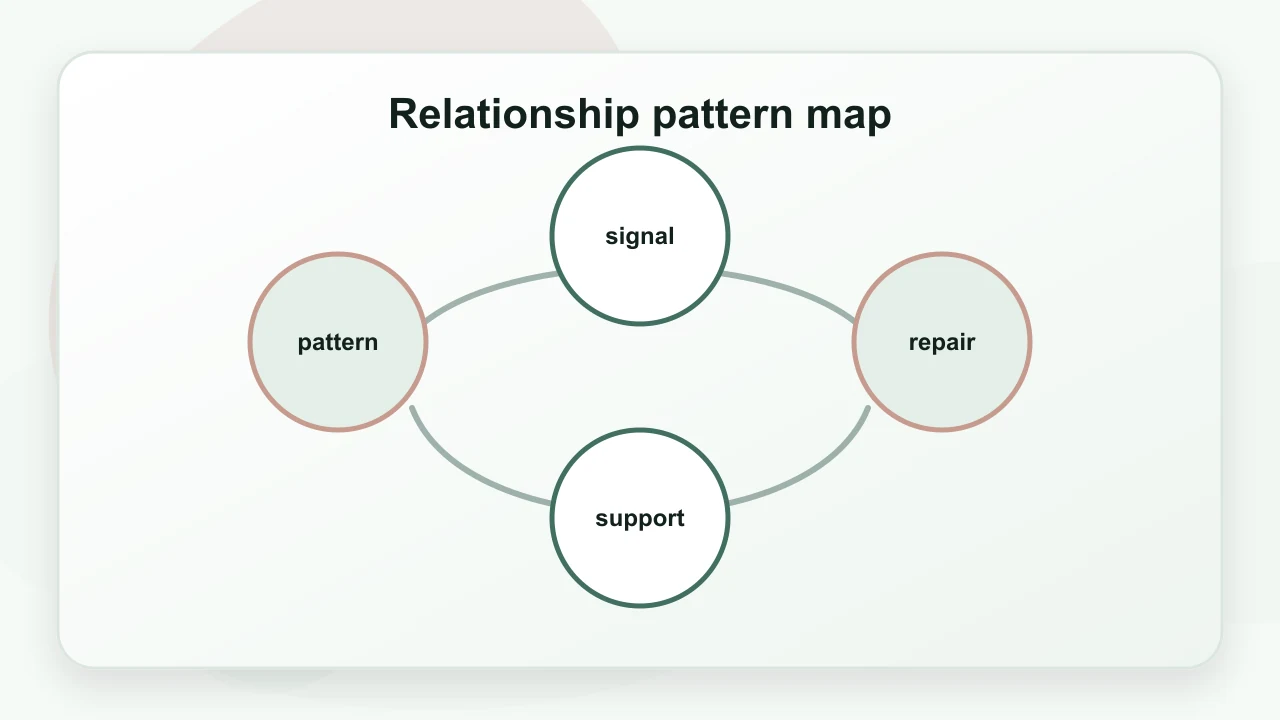
Visual summary
The infographic summarizes the article as pattern, signal, repair, support. It is a reading aid only and does not add new claims beyond the article.
Family connection is the sense that family members know one another, can reach for support, and have regular opportunities to share attention, responsibility, affection, and everyday life. Connection does not require constant harmony, frequent contact, or one traditional family structure.
A healthy connection with family also leaves room for privacy, difference, boundaries, and independence. In some families, creating distance is safer and healthier than increasing contact.
What family connection looks like
Connection may include:
- feeling noticed;
- being able to ask for help;
- knowing important details about one another’s lives;
- sharing routines and traditions;
- showing affection in ways people welcome;
- repairing after conflict;
- respecting age, culture, privacy, and autonomy;
- helping with practical needs.
Different families express connection differently. Some talk frequently; others connect through activity, humor, food, faith, caregiving, or shared work.
Connection is not the same as closeness at all times
Healthy family connection does not require:
- sharing every private thought;
- agreeing on values;
- daily contact;
- living nearby;
- forgiving without accountability;
- maintaining contact with unsafe relatives;
- children taking responsibility for adult emotions.
Connection should be voluntary and developmentally appropriate.
Everyday ways to build family connection
Create short, repeatable rituals
Examples:
- breakfast together twice a week;
- a five-minute evening check-in;
- Sunday phone calls;
- a shared walk;
- cooking one meal;
- reading with a child;
- a monthly family planning conversation.
Consistency matters more than complexity.
Ask specific questions
Replace “How was your day?” with:
- What was easier than expected?
- What was frustrating?
- Did anything make you laugh?
- Is there something you need help with?
- What are you looking forward to?
Do not turn every answer into advice.
Share practical responsibility
Connection often grows through doing ordinary things together: groceries, cooking, repairs, school preparation, caregiving, or planning.
Protect one-to-one relationships
In larger families, individual time helps each person feel seen. Even ten focused minutes can matter.
Repair after conflict
A useful repair includes:
- naming what happened;
- acknowledging impact;
- taking responsibility;
- making a change;
- returning to ordinary contact.
Respect different needs for contact
One person may want frequent conversation; another may connect better through activity or shorter contact. Negotiate rather than treating one style as correct.
Family-to-family connection
Families also benefit from connection with other families, neighbors, schools, faith communities, cultural organizations, and support groups. These networks can reduce isolation and provide models, resources, and practical help.
Family connection should not become social isolation from the wider community.
When connection feels difficult
Common barriers include:
- unresolved conflict;
- work and scheduling pressure;
- caregiving exhaustion;
- divorce or remarriage;
- grief;
- migration or distance;
- depression or anxiety;
- substance use;
- different cultural expectations;
- digital distraction;
- fear of judgment.
Choose the smallest barrier that can be changed. For example, schedule a specific call rather than expecting spontaneous contact.
Family connection counseling
Counseling may help when family members want connection but repeatedly fall into conflict, silence, or misunderstanding. Family therapy, couples therapy, individual therapy, or parenting support may be appropriate depending on who is involved.
Therapy should not pressure people into contact that is unsafe.
When distance is appropriate
More connection is not always healthier. Distance or no contact may be reasonable when there is:
- violence;
- coercive control;
- stalking;
- repeated severe boundary violations;
- active abuse;
- dangerous substance use;
- fear of retaliation.
Professional, legal, or specialized safety support may be needed.
A seven-day connection experiment
Choose one:
- share one meal without devices;
- send one thoughtful message;
- take a ten-minute walk together;
- ask one specific question and listen;
- complete one practical task together;
- revive one simple tradition;
- schedule the next contact before ending the current one.
Notice whether the action creates warmth, pressure, conflict, or relief. Adjust accordingly.
Practical takeaway
Family connection is built in small moments of reliability, interest, practical care, and repair. Begin with one repeatable ritual, one direct question, and one boundary that protects respect and safety.
See Family Psychology, Family Conflict Resolution, and Conflict Within Family.
Sources
- American Psychological Association — Relationships
- American Psychological Association — Parenting
- National Institute of Mental Health — Caring for Your Mental Health
- American Association for Marriage and Family Therapy — Consumer resources