
Visual summary
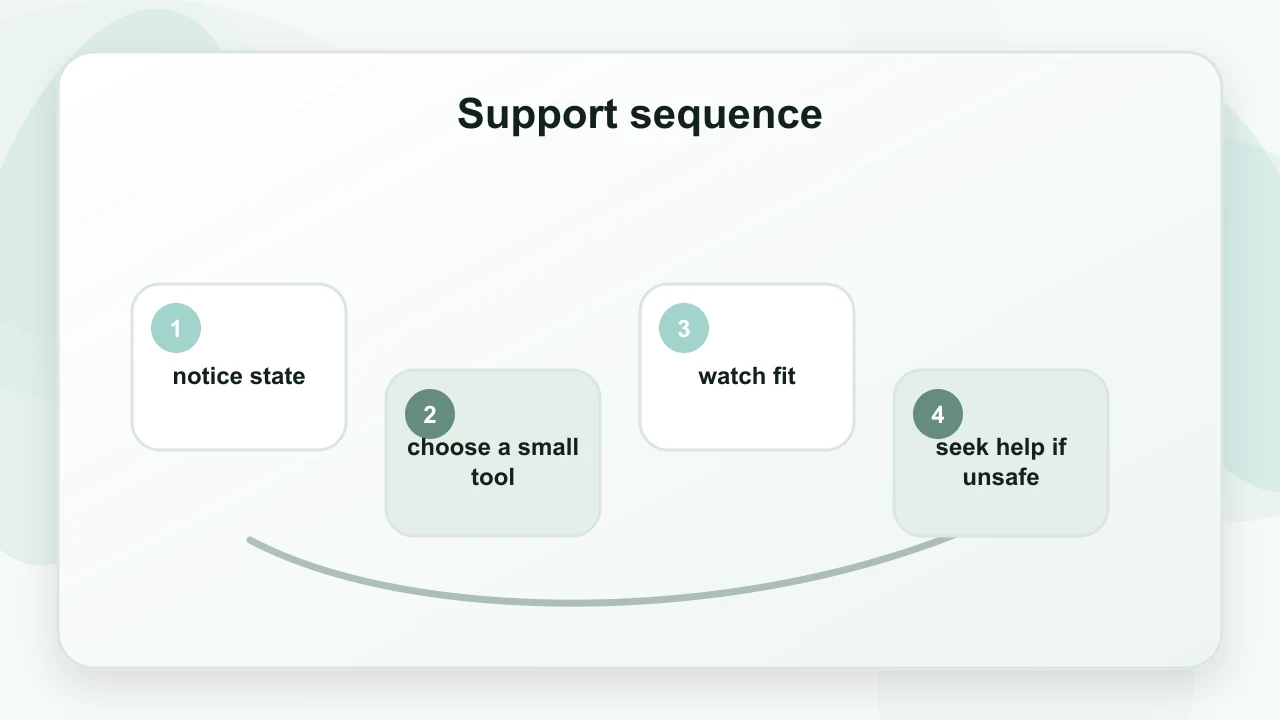
The infographic summarizes the article as notice state, choose a small tool, watch fit, seek help if unsafe. It is a reading aid only and does not add new claims beyond the article.
Deep breathing exercises for anxiety can provide a short, structured way to reduce breathing effort and shift attention. However, “deep” should not mean maximum-size breaths. When a person repeatedly inhales too much or too quickly, symptoms such as dizziness, tingling, air hunger, and panic may become stronger.
The following exercises use moderate breath size, relaxed posture, and brief practice. Stop immediately if symptoms worsen.
Exercise 1: Gentle diaphragmatic breathing
- Sit with the back supported.
- Place one hand over the lower ribs.
- Inhale gently.
- Allow the lower ribs and abdomen to move naturally.
- Exhale without squeezing the lungs empty.
- Repeat five to eight times.
Do not force the belly outward.
Exercise 2: Longer-exhale breathing
- Inhale comfortably for about three counts.
- Exhale for about four counts.
- Pause naturally without holding.
- Repeat for 30–60 seconds.
Adjust the count if it creates strain.
Exercise 3: Exhale plus grounding
- Look at one stable object.
- Feel both feet or the chair beneath you.
- Take one moderate inhale.
- Exhale slowly.
- Name one sound.
- Repeat three times.
This may be easier for people who become anxious when focusing only on the body.
What are the best deep breathing exercises for anxiety?
The best exercises are usually:
- simple enough to remember;
- gentle enough not to cause dizziness;
- short;
- easy to stop;
- compatible with open eyes;
- paired with external grounding;
- practiced before a crisis as well as during stress.
A method is not “better” because the count is more complicated.
Deep breathing exercises to reduce anxiety: realistic expectations
Breathing may reduce short-term physical arousal. It may not:
- stop every panic attack;
- remove the source of anxiety;
- treat trauma;
- correct an unsafe environment;
- replace therapy or medication;
- prevent all anxious sensations.
A useful goal is slightly more control and flexibility—not instant calm.
Common mistakes
Breathing too deeply
Maximum inhalation can worsen overbreathing.
Practicing too long
A 20-minute exercise may increase body monitoring.
Holding the breath
Long holds are unnecessary and can create air hunger.
Trying to breathe perfectly
Perfection pressure can become another anxiety trigger.
Using breathing to avoid exposure
Breathing should not become proof that you cannot tolerate a situation without a ritual.
What if deep breathing makes anxiety worse?
Stop and:
- return to ordinary breathing;
- open the eyes;
- stand or change position;
- orient to the room;
- walk gently if safe;
- seek medical care for severe or unfamiliar symptoms.
Do not keep taking rescue breaths.
Medical caution
Chest pain, fainting, severe shortness of breath, blue lips, new weakness, or a first unexplained episode needs urgent medical assessment.
People with significant heart or lung disease should ask a clinician about suitable breathing practices.
How these exercises fit into treatment
Anxiety care may also involve psychotherapy, exposure, medication, sleep treatment, lifestyle support, and medical evaluation. NIMH includes breathing and relaxation among skills that may be used within psychotherapy, not as complete substitutes for it.
Practical takeaway
Three deep breathing exercises to reduce anxiety:
- Gentle diaphragmatic breathing.
- Moderate inhale with a slightly longer exhale.
- Exhale combined with external grounding.
Use a small dose, evaluate the effect, and stop if symptoms worsen.
See Breathing Techniques for Anxiety, Deep Breathing Techniques for Anxiety, and Deep Belly Breathing for Anxiety.
Sources
- National Institute of Mental Health — Anxiety Disorders
- National Institute of Mental Health — Psychotherapies
- NCCIH — Relaxation Techniques: What You Need to Know