

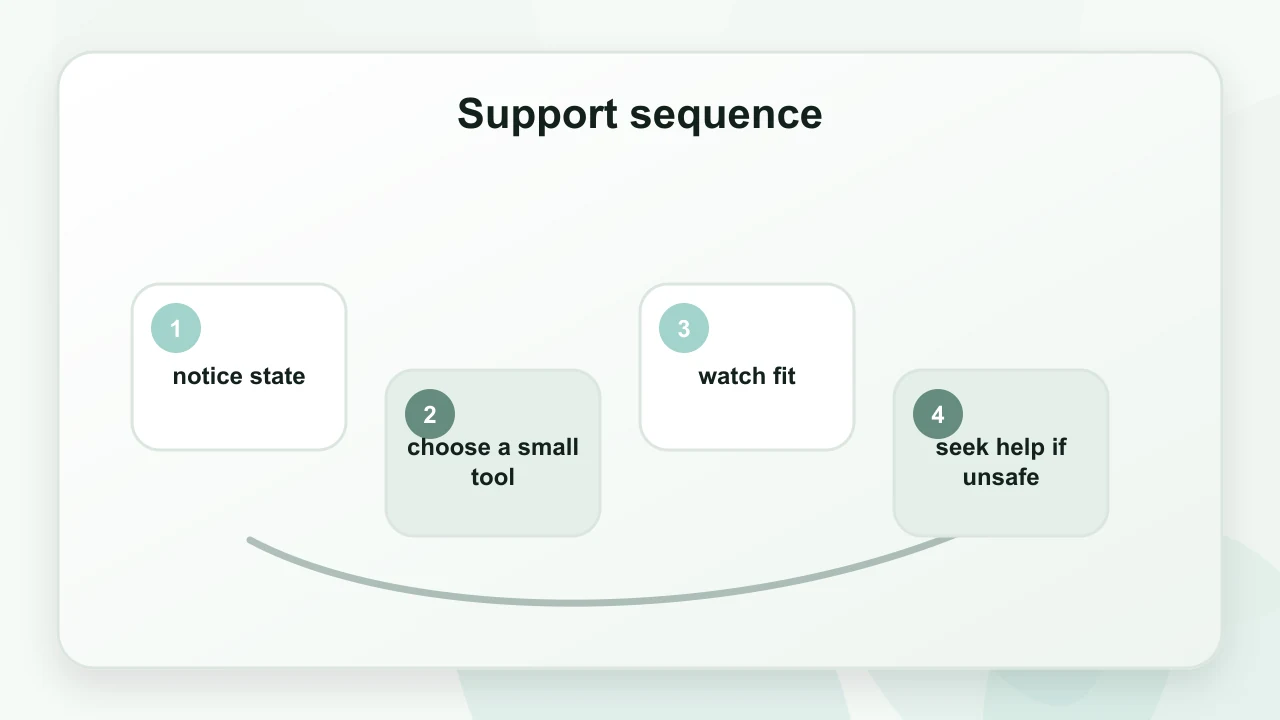
Visual summary
The infographic summarizes the article as notice state, choose a small tool, watch fit, seek help if unsafe. It is a reading aid only and does not add new claims beyond the article.
Grounding exercises for anxiety are short, concrete activities that bring attention back to the present. They can be useful when thoughts are racing, the body feels unreal, a memory is intruding, or anxiety is making it difficult to identify what is happening now.
This article focuses on step-by-step exercises. For the broader explanation, limitations, and difference between grounding and avoidance, read Grounding Techniques for Anxiety.
Before trying an exercise
Grounding is not a test. You do not need to complete every step.
- Keep the eyes open if closing them feels unsafe.
- Skip any sense connected to a trauma reminder.
- Avoid extreme temperatures or painful pressure.
- Do not use grounding to delay emergency help.
- Stop if you become more disoriented or distressed.
1. The 5-4-3-2-1 grounding exercise
Name:
- five things you see;
- four things you feel;
- three things you hear;
- two things you smell;
- one thing you taste.
Modify the order or use fewer categories. The numbers are only a structure.
2. Three-object description
Choose three objects. For each, describe:
- color;
- shape;
- texture;
- size;
- purpose;
- location.
This exercise is useful in public because it can be done silently.
3. Feet-and-floor exercise
- Place both feet on the floor.
- Press down gently.
- Notice the heel, arch, and toes.
- Shift weight slightly.
- Name the surface under you.
- Look up and identify where you are.
This can be paired with one slow exhale.
4. Present-time orientation
Say aloud or write:
- My name is ___.
- Today is ___.
- I am in ___.
- The current time is approximately ___.
- The event I am remembering is not happening right now.
- My next safe step is ___.
Use only statements that are accurate. If the present situation is unsafe, the next step should focus on safety.
5. Temperature and texture exercise
Hold a safe object with a noticeable but non-extreme temperature or texture, such as:
- a cool drink;
- a warm mug;
- a smooth stone;
- a textured cloth;
- a chilled spoon wrapped if necessary.
Describe the sensation without using pain or extreme cold.
6. Counting and categories
Choose a neutral category and list:
- five cities;
- five animals;
- five blue objects;
- the months backward;
- even numbers from two to twenty.
This cognitive grounding exercise may interrupt repetitive thought without requiring body focus.
7. Slow walking grounding
Walk at a safe pace and notice:
- heel contact;
- weight transfer;
- toes leaving the ground;
- arm movement;
- three things ahead of you;
- one sound behind you.
Do not use this exercise where traffic, falls, or environmental danger require full attention.
8. Supportive contact exercise
Contact a trusted person and use a clear request:
- “Please stay on the phone for five minutes.”
- “Please remind me where I am and what is happening.”
- “Can we talk about something ordinary?”
- “Help me decide the next safe step.”
Social grounding can be more effective than doing everything alone.
Grounding exercise for an anxiety attack
Use a very short sequence:
- Look at one fixed object.
- Press both feet down.
- Name your location.
- Exhale comfortably.
- Name one person you can contact.
- Decide whether symptoms need medical evaluation.
Do not assume chest pain, fainting, severe breathing difficulty, or neurological symptoms are “just anxiety.”
How to choose the right exercise
Choose based on what is happening:
- Racing thoughts: categories or object description.
- Feeling unreal: orientation statements and feet on the floor.
- Body-focused panic: external visual and sound exercises.
- Intrusive memory: current date, place, and safe contact.
- Restlessness: walking or controlled movement.
- Overwhelm in public: silent three-object description.
What if grounding becomes a ritual?
If you feel unable to proceed without repeating an exercise perfectly, it may be reinforcing anxiety rather than increasing flexibility. Discuss this with a clinician, particularly when obsessive-compulsive symptoms are present.
The goal is to regain choice, not to guarantee that nothing uncomfortable will happen.
When professional help is needed
Seek professional assessment when anxiety is persistent, worsening, causing major avoidance, disrupting sleep or daily functioning, or accompanied by trauma symptoms, dissociation, substance use, self-harm, or suicidal thoughts.
In the United States, call or text 988 for crisis support. Call emergency services for immediate danger or a medical emergency.
Practical takeaway
Pick three exercises:
- one sensory;
- one physical;
- one cognitive.
Write them in your phone. Practice briefly during a calm moment. After grounding, identify the next useful action rather than waiting for anxiety to disappear completely.
See Breathing Exercises for Anxiety, Emotional Regulation Techniques, and Nervous System Regulation.
Sources
- VA National Center for PTSD - Grounding Technique
- NIMH - Anxiety Disorders
- NCCIH - Anxiety and Complementary Health Approaches