

Visual summary
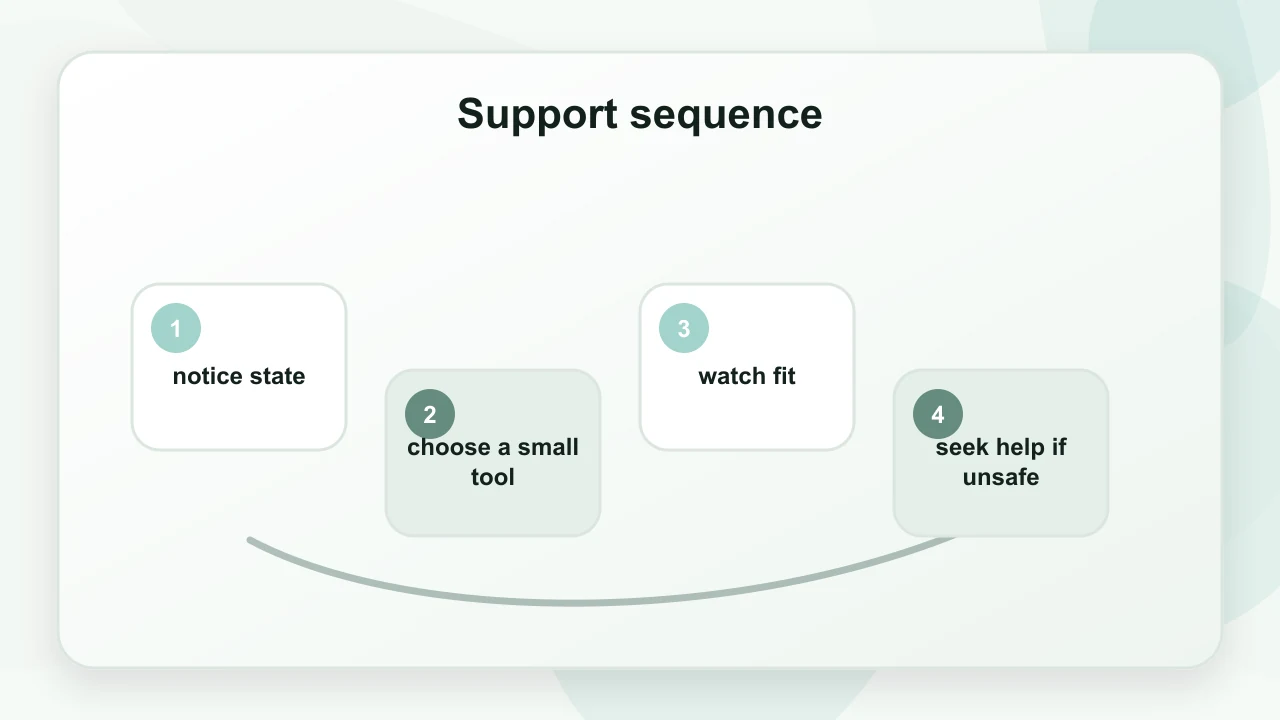
The infographic summarizes the article as notice state, choose a small tool, watch fit, seek help if unsafe. It is a reading aid only and does not add new claims beyond the article.
Grounding techniques for anxiety are methods that redirect attention from spiraling thoughts, intrusive memories, or frightening body sensations toward the present environment. Grounding may use sight, sound, touch, movement, facts, or simple orientation questions.
Grounding is not the same as relaxation. You may still feel anxious after using it. The immediate goal is often smaller: become more oriented, regain choice, and identify the next safe action.
How grounding works
Anxiety can narrow attention around threat. A person may become absorbed in:
- a feared future;
- a memory;
- a bodily sensation;
- an imagined interpretation;
- repetitive “what if” questions.
Grounding expands attention to information that is happening now. It does not prove that everything is safe; it helps the person assess the current situation more accurately.
Types of grounding techniques
Sensory grounding
Uses present sensory information:
- notice colors and shapes;
- listen for near and distant sounds;
- feel the texture of clothing;
- hold a cool or warm object safely;
- identify a familiar scent.
Cognitive grounding
Uses facts and orientation:
- say your name;
- state the date and location;
- name the people who are currently with you;
- describe what happened before the anxiety started;
- list the next three steps in your day.
Physical grounding
Uses movement and pressure:
- press the feet into the floor;
- grip and release a safe object;
- stretch the arms;
- walk slowly;
- push the palms together;
- notice the chair supporting your weight.
Social grounding
Uses another person or familiar presence:
- call someone trustworthy;
- ask a person to speak slowly;
- sit near a supportive person;
- interact with a calm pet when appropriate.
When grounding may help
Grounding may be useful during:
- rumination;
- panic escalation;
- intrusive memories;
- dissociation or feeling unreal;
- waiting for a difficult event;
- conflict when thoughts are moving too quickly;
- sensory overwhelm.
It can also be used before another skill, such as problem-solving, paced breathing, or communication.
When grounding may not help
A technique may be ineffective or counterproductive when:
- the instructions feel childish or mechanical;
- the environment itself is unsafe;
- sensory attention increases pain or trauma reminders;
- the person is being pressured to calm down;
- symptoms are medical rather than anxiety-related;
- the exercise becomes a ritual that reinforces fear;
- the person needs practical intervention, not attention redirection.
If grounding increases distress, stop. Use a different sense, move to a safer place, contact someone, or seek professional support.
Grounding versus avoidance
Grounding is useful when it helps you reconnect and continue with a meaningful action. It may become avoidance when it is repeatedly used to escape every mild emotion or prevent learning that anxiety can pass without a ritual.
A helpful question is: “After grounding, what will I do next?”
Possible answers:
- return to the task;
- ask for clarification;
- leave an unsafe setting;
- make a medical appointment;
- continue a planned exposure;
- contact a therapist;
- rest and reassess.
Grounding and breathing techniques for anxiety
Breathing and grounding can be combined, but they do different jobs.
Breathing changes pace and physical arousal. Grounding directs attention toward the present. For people who become dizzy or overly focused on breath, grounding alone may be preferable.
Try:
- Feel both feet.
- Look at three objects.
- Take one comfortable exhale.
- Name the next action.
Safety and professional-care boundaries
Grounding is not a treatment for all causes of anxiety. Seek qualified evaluation for persistent panic, trauma symptoms, dissociation, severe sleep disruption, substance withdrawal, medical symptoms, psychosis, mania, self-harm, or suicidal thinking.
In the United States, call or text 988 for crisis support. Call emergency services for immediate danger or a medical emergency.
Practical takeaway
A grounding technique should be:
- simple enough to remember;
- connected to the current environment;
- easy to stop;
- followed by a practical next step;
- adapted when it increases distress.
Start by choosing one visual, one physical, and one cognitive method. Practice briefly before you urgently need them.
See Grounding Exercises for Anxiety, Breathing Exercises for Anxiety, and Nervous System Regulation.
Sources
- VA National Center for PTSD - Grounding Technique
- NIMH - Anxiety Disorders
- NCCIH - Relaxation Techniques: What You Need To Know