

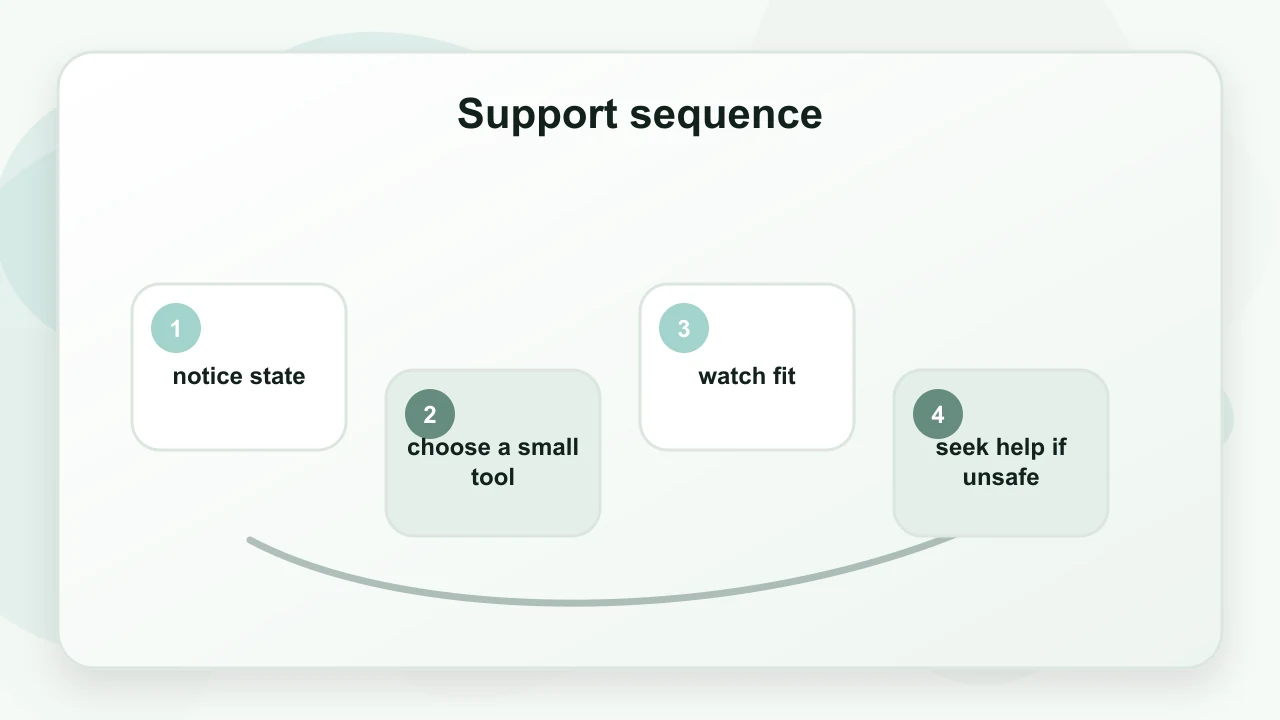
Visual summary
The infographic summarizes the article as notice state, choose a small tool, watch fit, seek help if unsafe. It is a reading aid only and does not add new claims beyond the article.
Grounding methods are different ways of reconnecting attention with the present moment during anxiety, stress, panic, dissociation, or emotional overload. They can be grouped into sensory, physical, cognitive, breathing-based, social, and routine-based methods.
No single grounding method works for everyone. The best option depends on whether the person feels mentally flooded, physically agitated, detached, or confused. Grounding should increase flexibility and orientation, not become a compulsory ritual or substitute for treatment.
Different methods of grounding
Sensory grounding
Uses sight, sound, touch, smell, or taste.
Examples:
- 5-4-3-2-1;
- describing one object;
- identifying near and distant sounds;
- holding a textured object;
- noticing temperature safely.
Physical grounding
Uses movement or pressure.
Examples:
- pressing both feet into the floor;
- walking;
- stretching;
- pushing the palms together;
- carrying out a simple household task.
Cognitive grounding
Uses current facts.
Examples:
- stating the date;
- naming the location;
- separating facts from assumptions;
- identifying what happened immediately before distress;
- naming the next safe action.
Breathing-based grounding
Combines gentle breathing with external focus.
Example:
- Look at one object.
- Inhale moderately.
- Exhale slightly more slowly.
- Feel the chair or floor.
- Name one sound.
Breathing is optional and should be skipped if it worsens panic.
Social grounding
Uses safe contact with another person.
Examples:
- asking someone to speak calmly;
- discussing ordinary facts;
- walking with a trusted person;
- using a written support plan.
The grounding method 54321
The 5-4-3-2-1 method is popular because it is structured and memorable. It may be useful for racing thoughts or mild dissociation.
However, the full sequence can feel too complicated during intense distress. A shorter version may be:
- three things you see;
- two things you hear;
- one thing you feel.
Grounding methods for dissociation
For dissociation, external methods may be preferable to intense inward focus.
Useful options include:
- open-eye orientation;
- reading a sign or clock;
- naming colors and shapes;
- moving slowly;
- touching a familiar object;
- stating the date and location;
- speaking with a trusted person.
Avoid painful stimulation, extreme cold, or forced memory work.
How to choose among grounding methods
Use:
- sensory methods when thoughts are racing;
- movement when the body feels agitated;
- factual orientation when you feel unreal or confused;
- social grounding when isolation worsens symptoms;
- breathing only when it feels comfortable;
- routine-based methods when decision fatigue is the main problem.
What grounding methods do not do
They do not:
- cure anxiety;
- diagnose trauma;
- guarantee calm;
- make danger disappear;
- replace exposure therapy;
- replace medication or psychotherapy;
- permanently regulate the nervous system.
When methods become unhelpful
A grounding method may be counterproductive when:
- it must be performed perfectly;
- it becomes a safety ritual;
- it is used to avoid every uncomfortable situation;
- it increases body monitoring;
- it involves pain;
- it delays care;
- it is forced by another person.
A practical method-selection plan
Write down:
- My early warning signs.
- One sensory method.
- One movement method.
- One factual statement.
- One support person.
- One professional-care threshold.
This is often more useful than collecting dozens of techniques.
When professional help matters
Seek qualified care when dissociation, panic, trauma symptoms, anxiety, self-harm, suicidal thoughts, psychosis, or major functional problems persist.
In the United States, call or text 988 for crisis support.
Practical takeaway
Grounding methods work best when they are:
- short;
- safe;
- specific;
- easy to stop;
- followed by one practical action;
- used alongside appropriate care.
See Grounding Techniques, Deep Breathing for Panic Attacks, and Breathing Exercise for Nerves.
Sources
- NIMH — Anxiety Disorders
- APA — Anxiety
- NCCIH — Relaxation Techniques: What You Need to Know