

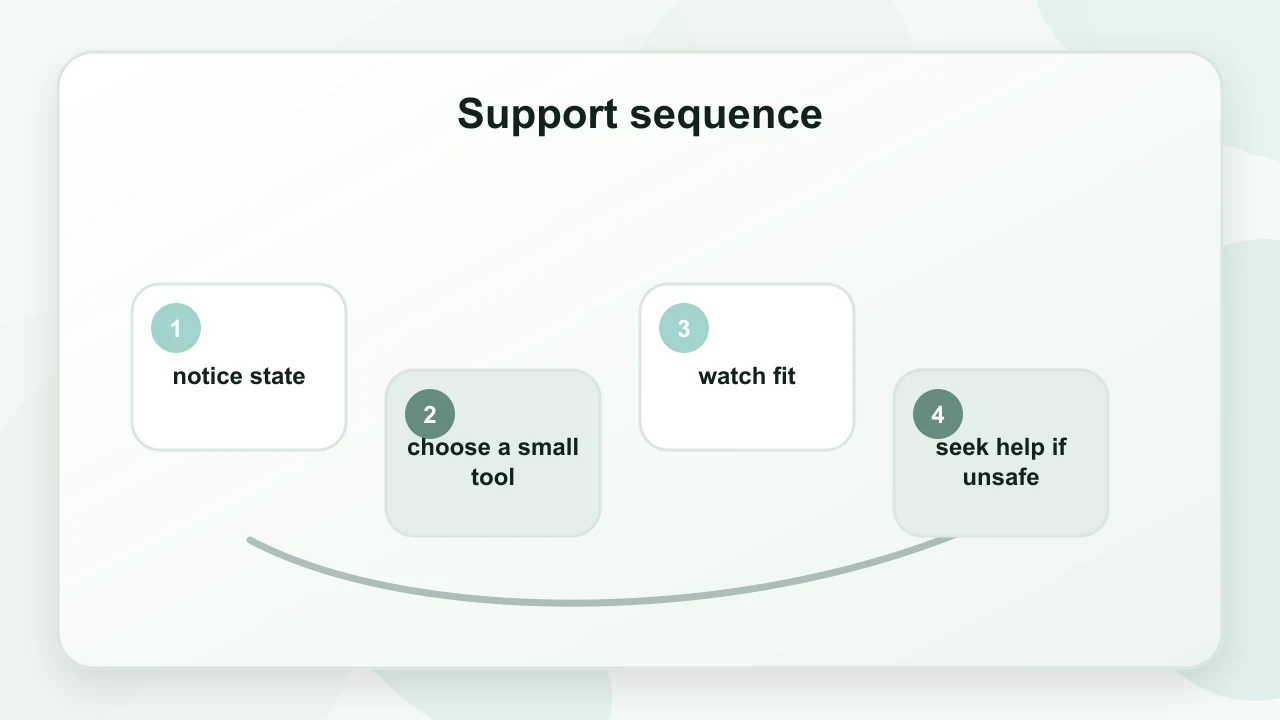
Visual summary
The infographic summarizes the article as notice state, choose a small tool, watch fit, seek help if unsafe. It is a reading aid only and does not add new claims beyond the article.
Grounding techniques are short practices that direct attention toward the present environment, physical support, current facts, and the next manageable action. They may help some people during anxiety, stress, panic, dissociation, depersonalization, derealization, or trauma-related activation.
Grounding is not meant to force calm or prove that nothing is wrong. Its purpose is to increase orientation and choice. The most useful technique is usually simple, safe, easy to stop, and matched to the person’s actual symptoms. Some people respond well to sensory grounding; others prefer movement, factual statements, or contact with a trusted person.
What is the grounding technique?
There is no single official “grounding technique.” The phrase may refer to:
- the 5-4-3-2-1 sensory sequence;
- feet-on-floor pressure;
- object description;
- movement;
- orientation statements;
- temperature used safely;
- breathing combined with external attention;
- social grounding through calm conversation.
The right choice depends on what is happening.
Sensory grounding techniques
5-4-3-2-1
Name:
- five things you see;
- four things you feel;
- three things you hear;
- two things you smell;
- one thing you taste.
Shorten the sequence if the full version feels overwhelming.
Object description
Choose one neutral object and describe its:
- color;
- shape;
- texture;
- size;
- material;
- practical function.
This can redirect attention away from catastrophic thinking.
Sound orientation
Identify one nearby sound and one distant sound.
Physical grounding techniques
Try:
- pressing both feet into the floor;
- sitting firmly against a chair;
- pushing the palms together;
- holding a textured object;
- walking slowly;
- stretching within a comfortable range;
- completing one simple household task.
Avoid pain, extreme cold, or forceful stimulation.
Grounding techniques for dissociation
Dissociation may involve numbness, detachment, memory gaps, or feeling unreal. External grounding is often easier than inward body scanning.
Helpful options may include:
- keeping the eyes open;
- naming signs, furniture, or colors;
- reading the date aloud;
- touching a familiar object;
- moving slowly;
- speaking with a trusted person;
- using a written orientation card.
Grounding techniques for depersonalization and derealization
Depersonalization may involve feeling detached from oneself. Derealization may involve feeling that the environment is unreal.
Try:
- State your name and location.
- Name the date and time of day.
- Describe three visible objects.
- Feel one stable point of contact.
- Complete one ordinary action.
Do not argue aggressively with the sensation. Reorientation is usually more useful than trying to force it away.
Grounding techniques for stress
For ordinary stress, use a brief transition:
- stand up;
- relax the jaw;
- notice the room;
- take one gentle exhale;
- identify the next task;
- begin for two minutes.
Grounding can help turn vague overwhelm into one concrete action.
Grounding techniques for trauma
Trauma-related grounding should emphasize control and choice.
Use:
- open eyes;
- external sensory focus;
- predictable pacing;
- permission to stop;
- no forced memory recall;
- no painful stimulation;
- no claim that distress must increase before healing.
A trauma-informed clinician may help when grounding repeatedly activates memories or dissociation.
What grounding does not do
Grounding does not:
- treat the cause of every symptom;
- guarantee calm;
- make an unsafe situation safe;
- replace psychotherapy or medication;
- permanently reset the nervous system;
- prove that symptoms are psychological;
- eliminate the need for medical assessment.
When grounding may backfire
Grounding can become unhelpful when it:
- becomes a required ritual;
- is used to avoid every feared situation;
- increases body monitoring;
- uses pain or extreme temperature;
- feels coercive;
- creates shame when it does not work;
- delays medical or mental-health care.
How to choose a technique
Ask:
- Am I overwhelmed by thoughts, sensations, or disorientation?
- Would external or internal focus feel safer?
- Do I need stillness or movement?
- What is the shortest useful exercise?
- What is the next practical action afterward?
When professional help is needed
Seek qualified care when anxiety, trauma symptoms, dissociation, panic, self-harm, suicidal thoughts, psychosis, or inability to function persist or worsen.
In the United States, call or text 988 for crisis support. Use emergency services for immediate danger or severe medical symptoms.
Practical takeaway
A simple grounding sequence:
- Name three things you see.
- Feel both feet.
- State your location and the date.
- Take one gentle exhale if comfortable.
- Choose one safe next action.
See Breathing Exercise for Nerves, Grounding Methods, and Emotional Regulation.
Sources
- NIMH — Anxiety Disorders
- APA — Anxiety
- NCCIH — Relaxation Techniques: What You Need to Know