

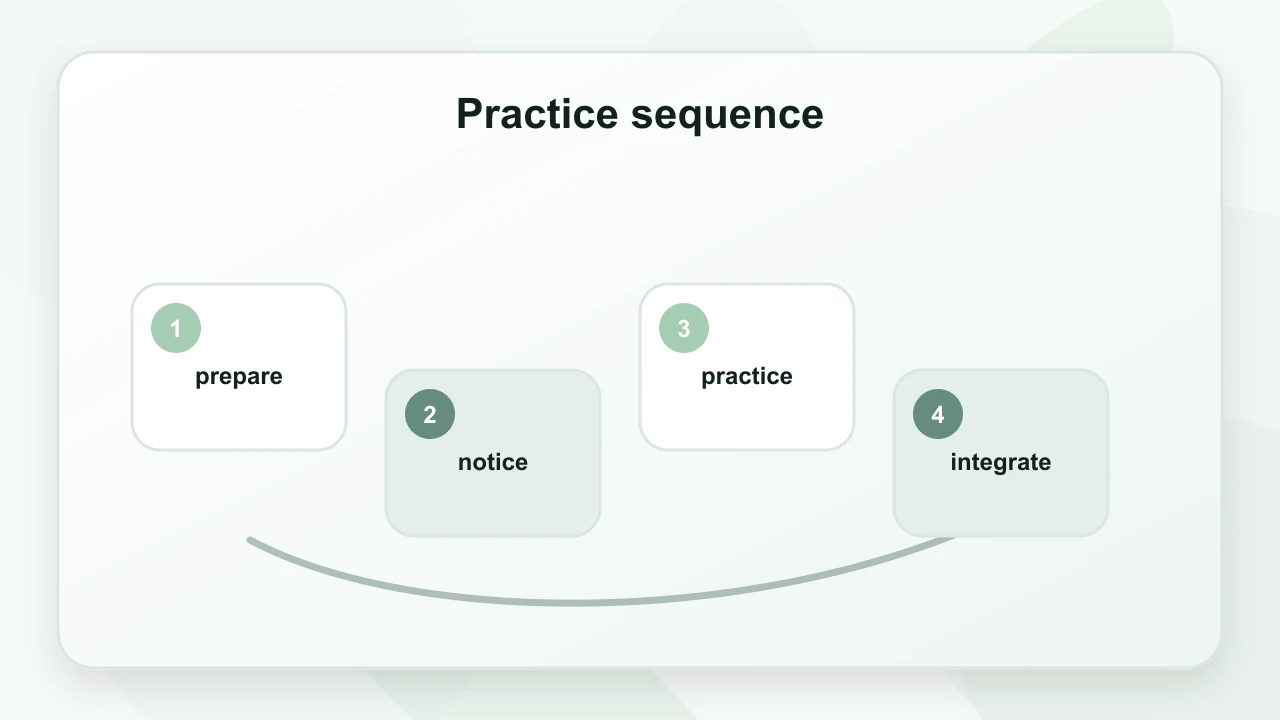
Visual summary
The infographic summarizes the article as prepare, notice, practice, integrate. It is a reading aid only and does not add new claims beyond the article.
Jacobson muscle relaxation refers to the progressive relaxation method developed by American physician Edmund Jacobson in the early twentieth century. Jacobson proposed that people could learn to recognize and reduce muscular tension through careful, systematic practice.
Modern progressive muscle relaxation is derived from this work but is often shorter and simpler than Jacobson’s original training. Contemporary versions typically tense and release major muscle groups over 5–20 minutes.
Who was Edmund Jacobson?
Edmund Jacobson was a physician and researcher whose work connected muscular tension with states of stress and arousal. His book Progressive Relaxation was published in 1938, although his research and teaching began earlier.
Jacobson’s method was detailed and required extensive practice. It was not simply a quick audio exercise.
What the original method emphasized
Jacobson’s progressive relaxation emphasized:
- careful detection of subtle tension;
- systematic work through muscle groups;
- repeated training;
- distinguishing tension from relaxation;
- reducing unnecessary muscular effort;
- applying the skill during daily life.
The original approach was more intensive than many current wellness versions.
Jacobson muscle relaxation versus modern PMR
Modern PMR generally:
- uses fewer muscle groups;
- requires less training time;
- uses shorter contractions;
- may include guided audio;
- may add breathing or imagery;
- is adapted for sleep, stress, anxiety, or pain management.
Both approaches rely on the contrast between tension and release.
A simplified Jacobson-inspired practice
- Sit or lie in a supported position.
- Notice one muscle group without changing it.
- Tense gently for three to five seconds.
- Release and observe for 10–15 seconds.
- Repeat only if comfortable.
- Move systematically through the body.
- Finish by noticing ordinary movement and breathing.
Possible sequence:
- dominant hand and arm;
- other hand and arm;
- face and jaw;
- shoulders;
- abdomen;
- thighs;
- lower legs and feet.
Why the method may help
Jacobson muscle relaxation may help some people:
- recognize tension earlier;
- reduce habitual clenching;
- create a structured relaxation routine;
- prepare for sleep;
- manage stress-related physical activation;
- distinguish effort from release.
The evidence base applies more broadly to progressive relaxation methods than to every historical detail of Jacobson’s original system.
Safety and modifications
Use less effort or skip areas when there is:
- pain;
- injury;
- recent surgery;
- cramping;
- limited mobility;
- neurological or muscular illness;
- cardiovascular concerns related to straining.
Imagining the tension and release may be an alternative when physical contraction is unsuitable.
Historical claims versus current evidence
Jacobson’s work was influential, but historical theories should not be treated as complete modern neuroscience. Muscular relaxation may influence stress and comfort without proving that all anxiety or illness originates in muscle tension.
When professional care matters
Use qualified care for persistent anxiety, insomnia, pain, trauma symptoms, depression, psychosis, mania, self-harm, suicidal thoughts, or unexplained physical symptoms.
Practical takeaway
Jacobson muscle relaxation is best understood as the historical foundation of PMR. Keep the core principle—systematic awareness and release—while using modern safety, shorter sessions, and individualized modifications.
See PMR Relaxation, Guided Muscle Relaxation, and Systematic Relaxation.
Sources
- VA Whole Health Library — Progressive Muscle Relaxation
- NCCIH — Relaxation Techniques: What You Need to Know
- Jacobson, Progressive Relaxation (historical source)