

Visual summary
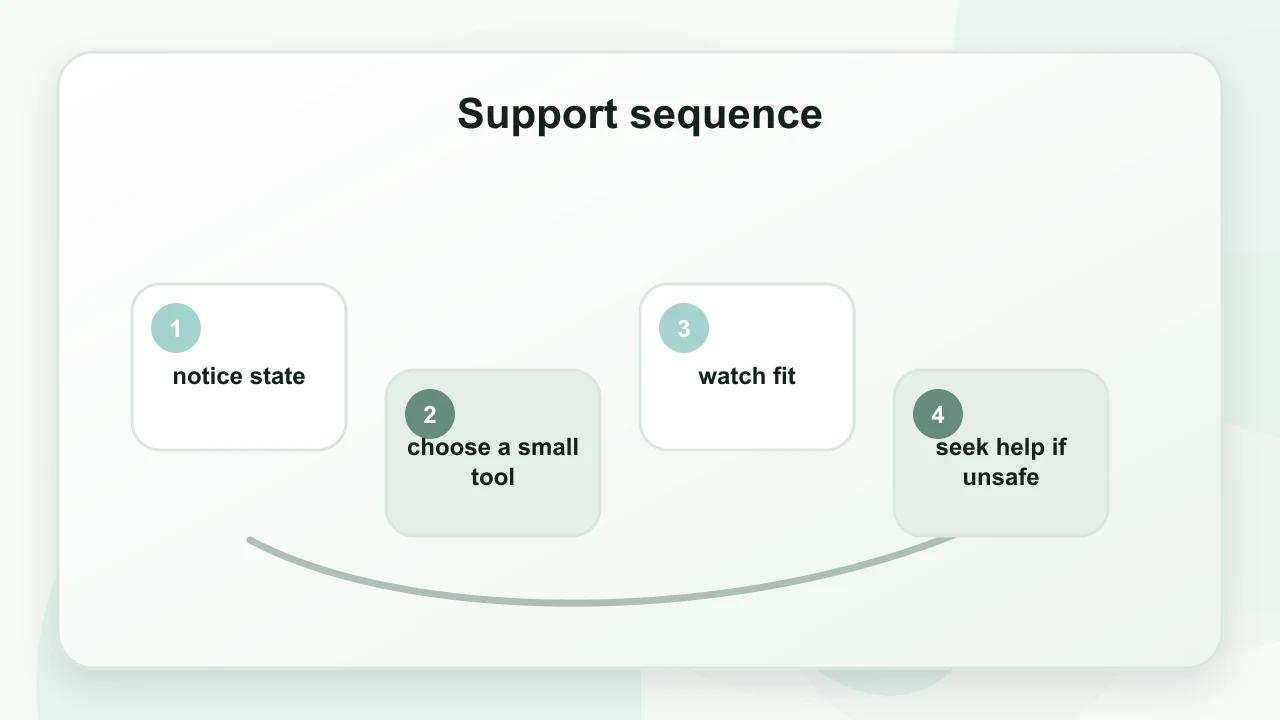
The infographic summarizes the article as notice state, choose a small tool, watch fit, seek help if unsafe. It is a reading aid only and does not add new claims beyond the article.
Polyvagal theory is a framework developed by Stephen Porges to explain how the autonomic nervous system may shape feelings of safety, social connection, mobilization, and shutdown. It is widely used in trauma-informed therapy, coaching, and nervous-system education.
The framework can give people accessible language for shifts in arousal. However, several of its anatomical, evolutionary, and physiological claims remain disputed. It is best used as a tentative clinical metaphor rather than as a complete or settled account of how the nervous system works.
What polyvagal theory proposes
The theory describes three broad response patterns:
- Social engagement or connection: relative calm, flexibility, and ability to interact.
- Mobilization: fight-or-flight activation, urgency, fear, anger, or restlessness.
- Immobilization: collapse, numbness, withdrawal, or shutdown-like experience.
Popular polyvagal explanations often call these “ventral vagal,” “sympathetic,” and “dorsal vagal” states. Real nervous-system activity is more complex than a three-state ladder, and people may experience mixed states.
Why people find it useful
Polyvagal theory in therapy can help people:
- describe bodily changes without shame;
- notice early signs of escalation;
- distinguish activation from danger;
- choose grounding, movement, rest, or social support;
- understand why calming strategies differ by state.
For example, a person who feels restless may respond better to walking than silent meditation. Someone who feels disconnected may need orientation and supportive contact before inward-focused relaxation.
What the theory does not prove
Polyvagal theory does not prove that:
- every emotion belongs to one nervous-system state;
- trauma is permanently “stored” in the vagus nerve;
- one exercise can reset the nervous system;
- heart-rate variability reveals a person’s exact emotional state;
- attachment style can be read directly from autonomic physiology;
- polyvagal therapy is a distinct, validated treatment for every condition.
Research supports the general importance of autonomic regulation, social safety, breathing, and stress physiology. That does not automatically validate every specific claim made under the polyvagal label.
Polyvagal theory and attachment
Polyvagal theory and attachment are often discussed together because both concern safety and connection. Attachment theory focuses on patterns of seeking protection and closeness in relationships. Polyvagal theory attempts to describe physiological conditions that may support or inhibit social engagement.
The connection is conceptually plausible, but attachment styles should not be reduced to nervous-system states. Relationships, learning history, culture, temperament, trauma, and current circumstances all matter.
Practical tools associated with polyvagal-informed work
The usefulness of these tools does not depend on accepting the whole theory:
Orienting
Slowly look around and identify where you are, what is happening now, and what appears safe or neutral.
Comfortable breathing
Use a gentle inhale and slightly longer exhale without forcing deep breaths.
Rhythmic movement
Walking, rocking, stretching, humming, or another repetitive activity may help some people shift arousal.
Supportive connection
A calm conversation, trusted person, pet, or familiar setting can reduce perceived threat.
Sensory adjustment
Reduce harsh light, noise, heat, or crowding. Add a safe texture, warm drink, or stable visual cue.
When polyvagal language becomes unhelpful
Be cautious when it:
- turns ordinary emotion into pathology;
- encourages constant monitoring of bodily states;
- presents speculation as established neuroscience;
- blames a person for being “dysregulated”;
- delays medical assessment;
- replaces effective treatment;
- encourages extreme cold exposure, breath retention, or other intense practices.
A framework should make experience clearer and expand choices. It should not make a person more frightened of their body.
How to use polyvagal theory responsibly
- Treat the state labels as rough descriptions.
- Notice whether a technique helps in practice.
- Keep explanations proportional to the evidence.
- Do not diagnose yourself from social-media graphics.
- Use validated treatment for diagnosed conditions.
- Discuss worsening symptoms with a qualified clinician.
When professional care matters
Seek assessment for severe anxiety, persistent dissociation, trauma symptoms, major sleep disruption, fainting, chest pain, psychosis, mania, self-harm, or suicidal thinking.
In the United States, call or text 988 for crisis support. Call emergency services for immediate danger or a medical emergency.
Practical takeaway
Polyvagal theory can be a useful map, but it is not the territory. Keep the practical parts that help you notice activation, orient to the present, move, breathe comfortably, and seek safe connection. Hold the biological claims lightly and keep professional-care boundaries intact.
See Nervous System Regulation, Grounding Exercises for Anxiety, and Breathing Exercises for Anxiety.
Sources
- National Institute of Mental Health — Anxiety Disorders
- NCCIH — Relaxation Techniques: What You Need to Know
- Porges — foundational publications describing Polyvagal Theory
- Grossman and Taylor — peer-reviewed critiques of core polyvagal premises
- Doody, Burghardt, and Dinets — critique of evolutionary assumptions in Polyvagal Theory