

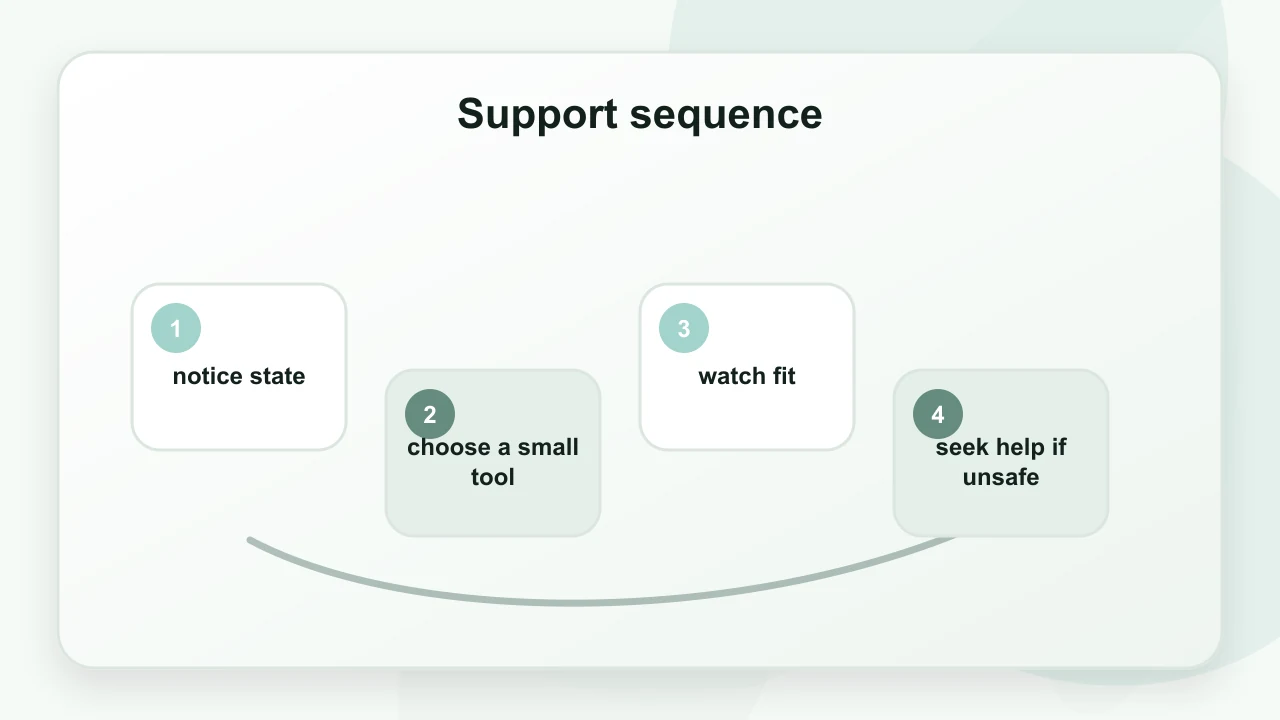
Visual summary
The infographic summarizes the article as notice state, choose a small tool, watch fit, seek help if unsafe. It is a reading aid only and does not add new claims beyond the article.
Polyvagal therapy refers to therapeutic practices inspired by polyvagal theory, a framework developed by Stephen Porges to explain how the autonomic nervous system may shape social engagement, mobilization, shutdown, and perceived safety. Therapists may use the language of “states,” “cues of safety,” co-regulation, breathing, movement, voice, orientation, and body awareness.
Some of these practices overlap with established approaches such as grounding, exposure, relaxation, behavioral activation, and trauma-informed care. However, important biological claims associated with polyvagal theory remain debated. Polyvagal therapy should therefore be treated as a clinical metaphor or organizing framework—not as settled neuroscience or a stand-alone cure.
What is polyvagal theory?
Polyvagal theory proposes that the vagus nerve and autonomic nervous system support different patterns of response, often described as:
- social engagement and connection;
- mobilization or fight-flight;
- shutdown, collapse, or immobilization.
In therapy, these are often simplified into “ventral vagal,” “sympathetic,” and “dorsal vagal” states.
This language may help some clients describe experience, but it should not be mistaken for a precise diagnostic map.
The polyvagal theory in therapy
A therapist may use the framework to help a client:
- notice bodily activation;
- identify triggers;
- recognize withdrawal or shutdown;
- use movement or grounding;
- seek safe social contact;
- practice slower breathing;
- build predictable routines;
- develop language for changing emotional states.
These interventions may be useful even when their benefit does not depend on every theoretical claim being correct.
What may help
Better state awareness
Clients may benefit from noticing patterns such as agitation, freezing, disconnection, or social withdrawal.
Grounding and orientation
External sensory focus can support present-moment awareness.
Co-regulation
A calm, predictable therapeutic relationship may support emotional regulation and trust.
Movement and behavioral activation
Walking, stretching, posture changes, and activity may help shift attention and arousal.
Voice and breathing
Speaking, humming, singing, or gentle breathing may feel regulating for some people, though broad claims about “vagal toning” should remain cautious.
What may not help
Treating the theory as proven fact
The autonomic nervous system is complex. Simplified state diagrams can overstate certainty.
Explaining every symptom through the vagus nerve
Anxiety, depression, trauma, pain, fatigue, and dissociation have multiple possible causes.
Using “dysregulation” as a diagnosis
Dysregulation is a broad description, not a complete clinical diagnosis.
Promising a nervous-system reset
No brief exercise can guarantee a permanent reset.
Avoiding evidence-based treatment
Polyvagal language should not replace CBT, exposure, medication, sleep treatment, medical evaluation, or other indicated care.
Scientific criticism and uncertainty
Critics have questioned aspects of polyvagal theory’s evolutionary narrative, anatomical interpretation, and claims about distinct vagal pathways and behavioral states.
That does not mean every practice used under the polyvagal label is useless. It means the mechanism should not be overstated. A grounding exercise may help because it redirects attention and increases orientation—not necessarily because it activates one specific vagal pathway.
Polyvagal theory occupational therapy
Some occupational therapists use polyvagal concepts to structure sensory, movement, environmental, or co-regulation interventions.
The occupational therapist should:
- stay within professional scope;
- assess functional goals;
- avoid unsupported neurological certainty;
- measure practical outcomes;
- coordinate with mental-health or medical care when needed.
Questions to ask a provider
- What is your license and training?
- Which specific techniques do you use?
- What evidence supports them?
- How do you distinguish metaphor from established physiology?
- How will progress be measured?
- What happens if symptoms worsen?
- How do you coordinate with other clinicians?
Red flags
Be cautious when a provider:
- promises to reset or heal the nervous system permanently;
- diagnoses vagal states without assessment;
- claims all symptoms come from polyvagal dysfunction;
- discourages medication or psychotherapy;
- sells expensive proprietary certification as proof of effectiveness;
- treats worsening as necessary release;
- cannot explain limitations.
A practical polyvagal-informed exercise
- Look around the room.
- Identify one cue of actual safety and one unresolved concern.
- Feel physical support beneath you.
- Use one gentle exhale.
- Choose one small movement.
- Identify one person or resource that could help.
- Return to a practical action.
The exercise uses orientation, breathing, movement, and support without claiming a specific biological reset.
When professional care is needed
Seek qualified assessment for persistent anxiety, panic, trauma symptoms, dissociation, depression, psychosis, mania, self-harm, suicidal thoughts, or unexplained physical symptoms.
In the United States, call or text 988 for crisis support.
Practical takeaway
Use polyvagal therapy with balanced expectations:
- Treat the framework as one possible map.
- Focus on specific observable skills.
- Ask what evidence supports each intervention.
- Avoid claims of precise vagal diagnosis or permanent reset.
- Track real-world functioning.
- Maintain appropriate professional care.
See Deep Breathing for Panic Attacks, Grounding Methods, and Grounding Techniques.
Sources
- NIMH — Anxiety Disorders
- APA — Anxiety
- NCCIH — Relaxation Techniques: What You Need to Know
- Peer-reviewed discussions and critiques of polyvagal theory