

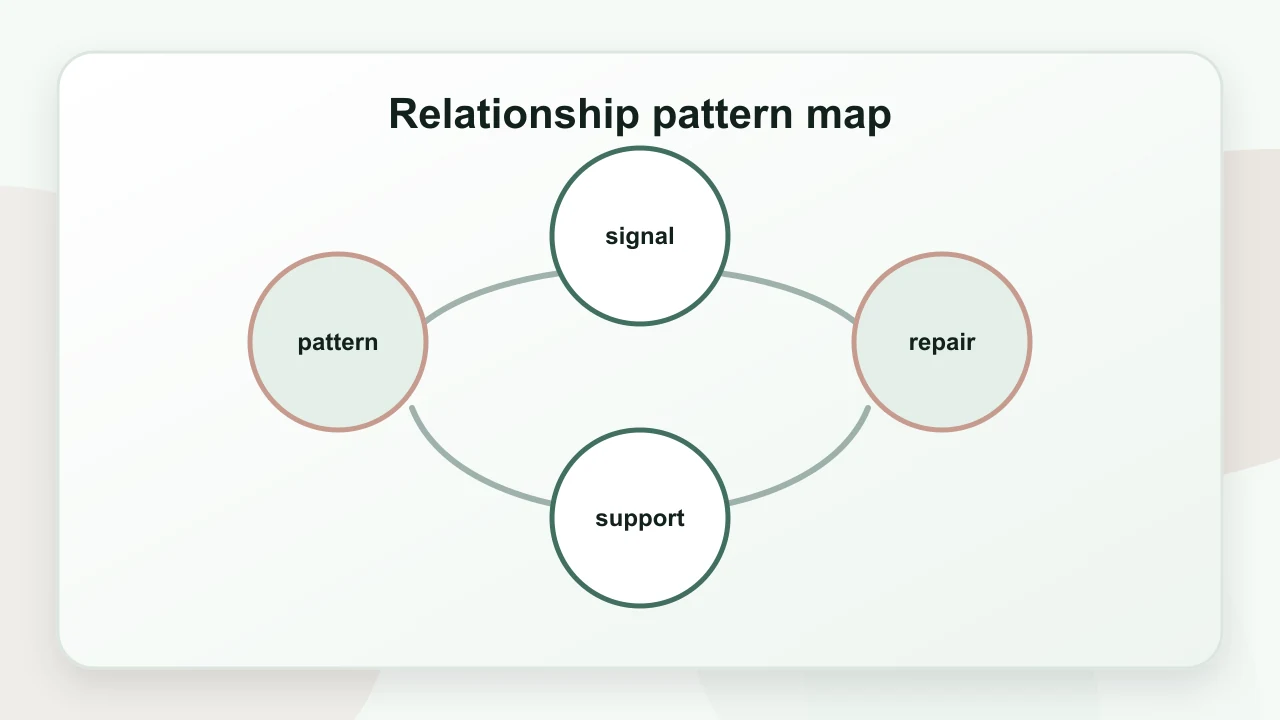
Visual summary
The infographic summarizes the article as pattern, signal, repair, support. It is a reading aid only and does not add new claims beyond the article.
Relationship problems counselling is professional support focused on recurring difficulties between partners or other close relationships. It may help people communicate more clearly, understand repetitive cycles, rebuild trust, negotiate differences, or decide whether the relationship should continue.
Counselling is not a guarantee that a relationship will be saved. A useful outcome may be repair, clearer boundaries, safer separation, or greater personal clarity.
What counselling may address
- repeated arguments;
- emotional distance;
- trust after betrayal;
- jealousy;
- communication breakdown;
- parenting disagreements;
- money and household responsibilities;
- sexual or affectionate disconnection;
- life transitions;
- uncertainty about staying together.
How relationship counselling works
Early sessions usually clarify:
- What each person believes the problem is.
- What pattern repeats.
- Whether joint work is safe.
- What each person wants.
- How progress will be evaluated.
The counsellor may help identify cycles such as criticism-withdrawal, pursuit-distance, secrecy-checking, or conflict avoidance.
Individual versus joint counselling
Joint counselling focuses on the relationship pattern.
Individual counselling may help one person with boundaries, communication, trauma, decision-making, or emotional regulation.
One person can benefit even when the other will not attend.
Free counselling for relationship problems
Possible low-cost or free options may include:
- nonprofit agencies;
- community mental-health centers;
- university training clinics;
- employee assistance programs;
- faith-based services;
- public-health programs;
- sliding-scale directories;
- domestic-violence organizations where safety is a concern.
Availability varies. “Free” does not always mean immediate, specialized, or suitable for every case.
Approaches a counsellor may use
- emotionally focused couples therapy;
- cognitive-behavioral couples work;
- integrative behavioral couple therapy;
- systemic family therapy;
- communication and problem-solving methods;
- attachment-informed work.
The provider should explain the approach clearly.
Signs counselling may be helping
- less escalation;
- clearer requests;
- better listening;
- greater accountability;
- fewer threats or insults;
- specific agreements that are followed;
- clearer decisions;
- safer boundaries.
What counselling cannot do
It cannot:
- force honesty;
- guarantee reconciliation;
- make one person change;
- erase incompatible values;
- make abuse safe;
- replace legal or medical help;
- restore trust without consistent behavior.
When joint counselling may be unsafe
Joint sessions may be inappropriate when there is:
- physical or sexual violence;
- coercive control;
- stalking;
- threats;
- fear of retaliation;
- financial restriction;
- pressure to disclose information that increases danger.
Specialized safety planning may be needed.
How to choose a counsellor
Ask:
- What is your exact qualification and license?
- What experience do you have with relationship problems?
- How do you assess for abuse?
- What approach do you use?
- How do you handle confidentiality and secrets?
- How will progress be reviewed?
- What are the fees and cancellation rules?
Practical takeaway
Relationship problems counselling is most useful when it turns vague distress into specific patterns, responsibilities, and choices. Look for qualified support, clear goals, measurable progress, and strong safety boundaries.
See Attachment Theory Fearful Avoidant, Counselling Marriage Problems, and Attachment Theory Disorganized.
Sources
- American Psychological Association — Relationships
- National Institute of Mental Health — Psychotherapies
- American Association for Marriage and Family Therapy — Consumer resources