

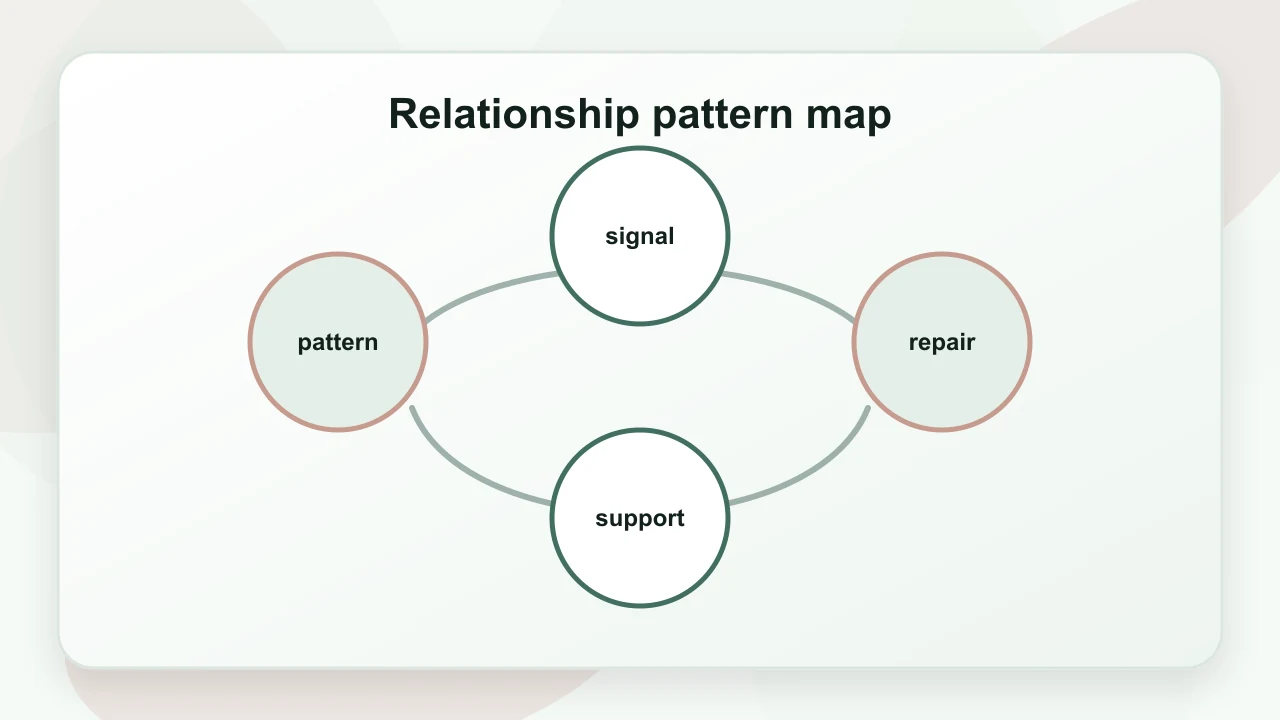
Visual summary
The infographic summarizes the article as pattern, signal, repair, support. It is a reading aid only and does not add new claims beyond the article.
In adult attachment theory, fearful-avoidant attachment generally describes high attachment anxiety combined with high attachment avoidance. A person may strongly want closeness while also expecting rejection, control, betrayal, or harm.
This can produce rapid movement between pursuit and withdrawal. The pattern is not a diagnosis or fixed personality type, and it should not be used to explain away current relationship behavior.
What fearful-avoidant attachment may look like
Possible signs include:
- wanting closeness and then pulling away;
- mistrusting reassurance;
- feeling overwhelmed by emotional intimacy;
- expecting abandonment;
- shutting down after conflict;
- returning quickly after distancing;
- difficulty depending on others;
- difficulty believing one is worthy of care.
One behavior alone does not establish an attachment pattern.
Fearful avoidant versus dismissive avoidant
A dismissive-avoidant pattern is commonly associated with high avoidance and lower reported anxiety.
A fearful-avoidant pattern is commonly associated with both high avoidance and high anxiety.
This distinction helps explain why one person may appear consistently detached while another alternates between strong pursuit and distance.
Fearful avoidant and disorganized attachment
These terms are often used interchangeably online, but they come from different research traditions.
- Disorganized attachment originally refers to infant behavior observed in structured research.
- Fearful-avoidant attachment is an adult attachment pattern often described through anxiety and avoidance dimensions.
They overlap but are not exact synonyms.
Why the pattern may develop
Possible influences include:
- inconsistent or frightening caregiving;
- betrayal or loss;
- trauma;
- unreliable adult relationships;
- temperament;
- cultural expectations;
- current stress;
- a partner’s actual behavior.
Avoid assuming childhood is the only cause.
The fearful-avoidant cycle
A common cycle is:
- Closeness feels desirable.
- Vulnerability triggers fear.
- The person withdraws or becomes defensive.
- Distance creates loneliness or abandonment fear.
- The person seeks closeness again.
- The cycle repeats.
What helps
Slow the cycle
Notice the first signs of fear before abrupt withdrawal.
Use a structured pause
Name the reason for space and the time of return.
Make one direct request
Replace testing, disappearing, or indirect protest with a specific need.
Separate discomfort from danger
Closeness can feel uncomfortable without being unsafe. But real coercion or dishonesty should not be reinterpreted as “just attachment.”
Build trust through consistency
Observe repeated behavior over time.
Consider therapy
Attachment-informed or trauma-informed therapy may help when patterns are persistent or painful.
What fearful-avoidant attachment does not mean
It does not mean someone:
- cannot maintain a relationship;
- definitely experienced abuse;
- has a personality disorder;
- should be rescued by a partner;
- is excused from harmful behavior;
- can be changed through patience alone.
When safety comes first
Attachment tools are not enough where there is violence, coercive control, stalking, threats, or fear of retaliation.
Seek specialized support rather than trying to communicate more effectively inside an unsafe situation.
Practical takeaway
Ask:
- What happens when closeness increases?
- What fear appears?
- Do I pursue, withdraw, or alternate?
- Is the current relationship actually reliable?
- What direct request or boundary is needed?
- Would professional support help?
See Attachment Theory Disorganized, Relationship Problems Counselling, and Attachment Theory Attachment Styles.
Sources
- American Psychological Association — Relationships
- American Psychological Association — Parenting
- National Institute of Mental Health — Caring for Your Mental Health
- Peer-reviewed adult attachment research