

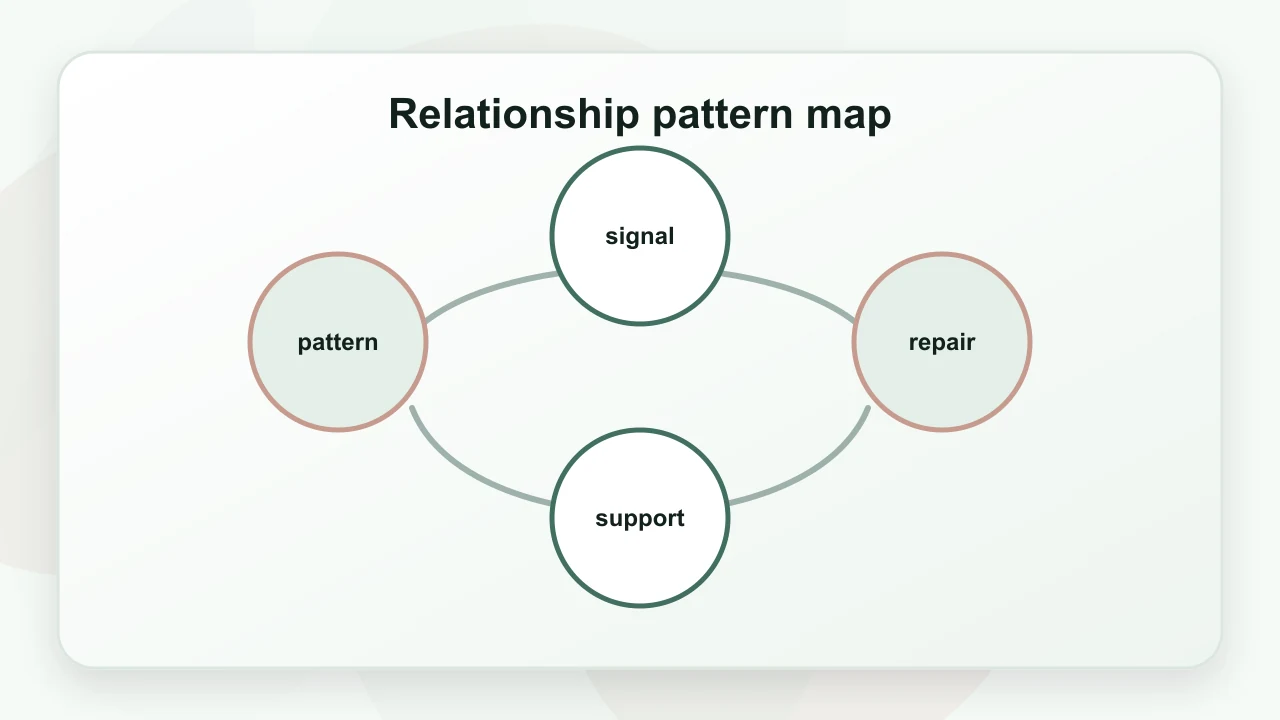
Visual summary
The infographic summarizes the article as pattern, signal, repair, support. It is a reading aid only and does not add new claims beyond the article.
Marriage counseling alternatives may be useful when a couple cannot access therapy, one partner will not attend, previous counseling was a poor fit, or the problem is primarily educational or practical rather than clinical.
Options can include relationship education, structured self-help, workshops, coaching, mediation, individual therapy, discernment counseling, faith-based support, and temporary changes in how difficult conversations are handled. These options have different goals and professional standards. None is automatically equivalent to licensed couples therapy.
Why people look for alternatives
Common reasons include:
- cost or insurance limitations;
- difficulty finding a qualified couples therapist;
- scheduling or childcare barriers;
- a partner who refuses counseling;
- a previous poor therapy experience;
- privacy concerns;
- uncertainty about whether to stay married;
- a need for practical rather than clinical help.
Understanding the barrier helps identify a suitable alternative.
1. Relationship education
Relationship education programs teach communication, conflict management, expectations, and repair skills. They may be offered through community organizations, online courses, books, or workshops.
This can be useful when both partners are relatively safe and stable and want structured skills practice.
2. Structured self-help
A couple can use a reputable workbook or program with scheduled conversations.
A useful format includes:
- one topic at a time;
- time limits;
- no insults or threats;
- each partner summarizes the other;
- one written agreement;
- a review date.
Self-help is less suitable when conversations repeatedly become frightening or coercive.
3. Marriage coaching versus counseling
Marriage coaching typically focuses on goals, habits, communication, and accountability. Coaching is not regulated in the same way as licensed mental-health treatment in many jurisdictions.
Counseling or psychotherapy is more appropriate when there is trauma, depression, anxiety, substance use, severe emotional instability, or another clinical concern.
Before hiring a coach, verify training, scope, fees, confidentiality, complaint procedures, and whether the coach refers clients for clinical care.
4. Individual therapy
One partner can benefit from individual therapy even when the other will not attend. Individual therapy may help with:
- boundaries;
- emotional regulation;
- decision-making;
- trauma;
- communication;
- understanding repeated patterns;
- preparing for a difficult conversation.
The therapist should not claim to treat the entire relationship without meeting the other partner.
5. Discernment counseling
Discernment counseling is designed for couples in which one partner is considering leaving and the other wants to preserve the marriage. The goal is usually clarity and confidence about the next direction, not immediate relationship repair.
Possible outcomes include maintaining the status quo temporarily, separation or divorce, or committing to a defined course of couples therapy.
6. Mediation
Mediation focuses on negotiating practical agreements, often involving separation, parenting, finances, or household responsibilities. A mediator is neutral and does not provide relationship therapy.
Legal advice may be needed separately.
7. Workshops or retreats
Workshops can create focused time and structure. Evaluate:
- facilitator credentials;
- evidence behind the program;
- privacy rules;
- pressure to disclose;
- refund terms;
- whether the program makes cure or guarantee claims;
- procedures for abuse or mental-health crises.
An expensive retreat is not automatically more effective than ordinary care.
8. Faith-based or community support
A trusted religious or community leader may offer values-based guidance and practical support. This can be helpful when the leader respects consent, safety, professional boundaries, and referral needs.
Avoid support that pressures someone to remain in danger, treats mental illness as moral failure, or demands secrecy.
9. A temporary communication structure
When discussions are repeatedly escalating, use a short-term protocol:
- discuss one issue;
- schedule the conversation;
- limit it to 20–30 minutes;
- pause when either person becomes overwhelmed;
- name a specific return time;
- write down agreements;
- avoid major discussions late at night or while intoxicated.
This is a stabilizing tool, not a complete solution.
When marriage counseling is not working
Before abandoning counseling, consider:
- Was the therapist trained in couples work?
- Were goals clear?
- Did both partners feel heard?
- Was progress measured?
- Were sessions focused on the actual cycle?
- Did either partner conceal major information?
- Was abuse or coercion missed?
- Would another model or therapist be a better fit?
A poor fit with one therapist does not prove that all marriage counseling does not work.
When alternatives are not enough
Licensed and specialized care may be necessary when there is:
- domestic violence or coercive control;
- suicidal risk;
- psychosis or mania;
- severe substance use;
- untreated trauma;
- child safety concerns;
- repeated threats;
- complex legal conflict.
Couples communication exercises may be unsafe in abusive relationships.
Practical takeaway
Choose a marriage counseling alternative according to the goal:
- Skills: education or structured self-help.
- Accountability: carefully vetted coaching.
- Personal clarity: individual therapy.
- Stay-or-leave decision: discernment counseling.
- Practical agreement: mediation.
- Clinical or severe relationship problems: licensed professional care.
See Therapy for Trust Issues, Relationship Problems Therapy, and Anxious Attachment Styles.
Sources
- APA — Relationships
- NIMH — Psychotherapies
- AAMFT — Professional information about marriage and family therapy
- AAMFT — Discernment counseling educational materials
- NIMH — Caring for Your Mental Health