
Visual summary
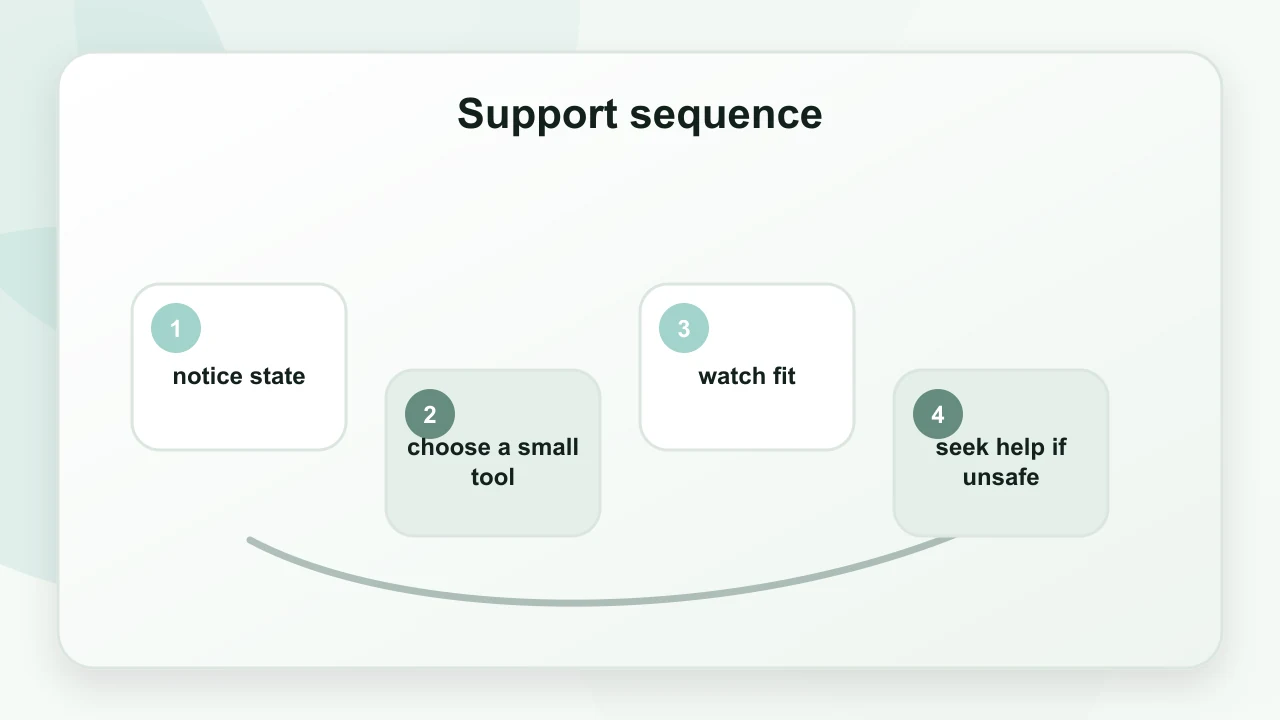
The infographic summarizes the article as notice state, choose a small tool, watch fit, seek help if unsafe. It is a reading aid only and does not add new claims beyond the article.
Anxiety and deep breathing have a complicated relationship. Slower, comfortable breathing can help some people reduce rapid breathing and physical tension. But repeatedly taking very large breaths may increase dizziness, tingling, chest discomfort, air hunger, or fear—especially when a person is already overbreathing.
The useful target is usually not the deepest possible breath. It is a quieter, slower, less effortful breathing pattern with a comfortable exhale.
Why anxiety changes breathing
Anxiety may lead to:
- faster respiratory rate;
- upper-chest breathing;
- repeated sighing;
- breath-holding;
- a feeling of not getting enough air;
- close monitoring of each breath.
These changes can produce sensations that then feel threatening, creating a feedback loop.
Why deep breathing helps anxiety for some people
A comfortable breathing practice may:
- slow rapid breathing;
- provide a simple focus;
- reduce muscle tension;
- interrupt escalation;
- pair well with grounding;
- create a practiced response to stress.
Evidence supports relaxation as a possible adjunct for anxiety, but it is not equally effective for everyone and is not a replacement for evidence-based treatment.
Why deep breathing causes anxiety for some people
Overbreathing
Taking breaths that are too large or too frequent can lower carbon dioxide and cause:
- lightheadedness;
- tingling;
- chest tightness;
- visual changes;
- feelings of unreality.
These sensations may be interpreted as danger.
Hyperfocus on the body
People with panic sensitivity or trauma symptoms may become more alarmed when monitoring breath and heartbeat.
Rigid instructions
Trying to breathe for an exact count may create performance pressure.
Long breath holds
Holds may produce air hunger and fear.
Medical symptoms
Breathing difficulty may have cardiac, pulmonary, allergic, neurological, infectious, medication-related, or other causes. Do not assume a new symptom is anxiety.
A safer breathing pattern
Try for one minute:
- Sit or stand with support.
- Keep the eyes open.
- Let the shoulders loosen.
- Inhale gently through the nose if comfortable.
- Exhale a little more slowly without emptying the lungs forcefully.
- Repeat five times.
- Return attention to the room.
The count is optional. Comfortable is more important than precise.
What to do when deep breathing gives you anxiety
- Stop the exercise.
- Return to ordinary breathing.
- Look at a stable object.
- Feel both feet or the chair.
- Avoid repeated rescue breaths.
- Move gently if safe.
- Seek medical evaluation for severe, new, or uncertain symptoms.
A technique that repeatedly worsens symptoms is not the right tool at that moment.
Deep breathing to calm anxiety: what not to do
Avoid:
- inhaling to maximum capacity;
- breathing rapidly;
- forcing the abdomen outward;
- holding the breath through distress;
- repeating the exercise until it “works”;
- using breathing to avoid every anxious situation;
- assuming all chest or breathing symptoms are psychological.
Breathing and panic attacks
During panic, use the smallest intervention possible. A gentle exhale, external grounding, and a safe posture may be enough.
Chest pain, fainting, severe breathing difficulty, blue lips, new neurological symptoms, or a first unexplained episode requires urgent medical assessment.
Can breathing become a safety behavior?
Yes. If a person believes they cannot enter a situation or tolerate anxiety without performing a breathing ritual perfectly, the exercise may reinforce fear.
Breathing should increase flexibility, not become a compulsory guarantee against discomfort.
How breathing fits into anxiety treatment
Anxiety treatment may include:
- cognitive behavioral therapy;
- exposure-based treatment;
- medication;
- sleep and activity support;
- medical assessment;
- grounding or relaxation;
- reduction of alcohol or stimulant-related effects.
Breathing is one tool within a broader plan.
When professional help matters
Seek qualified care when anxiety is persistent, causes major avoidance, disrupts sleep or functioning, or includes panic, trauma symptoms, depression, substance use, self-harm, or suicidal thinking.
In the United States, call or text 988 for crisis support.
Practical takeaway
For anxiety and deep breathing:
- Think gentle, not huge.
- Slow the exhale slightly.
- Keep attention partly outside the body.
- Avoid uncomfortable holds.
- Stop when symptoms increase.
- Seek medical care when symptoms are new or uncertain.
See Deep Belly Breathing for Anxiety, Breathing Techniques for Anxiety, and Deep Breathing Exercises for Anxiety.
Sources
- National Institute of Mental Health — Anxiety Disorders
- American Psychological Association — Anxiety
- NCCIH — Relaxation Techniques: What You Need to Know
- NCCIH — Anxiety and Complementary Health Approaches