
Visual summary
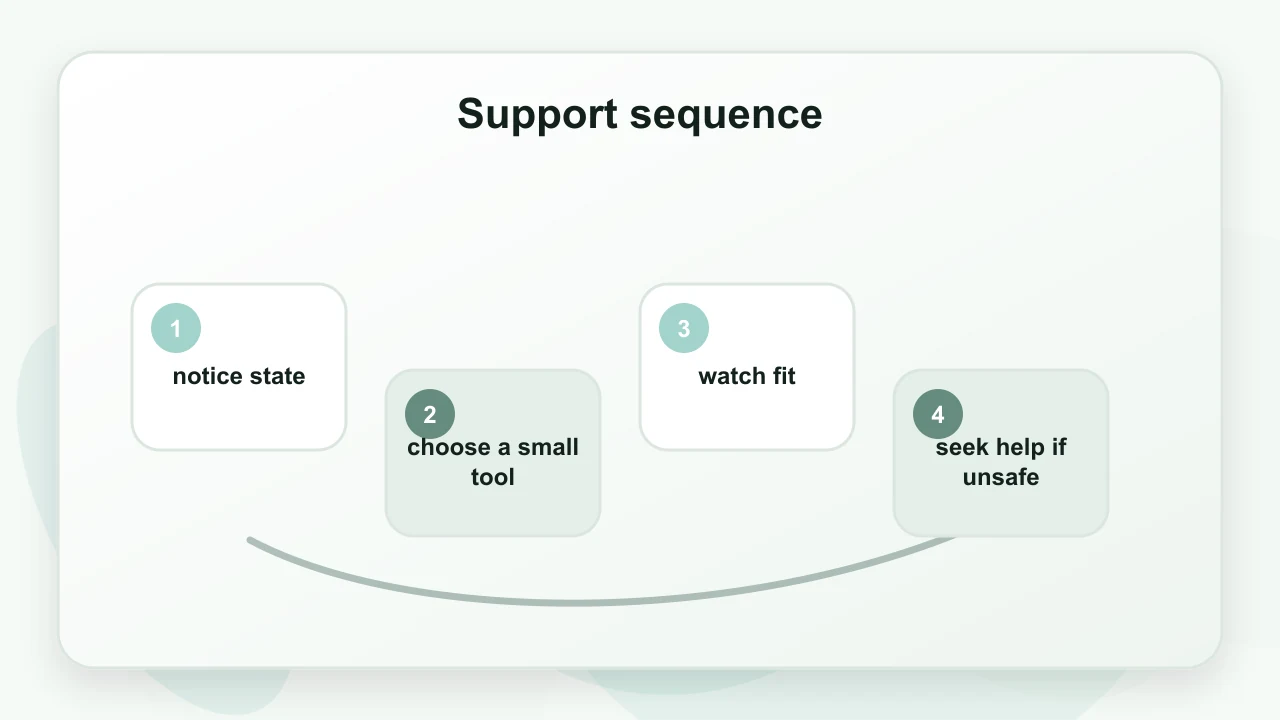
The infographic summarizes the article as notice state, choose a small tool, watch fit, seek help if unsafe. It is a reading aid only and does not add new claims beyond the article.
Deep belly breathing for anxiety is a common name for diaphragmatic breathing—a pattern in which the lower ribs and abdomen move gently as the diaphragm descends. The aim is not to push the stomach outward or fill the lungs as much as possible. The aim is a quieter, more efficient breath with less upper-chest effort.
It may help some people slow rapid breathing and reduce tension. It can also worsen dizziness or panic when breaths are too large, too frequent, or intensely monitored.
What belly breathing actually means
The diaphragm is the primary muscle of breathing. During a relaxed inhale, it moves downward and the lower ribs and abdomen may expand slightly.
“Belly breathing” is a practical cue, not a requirement to move only the abdomen. Healthy breathing normally involves coordinated movement of the diaphragm, ribs, and chest.
Belly breathing and anxiety
Anxiety may shift breathing toward a faster, more effortful pattern. Gentle diaphragmatic breathing may help by:
- reducing unnecessary upper-chest effort;
- slowing respiratory pace;
- creating a stable focus;
- pairing well with grounding;
- increasing awareness of tension.
The method does not directly remove the cause of anxiety.
A belly breathing exercise for anxiety
Try for one to two minutes:
- Sit with the back supported or lie comfortably.
- Place one hand on the lower ribs or abdomen.
- Keep the shoulders loose.
- Inhale gently through the nose if comfortable.
- Allow mild outward movement under the lower hand.
- Exhale slowly without squeezing all the air out.
- Repeat five to eight times.
- Stop and return to ordinary breathing.
The breath should remain quiet and moderate.
What helps
Practice when relatively calm
Learning during a low-stress moment reduces pressure.
Keep the eyes open
This can be useful when inward focus increases anxiety or dissociation.
Use a shorter session
One minute may be enough.
Pair it with external grounding
Notice the chair, floor, room, or a stable visual object.
Use an easy exhale
The exhale can be slightly longer, but should not create air hunger.
What does not help
Forcing the belly outward
This may create tension rather than relaxation.
Taking maximum inhalations
Very large breaths can contribute to overbreathing.
Holding the breath through discomfort
Breath holds are not required.
Trying to breathe only from the belly
The chest and ribs naturally move too.
Repeating until anxiety disappears
Breathing is a support tool, not a compulsory ritual.
Guided deep breathing for anxiety
A guided recording can help with pacing, but choose one that:
- uses gentle language;
- avoids extreme counts;
- does not demand long holds;
- allows modifications;
- reminds the listener to stop if symptoms worsen;
- avoids cure or nervous-system-reset claims.
“Anxiety coach belly breathing” advice
Coaches may teach general coping or performance skills, but a coach should not diagnose or treat an anxiety disorder unless separately licensed and operating within a clinical role.
Check the provider’s exact credentials and whether they refer clients for mental-health or medical care.
Why belly breathing can make anxiety worse
Possible reasons include:
- breaths are too large;
- the pace is too fast;
- body attention triggers panic;
- trauma symptoms are activated;
- the position feels restrictive;
- the person has an underlying respiratory or cardiac issue;
- the exercise becomes a performance test.
Stop, orient externally, and seek appropriate assessment when symptoms are severe or uncertain.
Belly breathing during panic
Use only a few gentle breaths. Do not gulp air. Keep attention on the environment and remind yourself that the exercise is optional.
Urgent medical evaluation is appropriate for severe breathlessness, fainting, chest pain, blue lips, new neurological symptoms, or a first unexplained episode.
Who should seek medical guidance first?
Ask a health professional when you have significant heart or lung disease, recurrent fainting, pregnancy-related complications, recent surgery, or breathing symptoms that have not been evaluated.
How it fits into treatment
Deep belly breathing may complement:
- cognitive behavioral therapy;
- exposure-based treatment;
- medication;
- grounding;
- sleep support;
- physical activity;
- reduction of stimulant-related symptoms.
It should not replace professional care for significant anxiety.
Practical takeaway
For deep belly breathing for anxiety:
- Support the body.
- Relax the shoulders.
- Allow, rather than force, lower-rib and abdominal movement.
- Keep the inhale moderate.
- Let the exhale slow naturally.
- Stop if symptoms worsen.
- Return to one useful action.
See Anxiety and Deep Breathing, Breathing Techniques for Anxiety, and Deep Breathing Exercises for Anxiety.
Sources
- National Institute of Mental Health — Anxiety Disorders
- American Psychological Association — Anxiety
- NCCIH — Relaxation Techniques: What You Need to Know
- NCCIH — Anxiety and Complementary Health Approaches