

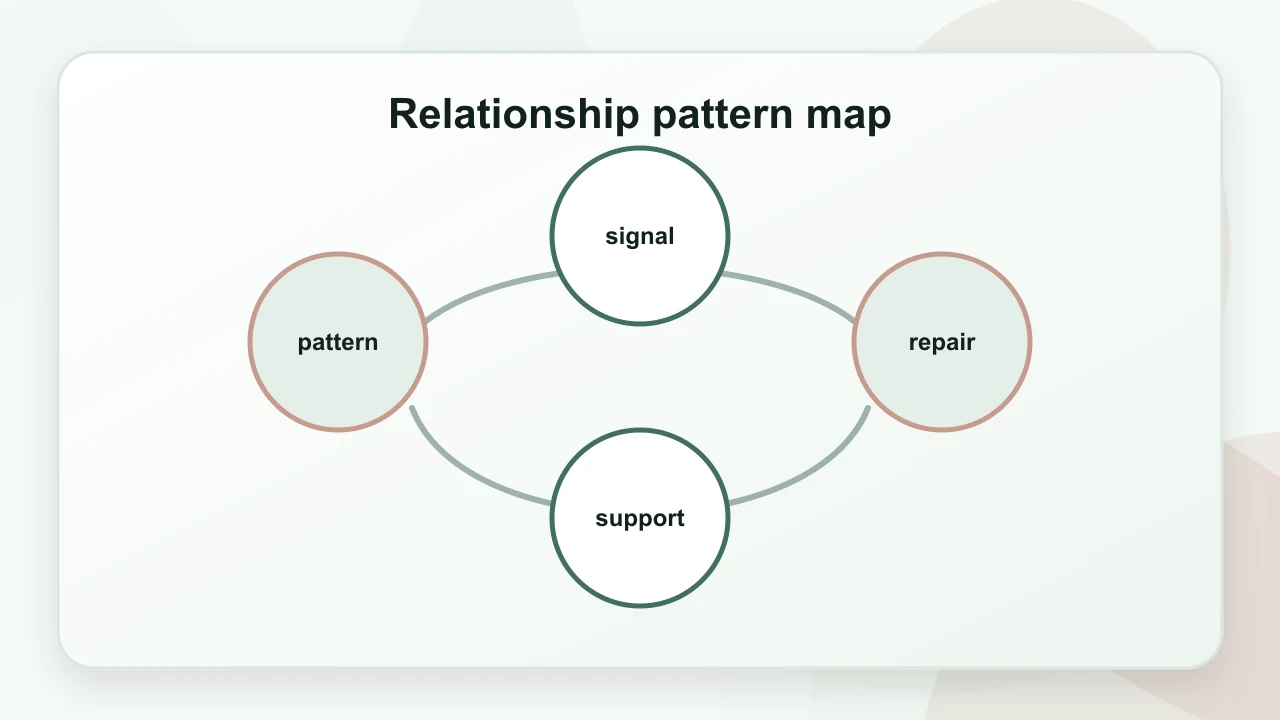
Visual summary
The infographic summarizes the article as pattern, signal, repair, support. It is a reading aid only and does not add new claims beyond the article.
Counselling marriage problems involves structured professional support for difficulties such as repeated conflict, emotional distance, trust problems, parenting disagreements, sexual disconnection, finances, or uncertainty about staying married.
Marriage counselling is not a promise of reconciliation. It may help a couple repair the relationship, improve co-parenting, make a clearer decision, or separate more safely.
Common marriage issues addressed in counselling
- criticism and withdrawal;
- emotional distance;
- betrayal or secrecy;
- parenting conflict;
- financial pressure;
- sexual or affectionate concerns;
- unequal household labor;
- extended-family conflict;
- major life transitions;
- disagreement about whether to stay together.
What happens in marriage counselling?
The counsellor may assess:
- the main concerns;
- the repeating cycle;
- each partner’s goals;
- safety and coercion;
- strengths in the relationship;
- practical and emotional barriers;
- how progress will be measured.
CBT for marriage problems
CBT-based couples work may address:
- automatic interpretations;
- unhelpful assumptions;
- communication habits;
- avoidance;
- problem-solving;
- behavior exchange;
- emotional and behavioral consequences.
CBT does not mean simply “thinking positively.” It links thoughts, feelings, behavior, and relationship patterns.
Other approaches
Emotionally focused couples therapy
Focuses on emotional needs, attachment, and interaction cycles.
Integrative behavioral couple therapy
Combines acceptance-oriented and behavior-change strategies.
Systemic approaches
Examine the relationship in its family, cultural, and social context.
When one partner refuses counselling
The other partner can still use individual therapy to:
- clarify boundaries;
- improve communication;
- manage emotions;
- make decisions;
- prepare for separation;
- understand repeated patterns.
Individual therapy does not treat the marriage as a couple, but it can still be useful.
What counselling cannot do
It cannot:
- force commitment;
- guarantee trust will return;
- make one person honest;
- resolve incompatible values automatically;
- replace legal advice;
- make an abusive marriage safe;
- guarantee that the marriage should continue.
When joint counselling may be inappropriate
Standard couples work may be unsafe when there is:
- physical or sexual violence;
- coercive control;
- threats;
- stalking;
- severe intimidation;
- fear of retaliation;
- pressure to reveal information that increases danger.
Specialized domestic-violence support and individual safety planning may be needed.
How to choose a counsellor
Ask:
- Are you licensed?
- What training do you have in couples therapy?
- How do you assess for abuse?
- What model do you use?
- What is your policy on secrets?
- What happens if one person wants to stop?
- How will we know whether counselling is helping?
Practical takeaway
Marriage issues counselling works best when:
- the problem is defined clearly;
- both people can participate safely;
- goals are explicit;
- the counsellor is trained in couples work;
- progress is reviewed;
- safety overrides reconciliation.
See Relationship Problems Counselling, Attachment Theory Fearful Avoidant, and Attachment Theory Disorganized.
Sources
- American Psychological Association — Relationships
- National Institute of Mental Health — Psychotherapies
- American Association for Marriage and Family Therapy — Consumer resources