

Visual summary
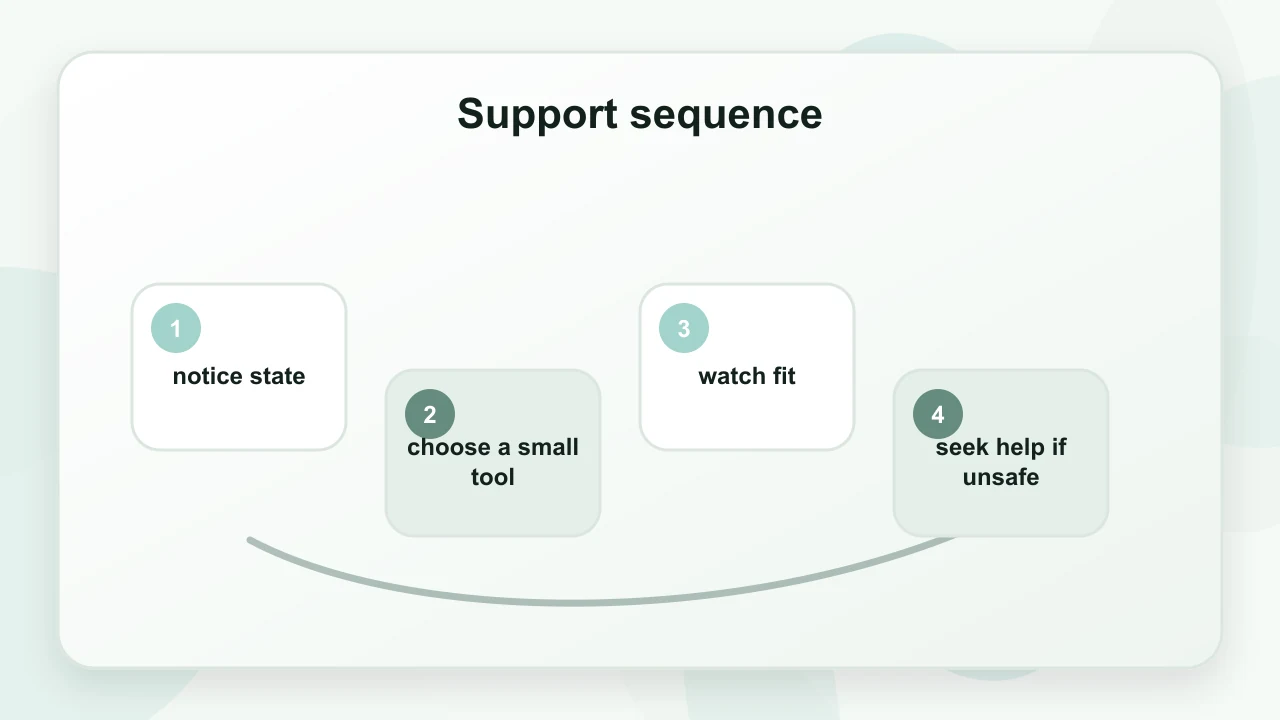
The infographic summarizes the article as notice state, choose a small tool, watch fit, seek help if unsafe. It is a reading aid only and does not add new claims beyond the article.
Grounding strategies for anxiety are broader plans for staying oriented during stress. An exercise is one specific activity; a strategy is a repeatable approach chosen for a particular situation. A useful strategy may combine sensory grounding, movement, factual reminders, routine, social support, or breathing.
Grounding does not eliminate the cause of anxiety. It can help create enough distance from escalating thoughts or sensations to choose the next action more deliberately.
Strategy 1: Match the method to the symptom
Use:
- visual grounding when thoughts are racing;
- movement when the body feels agitated;
- factual orientation when you feel unreal or confused;
- social contact when isolation increases anxiety;
- breathing only when breath focus feels safe.
A strategy is more effective when it fits the actual experience.
Strategy 2: Use a short sensory sequence
The 54321 anxiety grounding method is useful but may be too long during intense anxiety.
Short version:
- Name three things you see.
- Identify two sounds.
- Feel one point of contact.
- Choose the next action.
Strategy 3: Ground through activity
Grounding activities for anxiety may include:
- washing dishes;
- folding clothes;
- walking;
- organizing one drawer;
- watering plants;
- preparing a simple meal;
- holding a conversation about ordinary facts.
The activity should be safe, concrete, and limited in scope.
Strategy 4: Use grounding meditation carefully
Grounding meditation for anxiety may involve noticing sounds, support beneath the body, or the immediate environment.
Avoid long inward-focused meditation when it increases:
- panic;
- trauma memories;
- dissociation;
- self-monitoring;
- fear of losing control.
Meditation is optional.
Strategy 5: Use grounding mantras
A grounding mantra should be factual rather than artificially positive.
Examples:
- “I am in this room, on this date.”
- “This feeling is intense, and I can choose one safe action.”
- “I do not need to solve everything now.”
- “I can pause before responding.”
Avoid phrases that deny real danger or pressure you to feel calm.
Strategy 6: Build grounding into routine
Grounding yourself during anxiety is easier when the environment already includes:
- regular meals;
- sleep and wake anchors;
- movement breaks;
- reduced stimulant exposure;
- a written crisis or coping plan;
- contact information for trusted support;
- familiar sensory objects.
Routine does not prevent all anxiety, but it lowers decision load.
Strategy 7: Create a portable plan
Write a short plan:
- My early warning signs.
- One visual method.
- One movement method.
- One person to contact.
- One professional-care threshold.
- One emergency step.
Keep it in a phone note or wallet.
What grounding strategies do not do
They do not:
- cure anxiety;
- guarantee calm;
- prove that every sensation is harmless;
- make unsafe situations safe;
- replace exposure-based treatment;
- replace medication or psychotherapy;
- permanently “reset” the nervous system.
When grounding becomes avoidance
Grounding may reinforce anxiety when a person believes they cannot tolerate a situation without performing it perfectly.
A healthier use is:
“This strategy helps me stay present while I do what matters.”
Not:
“I must complete this ritual or something terrible will happen.”
When professional care matters
Seek qualified assessment when anxiety causes repeated panic, major avoidance, sleep disruption, dissociation, trauma symptoms, substance use, self-harm, or suicidal thoughts.
In the United States, call or text 988 for crisis support.
Practical takeaway
Build a grounding strategy, not a giant toolbox:
- Choose one sensory method.
- Choose one movement.
- Write one factual phrase.
- Identify one support person.
- Define when professional help is needed.
See Anxiety Grounding Exercises, Grounding Methods for Anxiety, and Deep Breathing for Anxiety Attack.
Sources
- National Institute of Mental Health — Anxiety Disorders
- American Psychological Association — Anxiety
- NCCIH — Relaxation Techniques: What You Need to Know